
A blog by Izzy Lemus
Maxwell School of Citizenship, Syracuse University
June, 2026
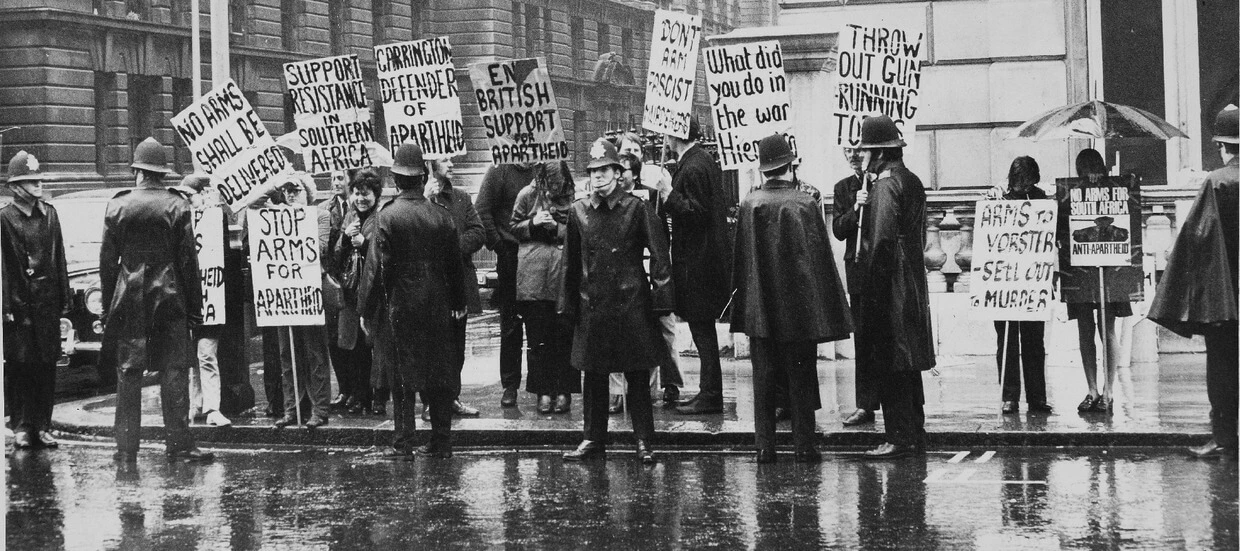
Header image is of a 1971 anti-apartheid protest opposite Ministry of Defence (Workers Press / AAM Archives)
This summer, I had the opportunity to intern at the Anti-Apartheid Legacy Centre for five weeks. This placement has been both an insightful experience for my academic studies and a way to apply a lens of analysis to history and activism.
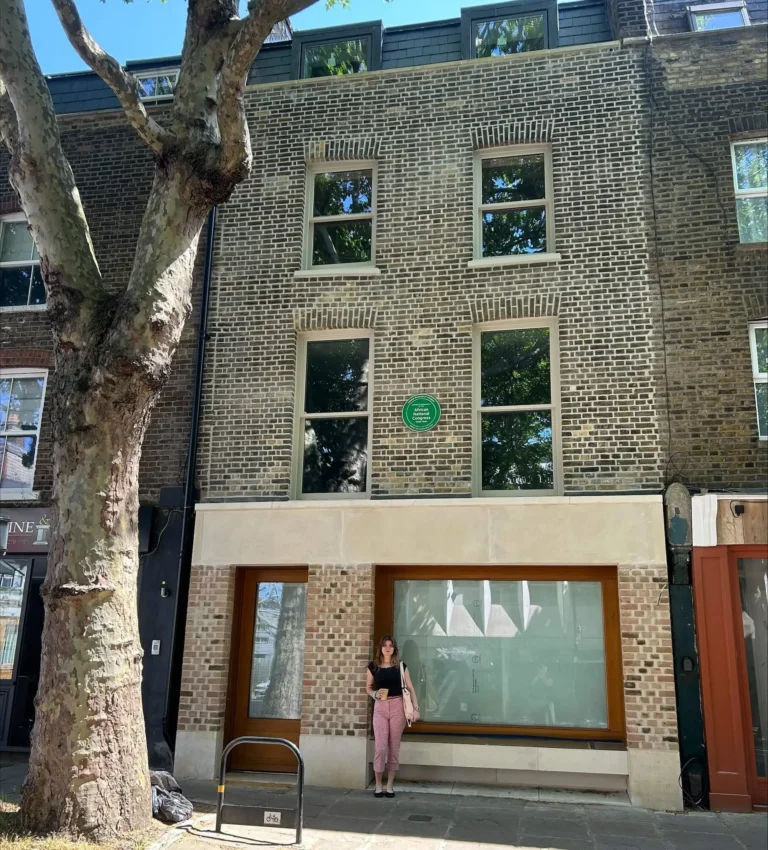
Visiting 28 Penton Street, the former HQ of the ANC-in-exile, being developed into Europe’s first anti-apartheid museum and education centre, opening later this year.
I’ve had the unique opportunity to learn about anti-apartheid heritage in London in a more hands-on way, with most of my work focused on the Anti-Apartheid London Digital Map, via the AALC project hosted on the Layers of London site. My responsibilities for the digital map project included research and writing on various anti-apartheid activists, with a focus on women’s history, conducting interviews and gathering oral histories, and photographing different sites of anti-apartheid activism around London.
Throughout my internship and by fulfilling my responsibilities, I was able to improve my skills in historical research and writing . This opportunity allowed me to practice these skills outside of an academic setting, helping me enhance my professional writing abilities. Alongside supporting the digital map, I contributed writing for the AALC website. I researched activists, filmmakers, locations, and cross-referenced different histories and perspectives. This not only improved my grammatical skills but also broadened my knowledge of London’s history and international relations.

Still from Antony Thomas’ film ‘Six Days in Soweto’ (1979) – one of my tasks was to support the content development of the educational films section on the AALC website. Accessible here
My learning covered the entire history of apartheid to anti-apartheid movements in South Africa and London, as well as the inner workings and dynamics of anti-apartheid organizations in London. My more focused research on anti-apartheid organizations in London was by far the most interesting. By examining international anti-apartheid support, it became clear to me that solidarity is not experienced for practiced in the same way by everyone, but is often shaped by personal history, political context, and lived experience.
By far the most interesting thing I’ve learned throughout my time here has been regarding Norma Kitson. Norma was a South African anti-apartheid activist involved in underground resistance, exile organizing, and grassroots protests. She became politically active in the 1950s in South Africa, was exiled to London in 1966, and went on to have a significant impact on the anti-apartheid struggle in Britain and the wider politics of protest itself.
Norma Kitson was one of the co-founders of the City of London Anti-Apartheid Group (City Group) in 1982, responsible for organizing the nonstop picket in Trafalgar Square, in front of the South African embassy. Beginning on February 24th 1986, the picket lasted over 1,400 days and became one of the most visible anti-apartheid protests in Britain. From my research, it seems this kind of sustained, continuous protest helped shape later traditions of direct action and campaigning in Britain.
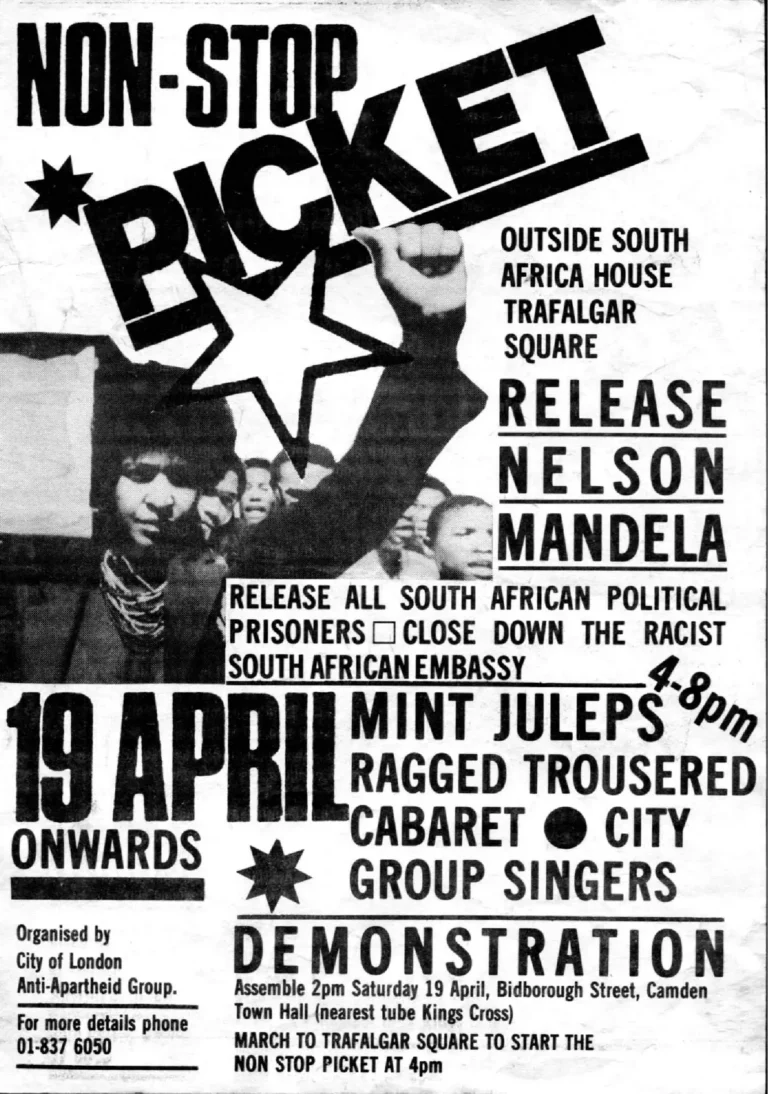
Leaflet advertising the launch of City of London AA Group’s non-stop picket calling for the release of Nelson Mandela. CLAAG supporters kept up a 24-hour picket of the South African embassy for nearly four years from 19 April 1986 until Mandela’s release on 11 February 1990. The picket attracted hundreds of enthusiastic young activists. CLAAG was formed as a branch of the AAM in 1982, but internal arguments led to its disaffiliation in February 1985. City AA Group/Bishopsgate Institute ( Accessed AAM Archives)
The most intriguing part of Norma Kitson’s story for me was the tension between the City Group and the Anti-Apartheid Movement (AAM), where you can see how different experiences shaped different approaches to solidarity. While the AAM was a broader-based movement, closely aligned with the ANC and focused on mass campaigning, sanctions, and political pressure, City Group appeared to build stronger links across a wider range of liberation groups in exile and prioritized more direct and disruptive forms of protest.
What stands out most to me is how much Norma’s activism was shaped by both political conviction and personal experience. Growing up under apartheid, living in exile, and seeing her husband imprisoned by the apartheid regime gave her activism a particular urgency. As someone interested in gender, history, and politics, I found this especially powerful because it shows how women’s political resistance is often shaped by lived experience, and how those experiences can influence the forms that activism takes.
I was also tasked with taking pictures of various anti-apartheid activism sites throughout Westminster and Islington, which provided historical context of the London anti-apartheid movement, as well as recreational knowledge of London’s geography and infrastructure. This assignment was meant to help me explore London while learning more about the anti-apartheid heritage. From this, I could witness firsthand how scattered anti-apartheid sites were during the struggle, and how secretive Anti-Apartheid organizations had to be to avoid detection.
Short video clip used on the Anti-Apartheid London Digital Map – includes a fade from image of 1971 protest opposite Ministry of Defence ( Workers Press / AAM Archives ) to a present-day view that I took during my internship. Video created by Akira Nakajima, Digital Map Project Producer.
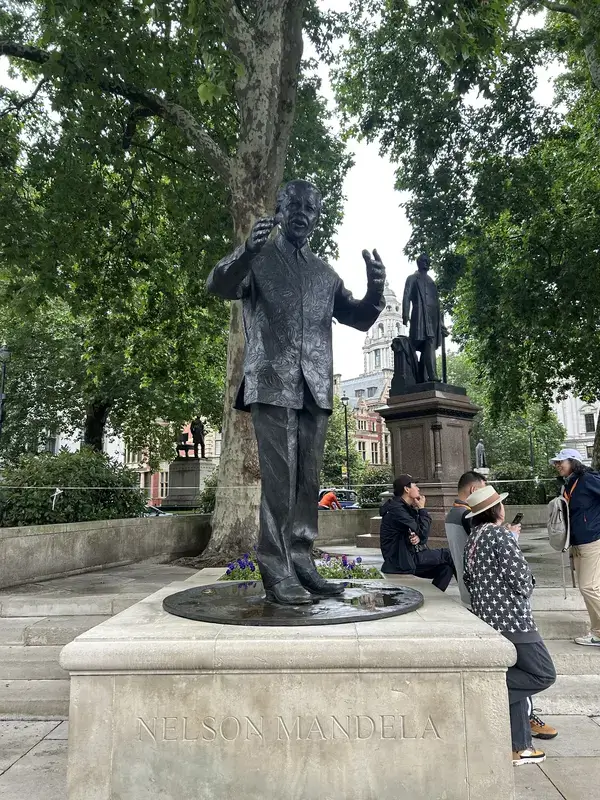
Nelson Mandela Statue on Parliament Square, another photo taken for the digital map project
Learning about Anti-Apartheid heritage in London has helped me understand the importance of solidarity and fighting injustice. Through my involvement with the Anti-Apartheid Legacy Centre team and by undertaking research, I have seen how courage through protests can create real change. The resilience, resistance, and accountability of activism form the foundation for making change, as I have come to see. Learning about anti-apartheid heritage has not only been about researching and developing my academic skills; it has also been about understanding the essence of activism itself. I have learned who activists are, what makes activism successful, and which injustices trigger significant retaliation through activism.
My placement at the Anti-Apartheid Legacy Centre this summer has provided me with many learning opportunities for both my professional career and personal growth. I’ve been able to further develop my academic skills, helping me achieve my future career goals, especially in understanding the sociological aspects of history and activism. Additionally, learning about Anti-Apartheid heritage during a time of geopolitical conflict, while abroad, has also offered insights into cultural differences in activism and solidarity, through my unique perspective as an American studying an international movement from London.
Blog by Izzy Lemus
Maxwell School of Citizenship, Syracuse University
June, 2026