

Learning from Apartheid – Primary & Lower Secondary Schools (KS3) Resource
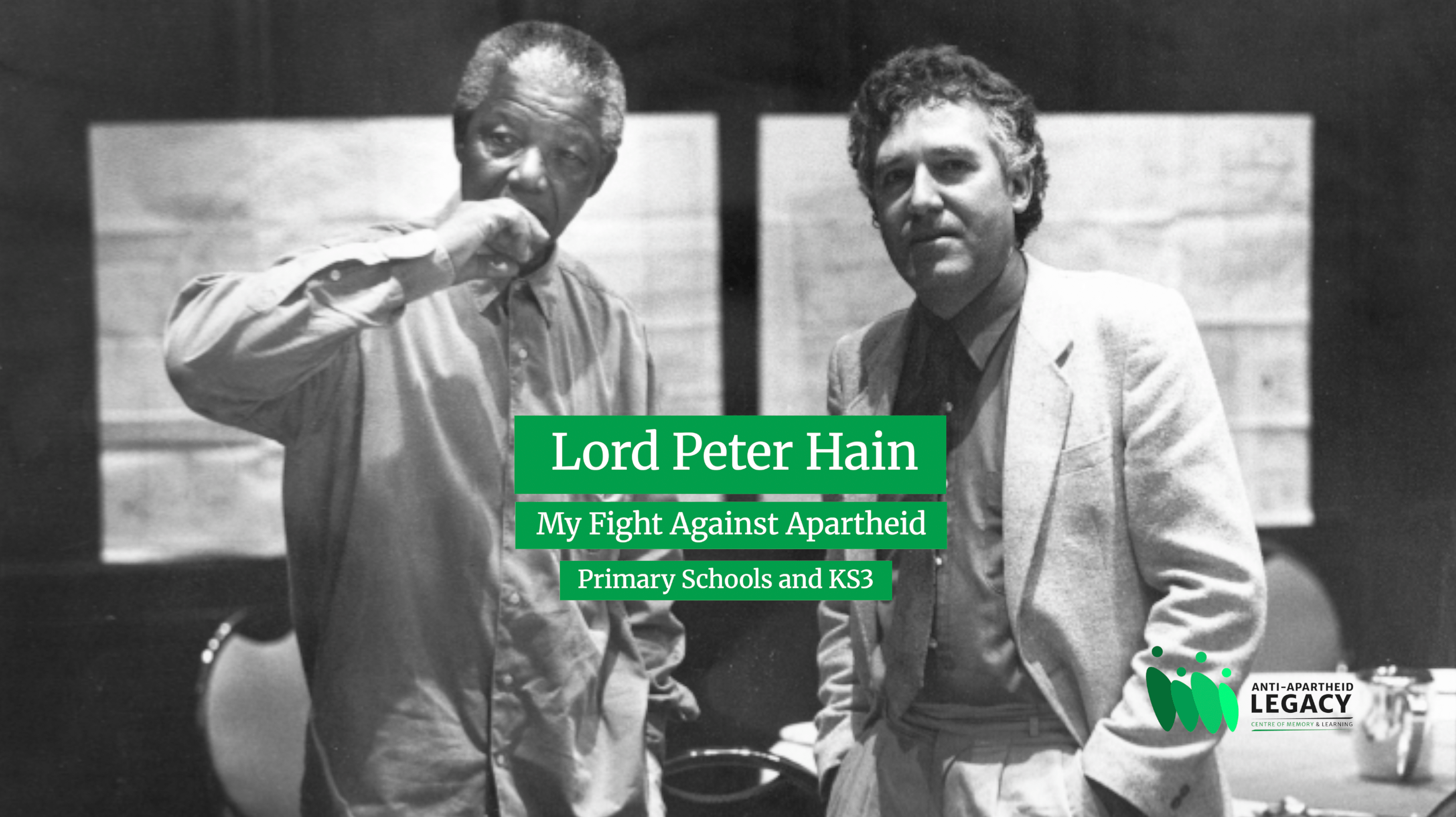
Suitable for: KS1 (Year 4), KS2 (Year 5–6) and KS3 (Year 7–8)
Themes: Justice • Equality • Anti-Racism • Courage • Protest • Human Rights
Film Length: 21-minute film + 8 short clips
Resource: Aside the film, this resource offers related discussion questions, classroom activities and teacher guidance
Introduction
This short film features Lord Peter Hain, a former anti-apartheid activist who grew up in South Africa under apartheid and went on to become a leading campaigner for justice, MP and member of Prime Minister Tony Blair’s cabinet.
Following banning orders served on his parents by the apartheid government due to their anti-apartheid activism, Peter and his family came to live, as political exiles, in Britain. Teenage Peter soon became involved in anti-apartheid activities, including leading the Stop the Tour campaign, which used non-violent protest to convince the world to isolate South Africa’s racist government. This short film explores Peter’s perspectives on the structures and policies of apartheid, its effects on the population of South Africa, insights into the anti-apartheid activities of his family and of the many others who stood up to apartheid, and his family’s unique relationship with Nelson Mandela.
The talk was recorded live with pupils from Hanover Primary School in Islington in 2025, where Peter spoke to students about the history of apartheid in South Africa, standing up against injustice, challenging racism, and how young people can make a difference. He was joined by the school’s Headteacher, Polly Shields, and a group of Year 6 pupils for a deeper discussion about how history connects to our lives today.
This three part resource introduces pupils to the history of apartheid in an accessible and age-appropriate way, while supporting meaningful conversations about equality, fairness, democracy and human rights. It is suitable for PSHE, Citizenship, History, English and whole-school assemblies.
Part 1 – Film
Part 2 – Clips and discussion points around key themes
Part 3 – Teacher guidance, classroom activities
Part 1 – Watch the Film
Lord Peter Hain: My Fight Against Apartheid
Recorded at Hanover Primary School, Islington, 2025
Runtime: 21 minutes
Recommended use: Assembly, starter for class learning or discussion
Filming and video production by Immanent Productions. This project was supported by The National Lottery Heritage Fund, Islington Council’s Local Initiatives Fund and Tony Tabatznik.
Part 2 – Clip Library – Explore Key Themes
These short clips can be used in lessons or assemblies to explore key themes from Peter Hain’s talk. Each clip includes questions to support classroom discussion and reflection. Suitable for upper KS1, KS2 and lower KS3.
Clip 1 – What does apartheid mean?
In this clip, Peter explains the word apartheid and how it was used to separate people in South Africa based on race. In the main film, Peter introduces the idea of unfair laws and why apartheid was more than just discrimination – it was legalised racism controlled by the government.
Discussion questions:
Why do you think laws were used to separate people?
What makes a law fair or unfair?
Clip 2 – How did apartheid happen?
Peter talks about how apartheid began and why some people supported it at the time. He explains how fear, power, and racist beliefs allowed apartheid to grow — and why many people accepted it without questioning it.
Discussion questions:
Why do you think unfair systems can last a long time?
What could ordinary people have done to challenge apartheid earlier?
Clip 3 – How did a minority white population control apartheid in South Africa?
This clip explores how the apartheid government used power, violence, and control to keep white people in charge. In the main film Peter explains how education, policing and the economy were used to keep people unequal.
Discussion questions:
What are some ways unfair systems control people?
Why is access to education important in equality?
Clip 4 – What made apartheid end?
In this clip Peter explains how apartheid was challenged by protests inside South Africa and international campaigns around the world. He shows that change takes time – but also that ordinary people working together can change history.
Discussion questions:
Why might protest sometimes be necessary?
What role did people outside South Africa play in ending apartheid?
Clip 5 – Why did black people continue working for white people under apartheid?
This clip helps pupils understand why many black South Africans had little choice but to work for white families. In the main film, Peter talks about poverty, unfair laws, and pass books that controlled where people could live and work.
Discussion questions:
Why didn’t Black people have other job choices?
How did apartheid limit people’s freedom?
Clip 6 – Learning from history – reflections from Hanover School
In this clip, Headteacher Polly Shields and a Year 6 student reflect on the talk and why apartheid history still matters today. They connect the past to present-day struggles for fairness, equality, and human rights.
Discussion questions:
Why is it important to learn about injustice from history?
What lessons can we use in our own lives?
Clip 7 – How did Nelson Mandela inspire people to fight for freedom?
In this clip Peter talks about Nelson Mandela’s leadership, how he inspired hope even while in prison, and why forgiveness and unity were key to South Africa’s future.
Discussion questions:
What made Nelson Mandela a powerful leader?
Why is forgiveness sometimes difficult?
Clip 8 – Why didn’t other countries intervene in South Africa?
This clip explores why many governments, including in Britain, stayed silent about apartheid for so long. In the main film, Peter explains how politics, economics and power can sometimes stop people from doing the right thing – and why speaking up matters.
Discussion questions:
Why do some people stay silent about injustice?
What can we do when others ignore something unfair?
Part 3 – Teacher Guidance and classroom activities
This resource provides a safe and age-appropriate introduction to apartheid and the history of the anti-apartheid movement. It encourages pupils to think critically about fairness, human rights, and the impact of injustice.
This resource supports upper KS1, KS2 and KS3 learning in History, PSHE and Citizenship, and helps schools explore British Values of equality, democracy and mutual respect through real stories of social justice and anti-racism.
We recommend watching the clips as part of guided discussion, using simple reflective questions and allowing pupils to explore emotions, fairness and moral choices in a supported environment.
Curriculum Links
| Area | How this resource supports learning |
| History (KS2 & KS3) | Significant individuals and movements; understanding apartheid; interpreting evidence; migration |
| PSHE | Exploring fairness, discrimination, and respect for others |
| Citizenship | Human rights, democracy, protest and standing up to injustice |
| English (Oracy & Comprehension) | Speaking, listening and presenting viewpoints |
| SMSC | Moral reflection, global awareness, social responsibility |
| British Values | Democracy, Rule of Law, Mutual Respect, Tolerance |
Learning Objectives
By using this resource, pupils will:
- Understand what apartheid was and why it was unjust
- Recognise how people work together to challenge injustice
- Learn about the role of protest, solidarity and activism
- Reflect on moral choices and standing up for what is right
- Connect history to their own lives and communities
Whole Class or Group Discussion Questions
- Why do people sometimes accept unfair systems?
- What gives people the courage to stand up against injustice?
- How can young people today make a difference?
- Why is it important to learn from difficult parts of history?
- What values are important in a fair and equal society?
Classroom Activity Suggestions
- Protest Timeline – Create a simple timeline of key anti-apartheid events
- Vocabulary Builder – Define words like boycott, solidarity, justice, racism, courage
- Role Model Profile – Write a short biography of a changemaker
- Act for Change Challenge – Plan a community social action project in school
Safeguarding Note
This resource covers themes of racism and injustice, which may connect to pupils’ own lived experiences. We recommend:
- Creating a safe and respectful learning space
- Offering opt-out options for sensitive discussion
- Encouraging empathy and active listening
- Using inclusive language at all times
Credits
Filmed on location at Hanover Primary School, Islington (2025)
Featuring The Rt Hon Lord Peter Hain, Hanover Primary School Headteacher Polly Shields, and Year 6 pupils
Resource produced by The Anti-Apartheid Legacy Centre
🎬 Filming and video production by Immanent Productions
Supported by The National Lottery Heritage Fund, Tony Tabatznik and Islington Council’s Local Initiatives Fund
Get Involved
If your school would like to host a similar lived experience talk or a related workshop, please get in touch: info@antiapartheidlegacy.org.uk