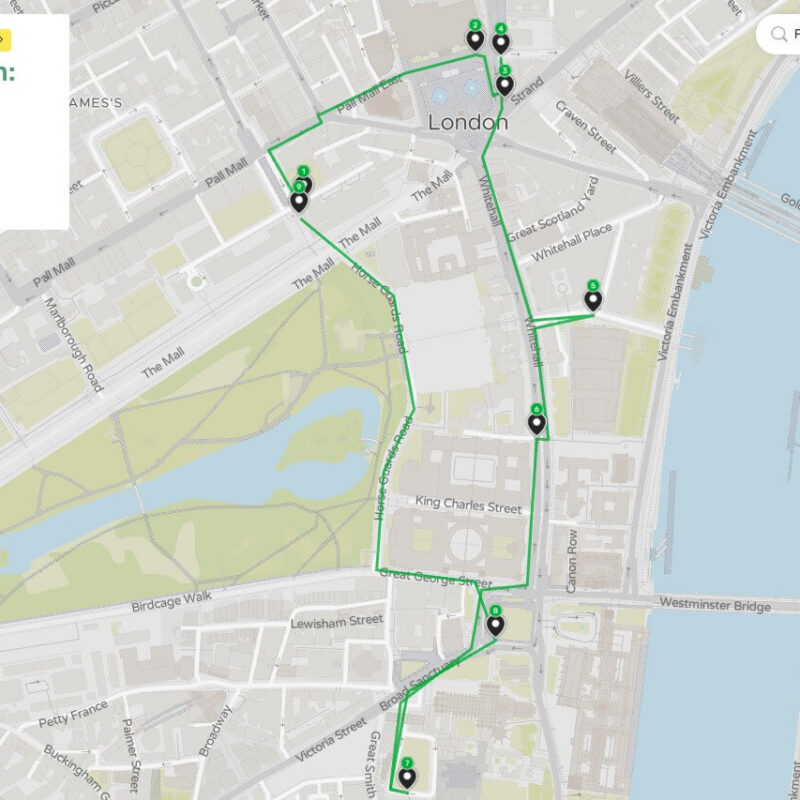
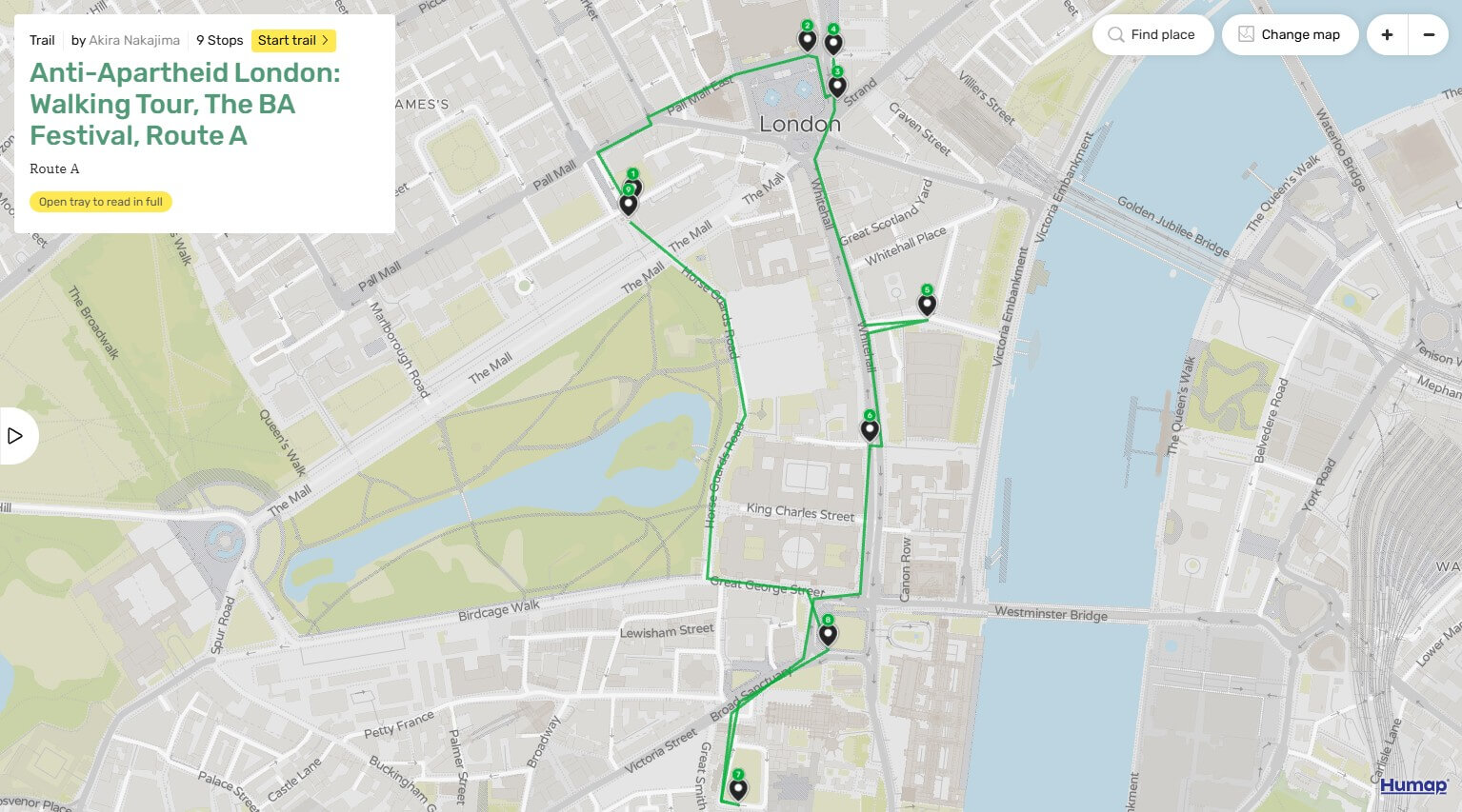
Westminster walking route

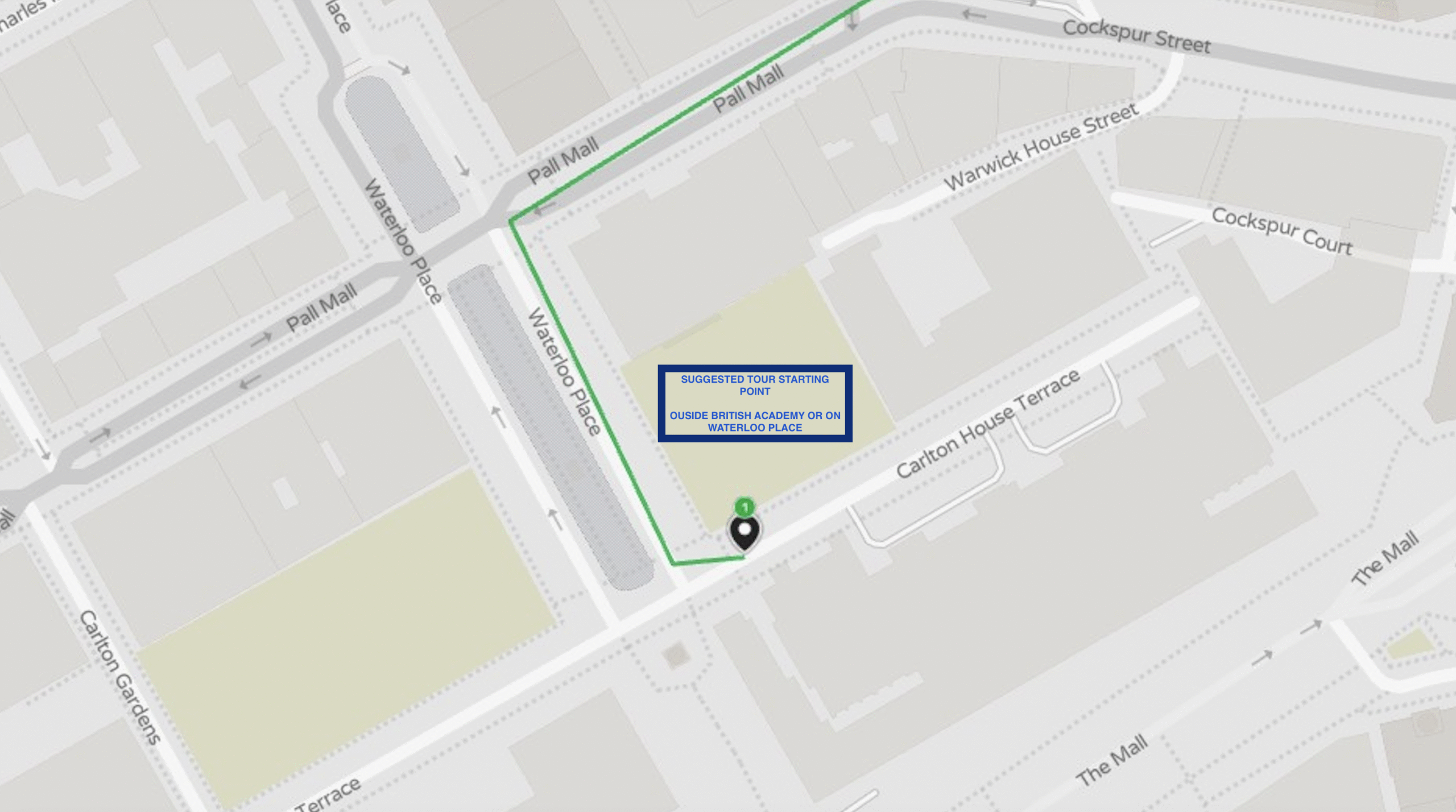
This route was first developed for the British Academy Ideas Festival, June 2026. The walk begins at the British Academy (10-11 Carlton Terrace, SW1Y 5AH) because of this festival context, but it can be started from any point on the route. We’d suggest Trafalgar Square as an alternative start point.

Free Nelson Mandela! Following the Footsteps of Britain’s Anti-Apartheid Movement

Westminster Walking Route

Join the Anti-Apartheid Legacy Centre for a 90-minute walking route through central London, uncovering the hidden geography of Britain’s Anti-Apartheid Movement.

From Trafalgar Square to Parliament Square, this route explores the streets, buildings and public spaces that became focal points for protest, organising and international solidarity with the struggle against apartheid in South Africa. Along the way, you’ll encounter stories of demonstrations, boycotts, exiled activists, political campaigning and the global movement that helped secure Nelson Mandela’s release and contributed to the end of apartheid.

This route was first developed for the British Academy Ideas Festival and celebrations marking 40 years of British Academy Postdoctoral Fellowships. It was led by historian of anti-apartheid heritage Dr Julie Partsch, drawing on research from the Anti-Apartheid London Digital Map project. Dr Partsch worked with Christabel Gurney, Anti-Apartheid Legacy Centre trustee and Secretary of the Anti-Apartheid Movement Archives Committee, to develop this iteration of the tour from the wider map project.

The walk begins at the British Academy because of this festival context, but it can be started from any point on the route. We suggest walking between Parliament Square and the British Academy via the edge of St James’s Park, allowing you to include The Mall as part of the wider landscape of protest, power and public memory.

The walking tour has been developed as part of the Anti-Apartheid London Digital Map, a collaborative public history project led by Dr Natasha Robinson (Oxford University’s Department of Education) in partnership with the Anti-Apartheid Legacy Centre.

Practical notes before you walk

Central London is busy. Please use designated crossings, stay aware of traffic, crowds, bikes, uneven pavements and personal belongings, and adapt the route if an area is congested or blocked. Trafalgar Square, Whitehall and Parliament Square may be affected by public events, protests, temporary barriers or high crowd density.

This route discusses racism, apartheid violence, detention, torture and deaths in custody. Some historical terminology reflects apartheid racial classifications and is included only to explain the system and its harms.

Overview of Westminster walking tour route

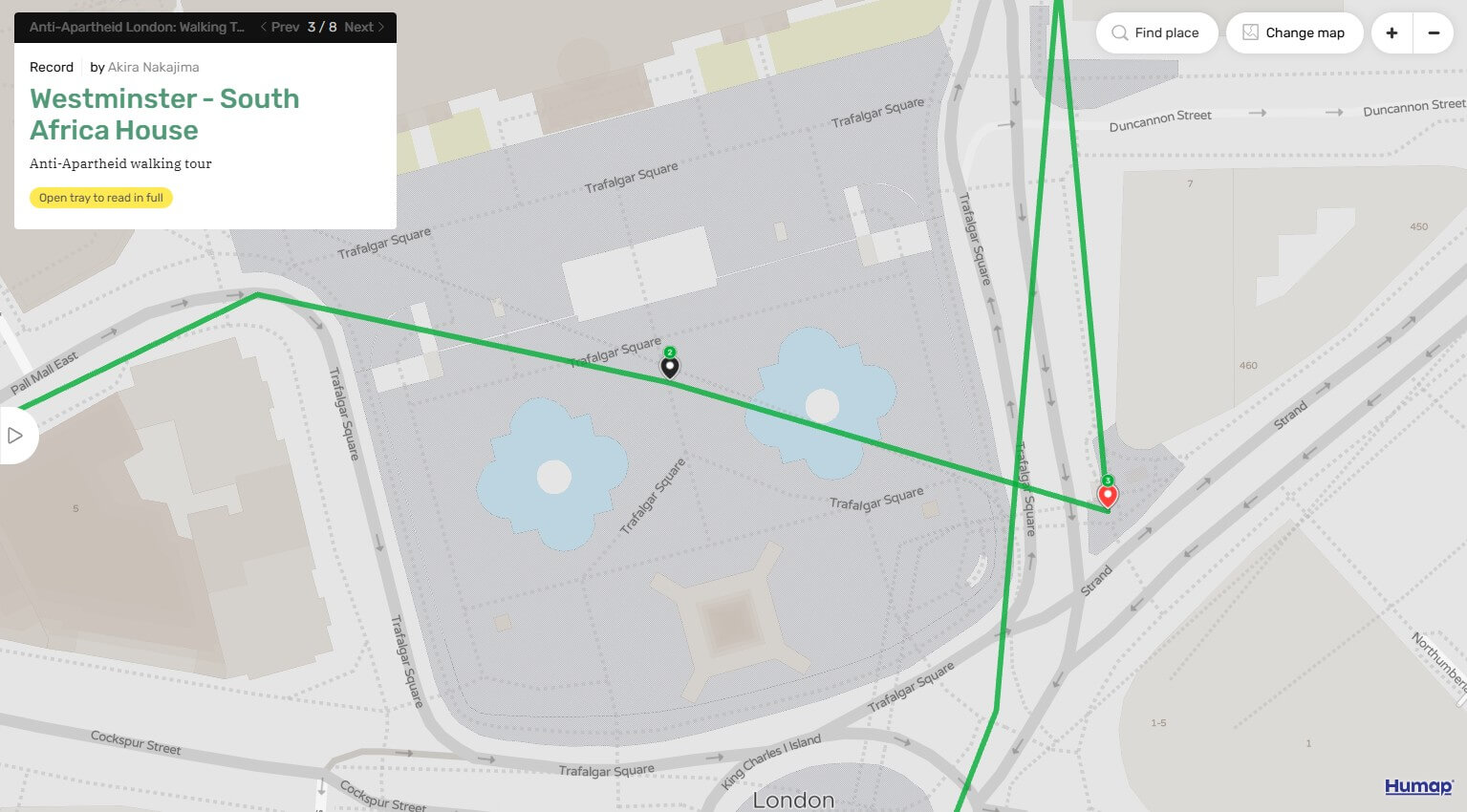
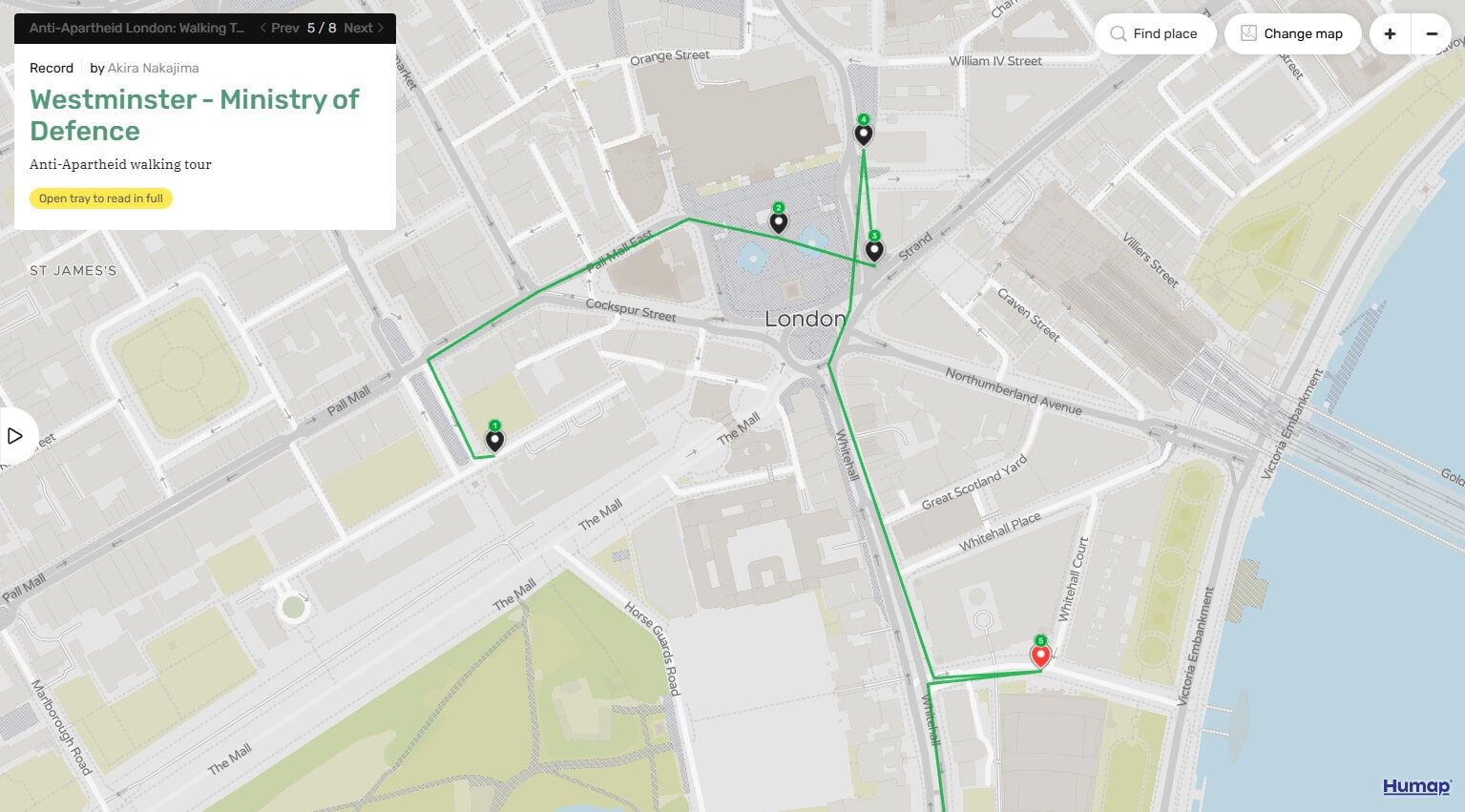
For each stop on the route, we have provided context material, a ‘site specific’ map point image, relevant archival images and a link to the entry on the Layers of London ‘Anti-Apartheid London’ Digital Map

For best viewing, click on the image you wish to view and it will open in a new window.

Stop 1: British Academy, Carlton House Terrace (SW1Y 5AH)

Theme: Setting the scene — apartheid, empire and why this route matters

Before beginning the walk, it is important to understand the history and context that shaped both apartheid in South Africa and the solidarity movement that emerged in Britain to challenge it.

Apartheid was the system of racial segregation imposed in South Africa between 1948 and 1994. Under apartheid, the white minority government classified people into racial groups and enforced laws that controlled where people could live, work, learn and move. Millions were forcibly removed from their homes, denied political rights, and subjected to systems of violence, surveillance and economic exclusion. While apartheid formally began in 1948, its roots lay in much longer histories of colonial conquest, land dispossession and racial hierarchy.

Standing here at Carlton House Terrace offers an important vantage point to begin thinking about those histories. Looking down towards The Mall, and up towards Waterloo Place, you are surrounded by landscapes shaped by monarchy, empire and military power. Across this walk, these streets reveal how spaces associated with imperial authority and government also became sites of resistance, protest and international solidarity.

Britain’s connection to apartheid was deep. South Africa had been part of the British Empire and remained closely tied to Britain economically, politically and socially throughout the twentieth century. By the late 1950s, as anti-colonial movements gained momentum across Africa and resistance intensified inside South Africa, London became an important centre for political organising, exile activism and solidarity campaigns.

It was from this context that the Boycott Movement emerged in 1959, becoming the Anti-Apartheid Movement (AAM) in 1960. Over the next 35 years, the AAM helped build one of the most significant international solidarity movements of the twentieth century — mobilising boycotts, protests, campaigns for sanctions and support for political prisoners, and sustaining the global pressure that contributed to Nelson Mandela’s release and the eventual end of apartheid.

This route follows some of those stories through Westminster — tracing how campaigners, exiles and ordinary people transformed the streets of London into spaces of resistance and solidarity.

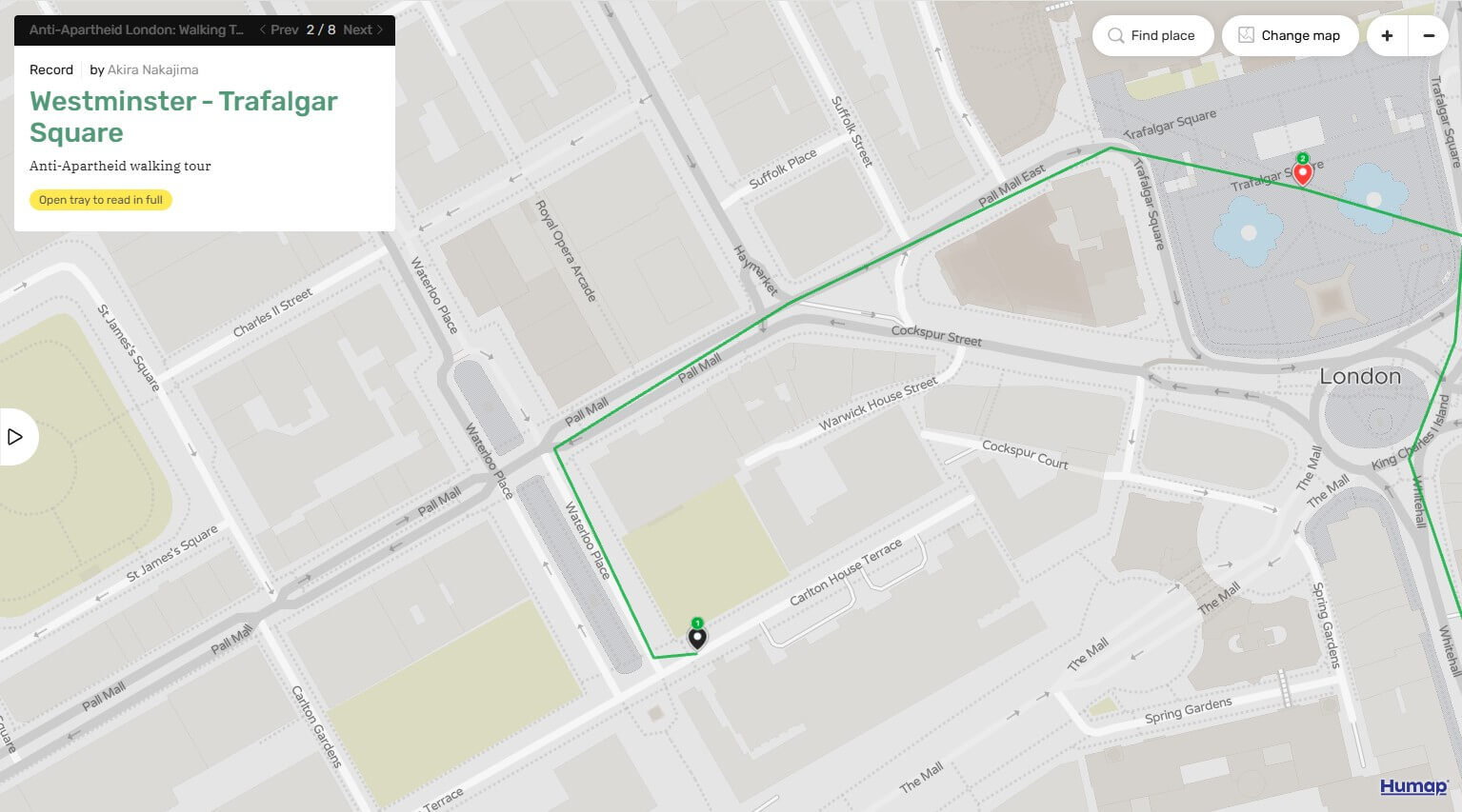
Starting point at Carlton Terrace
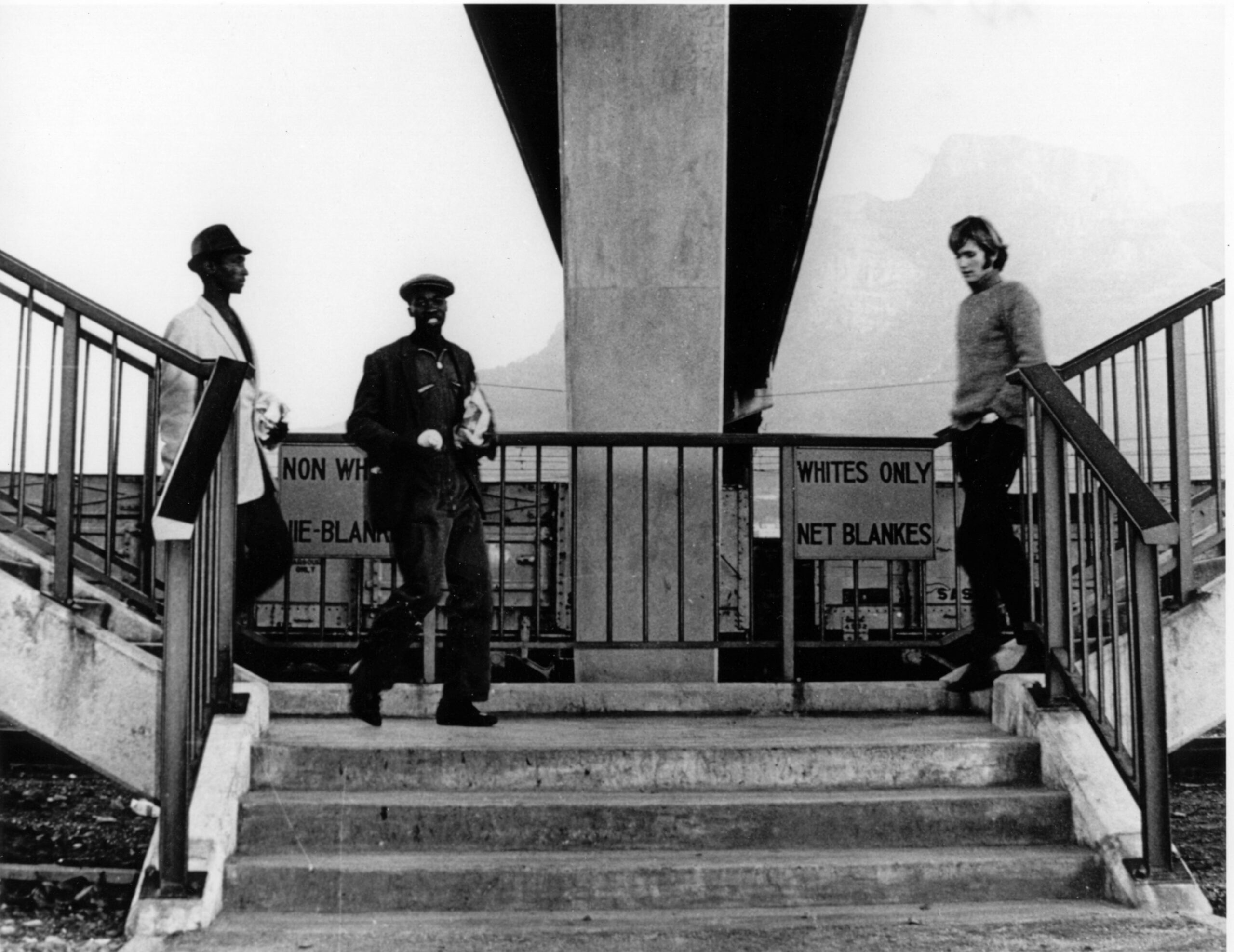
Segregated facilities at Cape Town railway station in the 1950s.

Anti-Apartheid Movement Archives

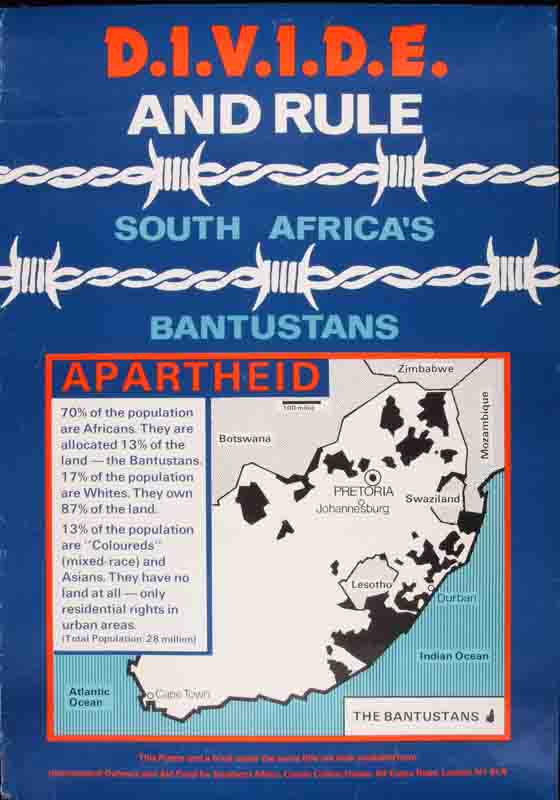
Under apartheid 87 per cent of South Africa’s land was reserved for whites. Rural Africans were confined to the overcrowded Bantustans and urban Africans were treated as migrant workers. This poster shows how the Bantustans were made up of small fragmented parcels of land.

Poster: International Defence and Aid Fund. Anti-Apartheid Movement Archives

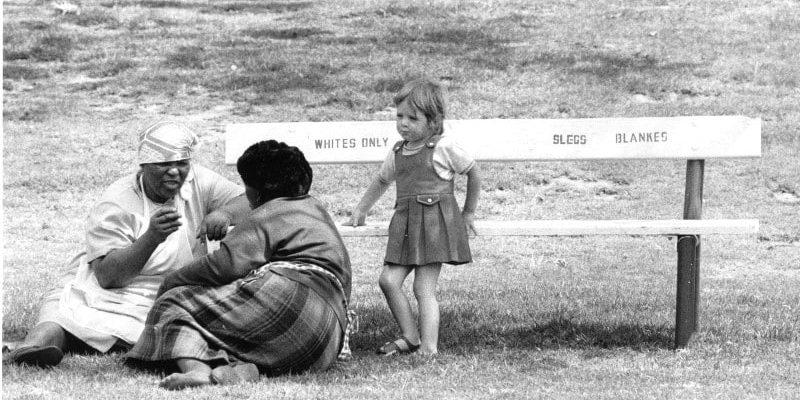
Black domestic workers employed as nannies sit on the ground looking after white children because the park bench is for whites only.

Anti-Apartheid Movement Archives

Apartheid and the fight against it

Apartheid in South Africa was a system of racial segregation and white supremacy, which was enshrined in law from 1948, after nearly three centuries of racist colonial rule by Dutch and British settlers. In 1948, the National Party won an all-white election on a ‘manifesto’ of ‘apartness (apartheid)’ as official policy. Over the next four decades, the Nationalists implemented this system through an increasingly oppressive and deeply discriminatory legal framework. But in 1994, apartheid was overthrown by the South African people, who worked with socialist, anti-racist and anti-colonial movements around the world for decades.

Under apartheid, all productive land was allocated to whites, while Africans were relegated to overcrowded and barren ‘homelands’. Black workers in designated white areas were subjected to stringent pass laws which severely limited their freedom of movement, and received wages below subsistence levels. Health and education facilities were segregated, with those for blacks being vastly inferior to those for whites. Repressive laws allowed for indefinite detention without trial, and the state systematically practised torture; the apartheid system was maintained through fear and coercion.

Despite brutal repression, South Africa’s African, Indian, and Coloured (the latter a term given to mixed-heritage people by the apartheid regime) communities, together with a small number of White South Africans, resisted apartheid through mass protests, strikes, boycotts, and armed struggle. They appealed to people worldwide, and with resilience and determination secured widespread popular support. In the UK, boycotts and protests targeted those doing business with the apartheid state, including banks, agricultural importers, and mining companies.

For information about key events and dates during the struggle against apartheid, click below:

Key dates

  • 1910 – The Act of Union – a colonial tool to ensure white domination becomes part of racist law
  • 1912 – The African National Congress is formalised for African resistance to colonialism.
  • 1913 – The Land Act – the expropriation of land by the White settlers that had belonged to the indigenous Black population
  • 1914 – The National Party is formed to oppose British colonial rule.
  • 1921 – South African Communist Party is founded
  • 1946 – The Indian Congress, inspired by Gandhi, embarks upon a Passive Resistance Campaign
  • 1948 – The policy of apartheid is officially implemented by National Party as government
  • 1952 -The Defiance Campaign involves activists from all the oppressed peoples
  • 1955 – The Freedom Charter was adopted by the ANC at Kliptown, Soweto.
  • 1956 – The Treason Trial begins. 156 male and female activists from Black, Indian, Coloured and White backgrounds are accused of High Treason
  • 1960 – 69 Black Pan-African Congress demonstrators are killed by police at Sharpeville whilst peacefully marching against the Pass laws. The ANC is banned.
  • 1961 – South Africa is declared a republic and leaves the Commonwealth. The ANC starts an underground armed wing, Umkhonto We Sizwe (Spear of the Nation), and launches a sabotage campaign, targeting buildings not people
  • 1964 – ANC leader Nelson Mandela and his fellow defendants in the Rivonia Trial were sentenced to life imprisonment
  • 1970s – More than 3 million Black people are forced out of their homes and into so-called ‘homelands’
  • 1976 – School age students lead peaceful protests against the racist education system where they are taught in Afrikaans. The police and army are called in and hundreds of children shot dead and injured.
  • 1984-89 – Uprisings by Black people are responded to by the state declaring an ongoing state of emergency
  • 1989 – FW de Klerk replaced PW Botha as president. Public amenities were desegregated.
  • 1990 – the ANC was unbanned; Mandela and his comrades were released after 27 years in prison
  • 1991 – Multi-party talks commenced. Remaining apartheid laws and international sanctions were lifted.
  • 1993 – An agreement was reached on an interim constitution
  • 1994 April – ANC won the first non-racial election and Nelson Mandela became the first democratically elected president

For more information visit ‘Forward to Freedom’, at aamarchives.org

Further information on history of apartheid

Read more at “Apartheid: A Short History

Visit Forward to Freedom for more archival content

Route information: Between Carlton Terrace (Stop 1) and Trafalgar Square (Stop 2)

From the starting point, walk north up Waterloo Place, passing the monuments and imperial architecture that frame this part of Westminster. On your way, look out for the Banksy artwork installed here in 2026 — a contemporary intervention in a landscape long associated with state power, authority and public memory, and a reminder that protest continues to reshape the city.

At the top of Waterloo Place, turn right onto Pall Mall East and continue towards Trafalgar Square. As you walk, notice how this route moves through spaces closely tied to empire, military history and government. These same streets would later become important stages for anti-apartheid protest, where activists challenged Britain’s political and economic ties to South Africa. Ahead, Trafalgar Square opens up as one of London’s most symbolic public spaces — and one of the most important sites of international solidarity in the struggle against apartheid.

Stop 2: Trafalgar Square (WC2N 5DN)

Theme: Boycott, mass protest and international solidarity

Trafalgar Square was one of the most important public stages for Britain’s Anti-Apartheid Movement. Positioned directly opposite South Africa House, it became a focal point for protest, mass gatherings and public acts of solidarity over three decades.

It was here, on 28 February 1960, that more than 8,000 people gathered for the launch rally of the Boycott Movement, calling on people across Britain to stop buying South African goods. At its heart was a simple but powerful idea: ordinary people could challenge apartheid through everyday choices. Refusing South African fruit, wine and other imports became one of the most accessible and effective ways to participate in the struggle, connecting households, supermarkets and local communities across Britain to events unfolding thousands of miles away.

The boycott quickly spread beyond London. Local Anti-Apartheid groups organised pickets outside supermarkets, pressured retailers like Tesco and Sainsbury’s to stop stocking South African produce, and turned consumer action into political action. By the mid-1980s, polling suggested that more than a quarter of people in Britain were actively boycotting South African goods.

This square was also shaped by moments of crisis and escalation. Just weeks after the boycott launch, on 21 March 1960, police in South Africa opened fire on peaceful demonstrators in Sharpeville, killing 69 people. The massacre shocked the world and transformed the anti-apartheid struggle, pushing international solidarity into sharper focus. Days later, a march from Marble Arch to Trafalgar Square brought 15,000 people together here in protest. From that point on, Trafalgar Square became one of the movement’s central stages: for rallies, vigils, commemorations and dramatic protests against Britain’s ongoing political and economic ties to apartheid.

Standing here today, surrounded by monuments of empire and national memory, it is possible to imagine how this space was repeatedly reclaimed by anti-apartheid activists — turning one of Britain’s most symbolic public squares into a site of global resistance.

Standing in Trafalgar Square. We recommend a view point from North Terrace if possible.
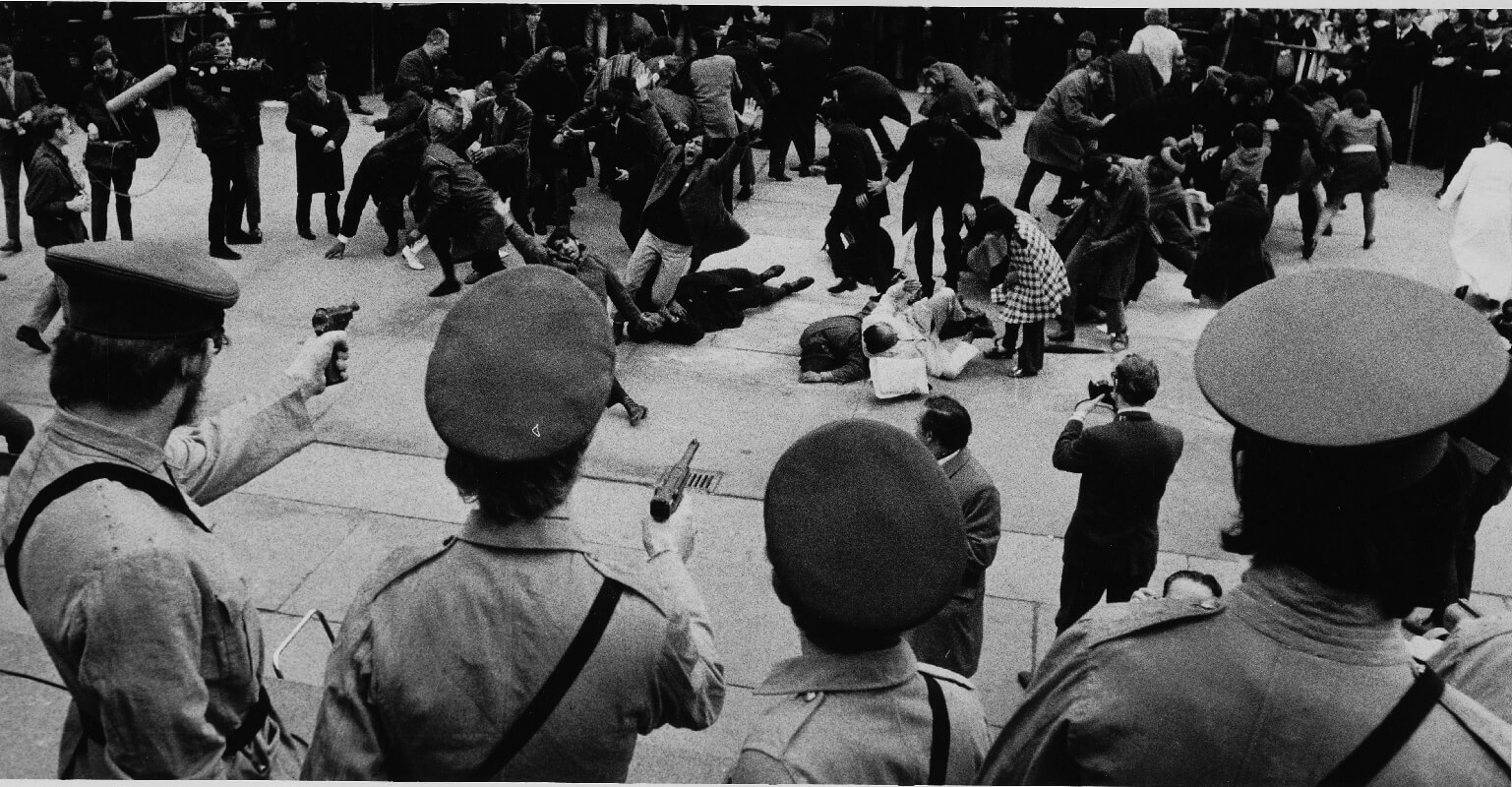
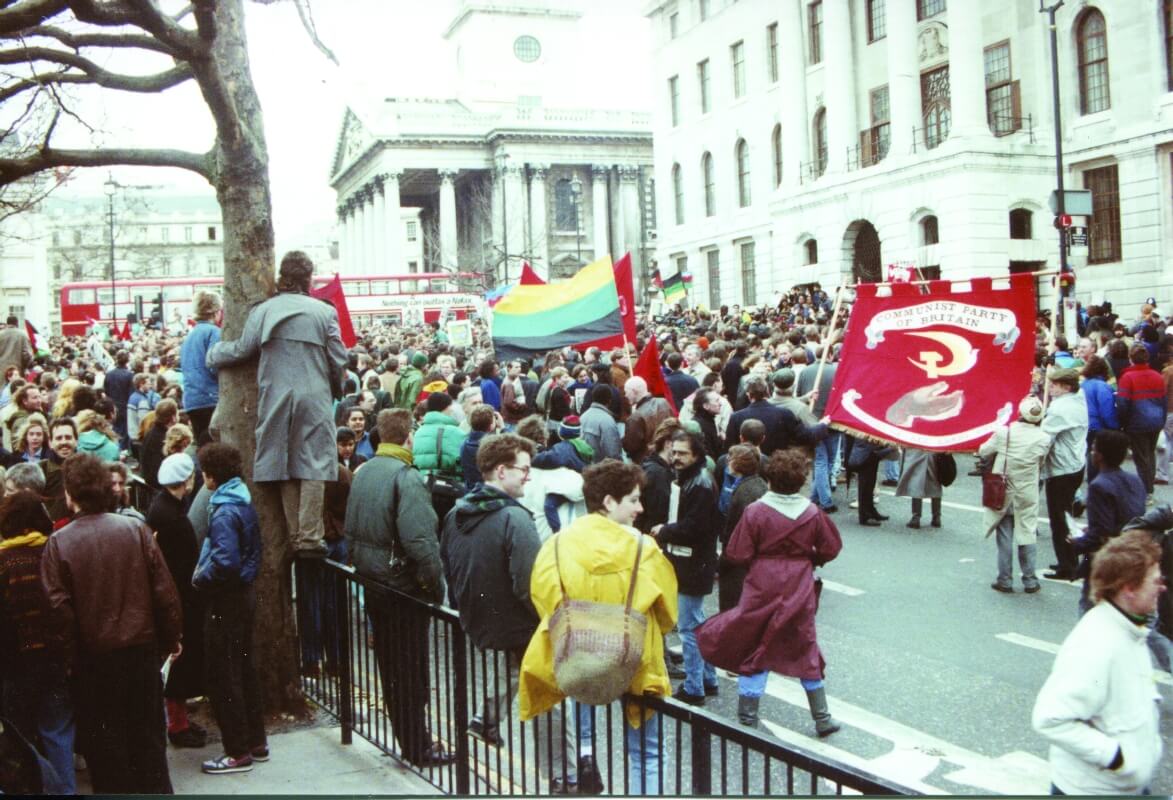
On the tenth anniversary of the Sharpeville massacre the AAM staged a re-enactment in Trafalgar Square. Around 3,000 people watched as actors dressed as South African police took aim and people in the crowd fell to the ground. The event was organised by the AAM and the United Nations Students Association (UNSA).

Anti-Apartheid Movement Archives

Poster asking shoppers to boycott South African goods. This poster was first produced in 1978. Some of the items incorporate images of the shootings of school students in Soweto in June 1976.

Anti-Apartheid Movement Archives

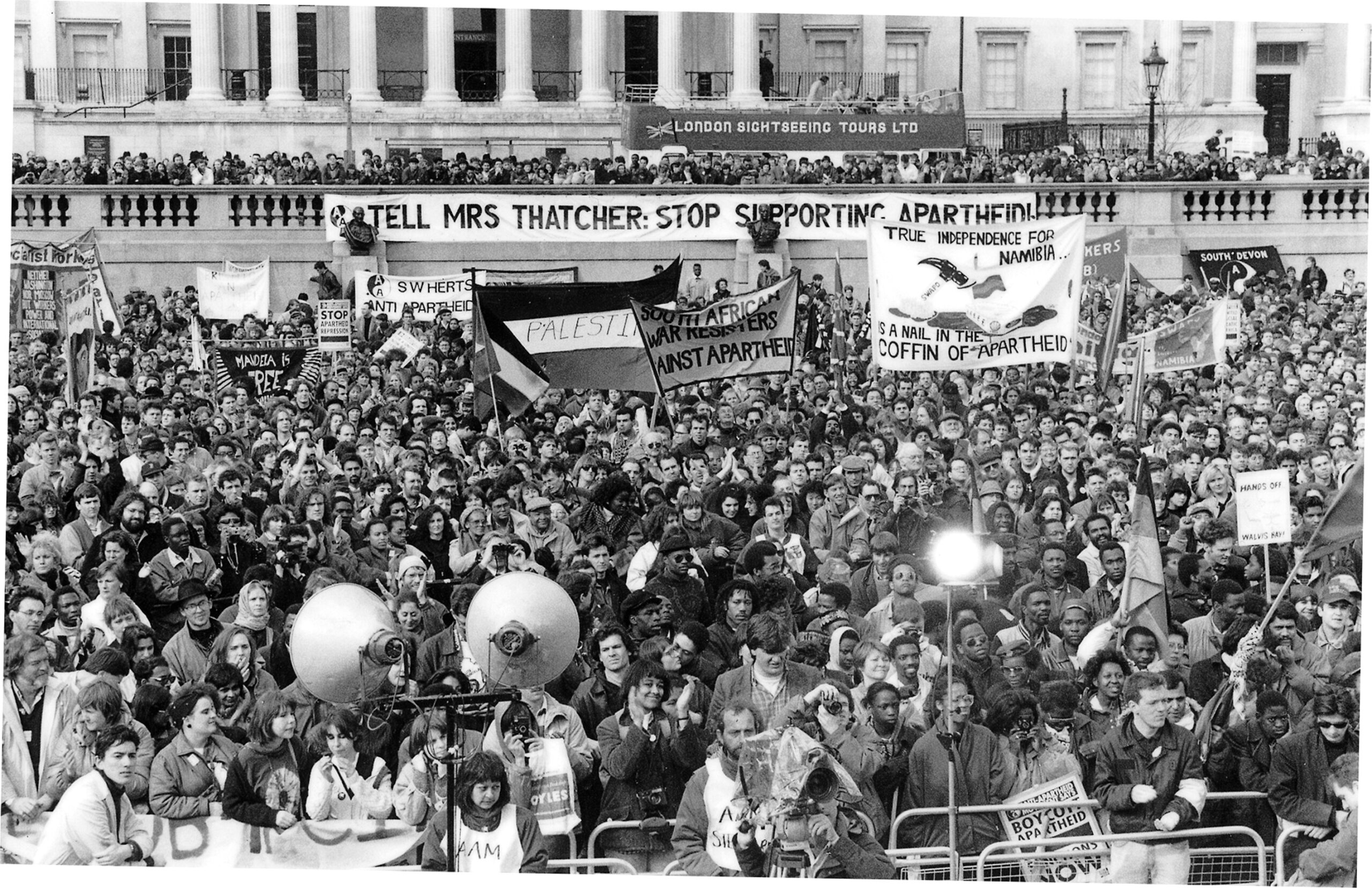
Over 20,000 demonstrators packed Trafalgar Square on 25 March 1990 in the first big anti-apartheid demonstration in Britain after the release of Nelson Mandela. Former Robben Island prisoner Andrew Mlangeni told the crowd ‘We were never alone. You continued to inspire us from outside our prison walls’.

Anti-Apartheid Movement Archives

Further information for Anti-Apartheid & Trafalgar Square (Stop 2)

Visit our Layers of London ‘Anti-Apartheid London Digital Map’ information point for Trafalgar Square

Route information: Between Trafalgar Square (Stop 2) and South Africa House (Stop 3)

From your position in Trafalgar Square, walk across the square towards South Africa House, keeping its grand stone façade in view.

As you cross, take in the scale of the square and imagine it filled with thousands of protesters — from the 8,000 people gathered for the Boycott Movement launch in 1960, to the many mass rallies, vigils and demonstrations that followed over the next three decades, often drawing 100s of 1000s of people at a time. This open civic space became one of Britain’s most visible stages for international solidarity.

Pause for a moment near the centre of the square and look up at Nelson’s Column. In 1977, anti-apartheid activists and climbers Edwin Drummond and Colin Rowe scaled the column and unfurled a banner protesting British investment in South Africa — a dramatic act that transformed one of Britain’s most iconic imperial monuments into a platform for resistance. Think about the courage, planning and determination such an action required, and what it meant to challenge apartheid so publicly at the heart of London.

As you approach South Africa House, take time to study its façade. Look for its carved and gilded symbols: South African wildlife, imperial motifs, inscriptions in Afrikaans, and the large central balcony. These architectural details reveal how the building projected a particular image of South Africa — one rooted in colonial power, settler identity and state authority — even as protesters gathered directly beneath it to demand change.

Stop 3: South Africa House (WC2N 5DP)

Theme: Diplomacy, protest and apartheid’s presence in London

Standing outside South Africa House, it becomes clear why this building was such a powerful focus for anti-apartheid protest. For decades it served as the official diplomatic headquarters of the apartheid state in Britain — the place where South Africa’s government projected its authority internationally, even as it faced growing resistance at home and abroad.

The building itself still carries traces of that history. Look closely and you can see symbols of colonial conquest and white settler power embedded in its architecture: references to European “discovery,” imperial expansion and settler nationalism. These symbols remind us that apartheid did not emerge in isolation, but from longer histories of colonial rule and racial domination.

Because of its symbolic and political importance, South Africa House became one of London’s most consistent sites of anti-apartheid action. In the days following the Sharpeville Massacre in 1960, protesters gathered here continuously, demanding international action. Over the years, hundreds of demonstrations would take place outside these doors — calling for the release of political prisoners, protesting bannings, executions and state violence, and challenging Britain’s continued economic and political links to apartheid.

Some of the most emotional vigils were held here overnight, as activists awaited news of executions in South Africa. These included campaigns for imprisoned members of the ANC’s armed wing, Umkhonto we Sizwe, such as Solomon Mahlangu, who was executed in 1979 at the age of 23. His death became a rallying point for international protest.

This was also the site of the famous Non-Stop Picket, launched by the City of London Anti-Apartheid Group on 19 April 1986 to demand Nelson Mandela’s release. Protesters maintained a 24-hour presence outside South Africa House every day until Mandela walked free on 11 February 1990 — nearly four years later. The picket became one of the most enduring acts of political protest in modern British history.

Yet South Africa House was not only a site of protest — it was also a centre of apartheid surveillance and intimidation. Evidence later showed that South African intelligence services used diplomatic spaces like this to monitor, harass and target anti-apartheid activists in Britain and Europe, linking this building directly to the wider violence of the apartheid state.

Standing here today, the building remains a powerful reminder of how London became both a centre of apartheid diplomacy and one of its most persistent sites of resistance.

Stand facing South Africa House, if possible,  from just inside the south east corner of Trafalgar Square.
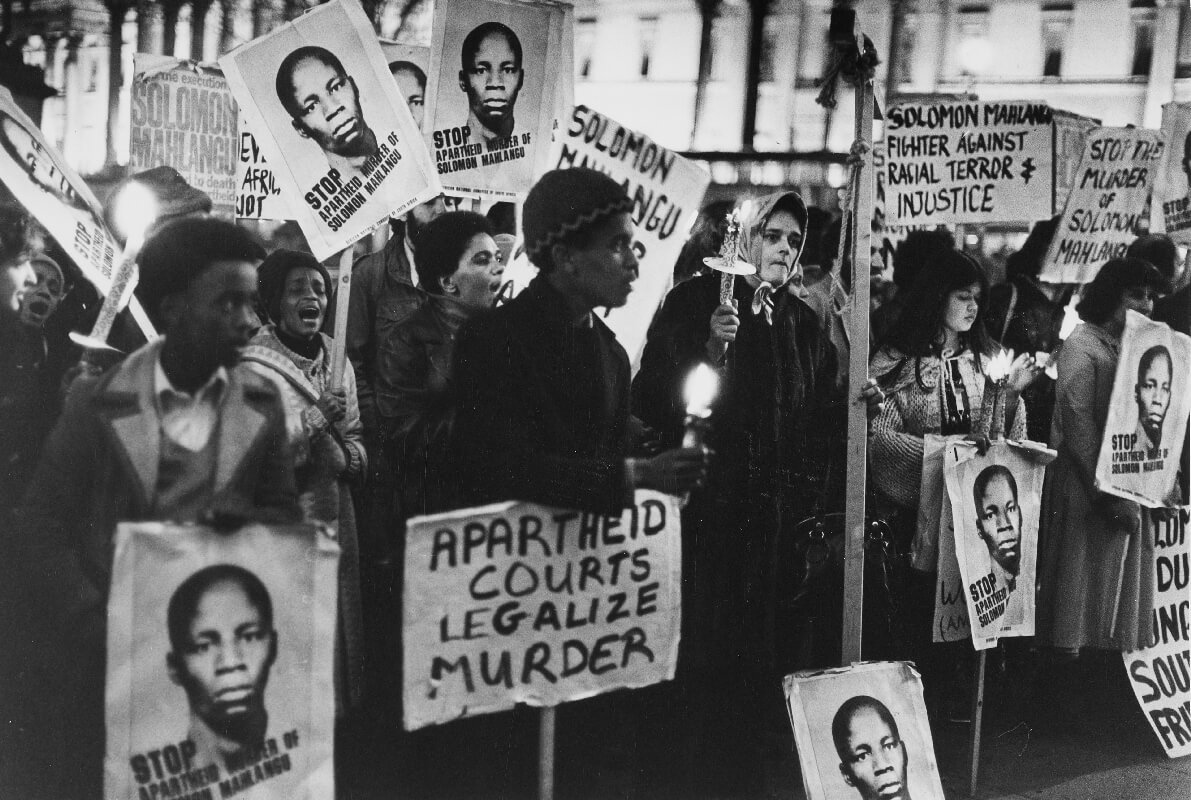
Hundreds of people kept an all-night vigil at South Africa House in London before the execution of Solomon Mahlangu on 6 April 1979. In Scotland AAM supporters picketed the South African consulate in Glasgow. Solomon Mahlangu was hanged in spite of a huge international campaign. The UN Security Council and the governments of the UK and all the other major Western European countries appealed to the South African government for clemency. US President Jimmy Carter also intervened.

Anti-Apartheid Movement Archives

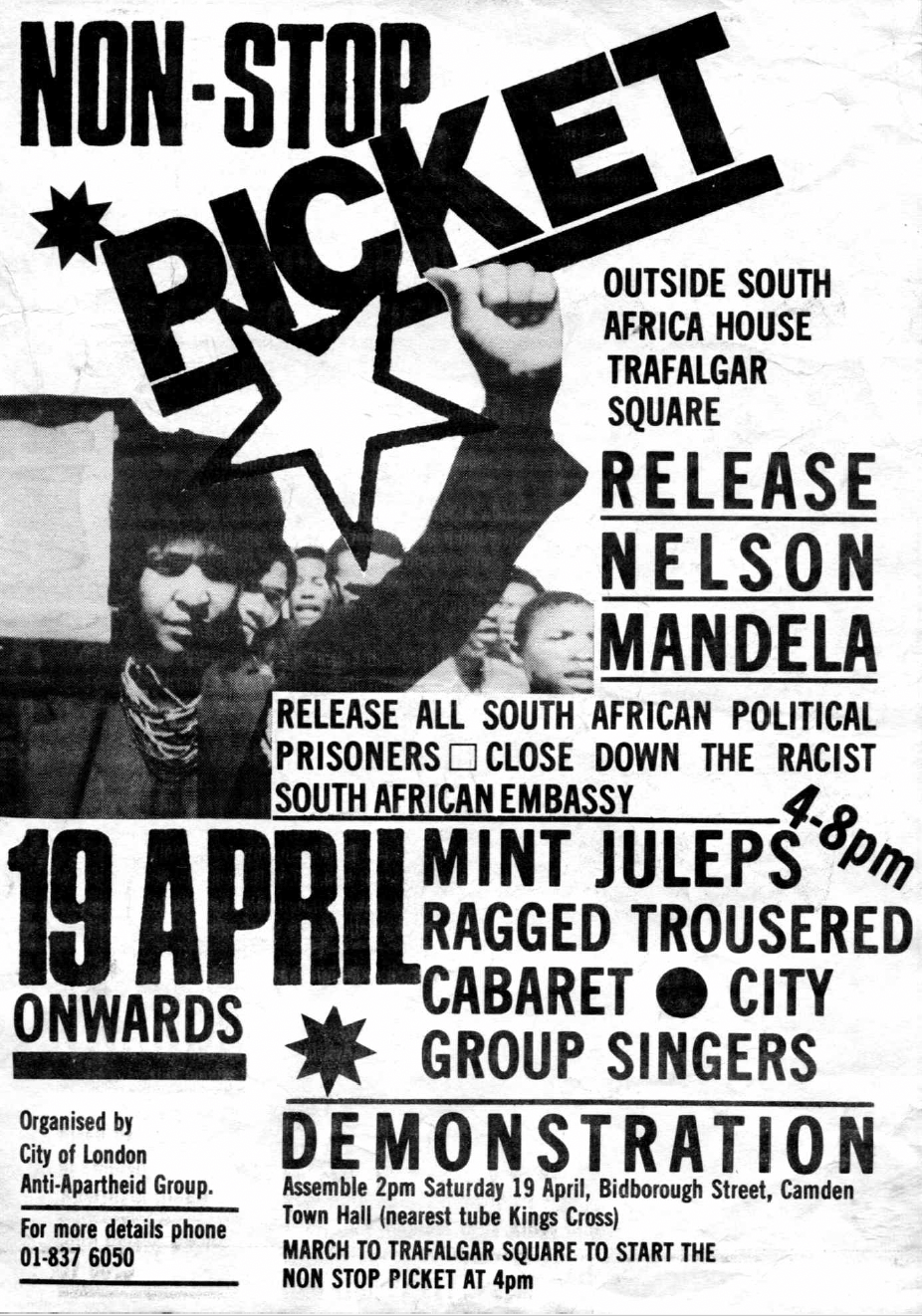
Leaflet advertising the launch of City of London AA Group’s non-stop picket calling for the release of Nelson Mandela. CLAAG supporters kept up a 24-hour picket of the South African embassy for nearly four years from 19 April 1986 until Mandela’s release on 11 February 1990. The picket attracted hundreds of enthusiastic young activists.  CLAAG was formed as a branch of the Anti-Apartheid Movement in 1982, but internal arguments led to its disaffiliation in February 1985.

Bishopsgate Institute

Thousands of people gathered spontaneously outside South Africa House in London on 11 February 1990 to celebrate Nelson Mandela’s release.

Anti-Apartheid Movement Archives

Further information for Anti-Apartheid & South Africa House (Stop 3)

Visit our Layers of London ‘Anti-Apartheid London Digital Map’ information point for South Africa House

Route information: Between South Africa House (Stop 3) and St Martin-in-the-Fields (Stop 4)

Looking at the front of South Africa House, with Trafalgar Square behind you, turn left and walk up to the crossroads with St Martin’s Place. Cross here and continue towards St Martin-in-the-Fields, the large church on the north-east corner of Trafalgar Square.

This is a short section of the walk, but it marks an important shift in the story — from the visible site of protest at South Africa House to a place of reflection, solidarity and campaigning around political imprisonment, detention and state violence. As you cross, look back at South Africa House and consider how closely these sites of diplomacy, protest and faith sit alongside one another in the heart of Westminster.

Stop 4: St Martin-in-the-Fields (WC2N 4JJ)

Theme: Political prisoners, detention and remembering the disappeared

From here, facing back towards South Africa House, the route shifts from public protest to the more intimate and often devastating stories of political imprisonment, detention and death under apartheid.

During the 1960s and 1970s, the South African state increasingly relied on detention without trial to suppress resistance. Under laws such as the Terrorism Act, people suspected of political activity could be held indefinitely, often in solitary confinement, without charge or access to lawyers. Torture became routine, and detention was used not only to extract information but to break political organisation and morale.

In response, solidarity organisations in Britain expanded their focus beyond boycotts and sanctions. In 1973, the Anti-Apartheid Movement and allied organisations established the Southern Africa the Imprisoned Society (SATIS) to campaign for political prisoners in South Africa and Namibia. SATIS organised petitions, public meetings and international campaigns to demand the release of detainees and to make sure prisoners knew they had not been forgotten.

One of the most internationally significant cases was Steve Biko, founder of the Black Consciousness Movement. Biko’s politics centred on psychological liberation, Black pride and self-determination — ideas that deeply influenced a new generation of activists in South Africa. In 1977, he was arrested, brutally beaten in police custody and died from his injuries. His death exposed the scale of state violence and sparked outrage around the world.

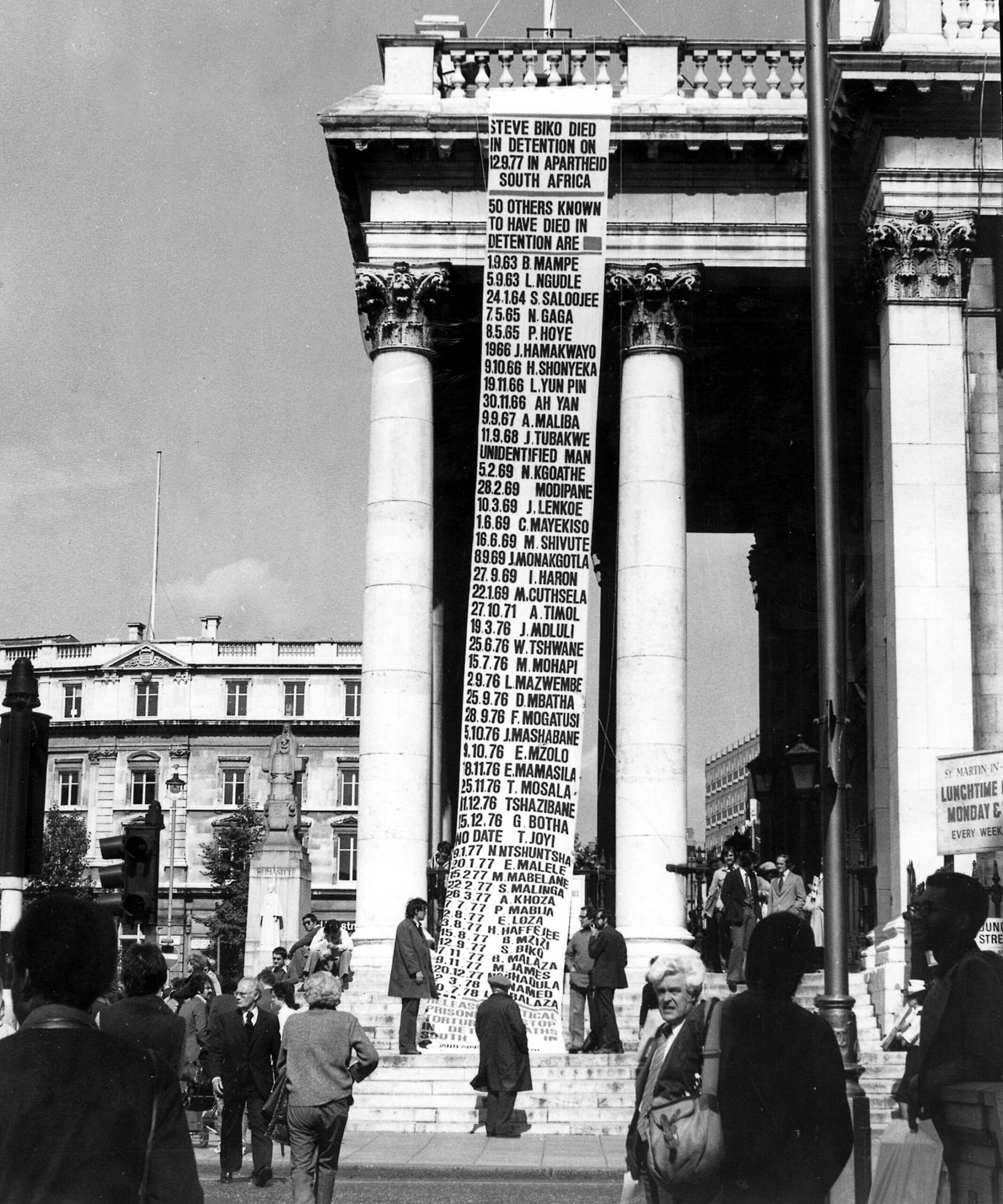
St Martin-in-the-Fields became one of the places where this grief and anger was publicly expressed. During the anti-apartheid years, the church and its congregation actively supported protests taking place across the road at South Africa House, offering moral and practical solidarity to campaigners. Activists unfurled banners here to draw attention to deaths in detention and the growing list of political prisoners.

That connection has endured. Today, St Martin-in-the-Fields continues its long-standing commitment to confronting injustice — globally and locally — through advocacy, cultural exchange and direct support, making it part of a living tradition of social justice that stretches from the anti-apartheid struggle to the present.

This stop reminds us that the anti-apartheid struggle was not only about mass demonstrations or international sanctions, but also about insisting on the humanity of those imprisoned, tortured or killed by the state — and refusing to let their stories disappear.

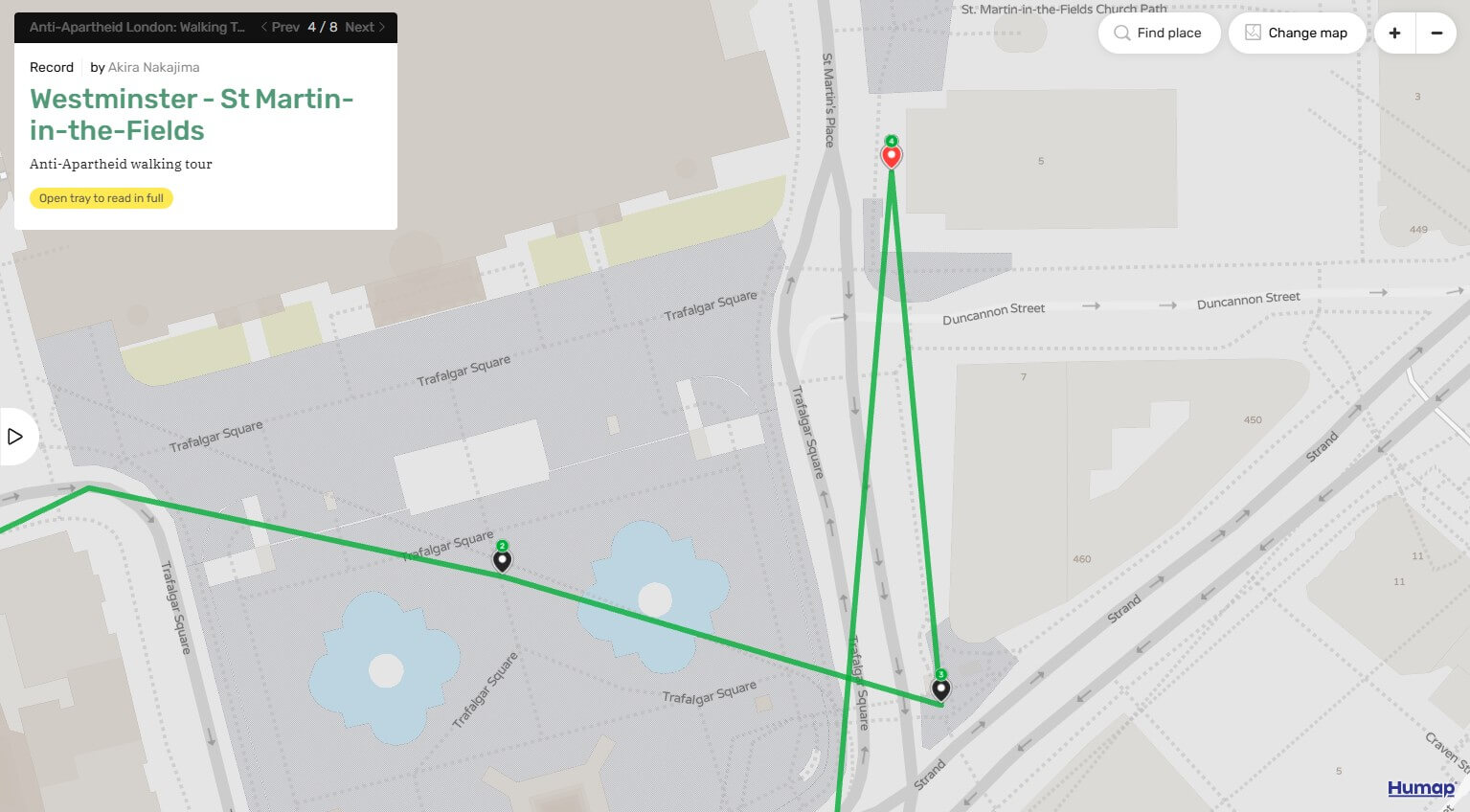
Stand facing St Martin-in-the-Fields, if possible,  from the pavement at the corner of Duncannon Street and St Martin’s Place.
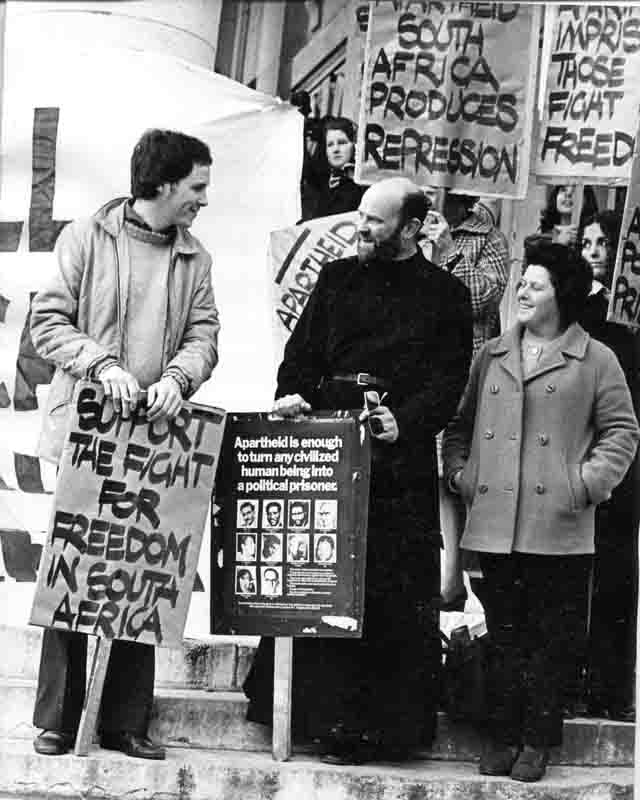
AAM supporters held a 24-hour vigil on the steps of St Martin’s in the Fields on Good Friday, 11–12 April 1974 to call for the release of all South African political prisoners. They collected over 2,500 signatures for a petition to be presented to the UN in June. The vigil and petition were part of the campaign launched by Southern Africa the Imprisoned Society (SATIS) at its founding conference in December 1973. In the photograph are Kay Hosey, mother of political prisoner Sean Hosey, and Rev Paul Oestreicher.

Chris Cornwell / Anti-Apartheid Movement Archives

On the first anniversary of the death of Steve Biko on 12 September 1978, Southern Africa the Imprisoned Society (SATIS) unfurled a 90-foot banner from the roof of St Martin-in-the-Fields. It listed the names of all those known to have died under interrogation by the South African Security Police. Inside the church a special service commemorated Steve Biko’s life.

Anti-Apartheid Movement Archives

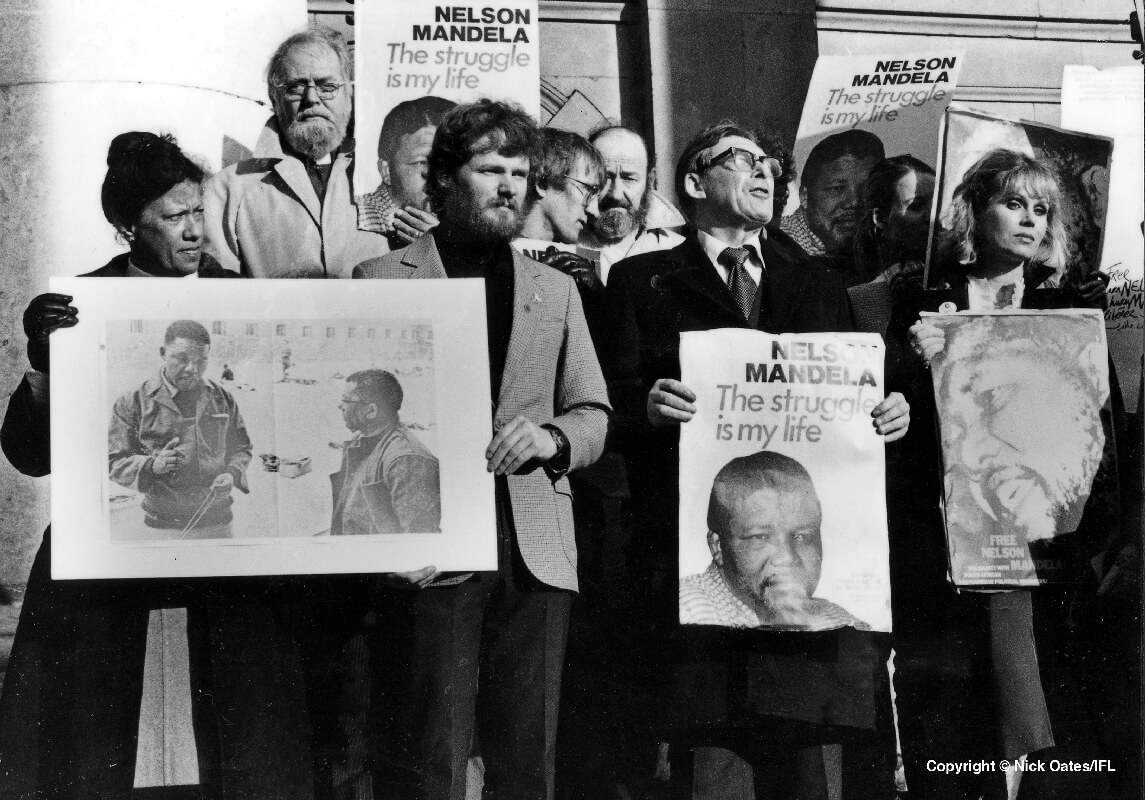
Vigil on the steps of St Martin-in-the-Fields on 16 March 1981, calling for the release of Nelson Mandela. Left to right: Dulcie September, Theo Kotze, former Director of the South African Christian Institute, former political prisoners Stephen Lee and Tim Jenkin, British miners leader Mick McGahey and actor Joanna Lumley. The vigil was the start of a joint campaign by the AAM and the International Defence and Aid Fund.

Nick Oates/IFL – Anti-Apartheid Movement Archives

Further information for Anti-Apartheid & St Martin in the Fields (Stop 4)

Visit our Layers of London ‘Anti-Apartheid London Digital Map’ information point for St Martin in the Fields

Route information: Between St Martin in the Fields (Stop 4) and Ministry of Defence (Stop 5)

From St Martin-in-the-Fields, pass back in front of South Africa House and walk along Whitehall (on the left side pavement) before you turn into Horse Guards Avenue, you pass The Clarence — a pub remembered by many Anti-Apartheid Movement activists as a regular meeting and gathering place after protests, marches and long evenings of organising. These informal spaces mattered too: solidarity was built not only in demonstrations, but in conversations, friendships and shared political commitment.

Stop 5: Ministry of Defence (SW1A 2HB)

Theme: Arms embargo and confronting British support for apartheid

Although the Ministry of Defence officially lists its address as Whitehall, this point on Horse Guards Avenue offers a clearer sense of the building’s scale and the routes taken by ministers and officials entering and leaving for high-level meetings.

This stop focuses on Britain’s military relationship with apartheid South Africa — and the protests that challenged it.

In the early years of apartheid, Britain was one of South Africa’s major arms suppliers. These military ties strengthened the apartheid state’s ability to enforce racial rule internally and project force across the region. While the Labour government introduced an arms embargo in the mid-1960s, it continued supplying spare parts for key weapons systems, including Buccaneer bombers. When the Conservatives came to power in 1970, even this limited embargo was lifted.

This made the Ministry of Defence a direct site of anti-apartheid protest.

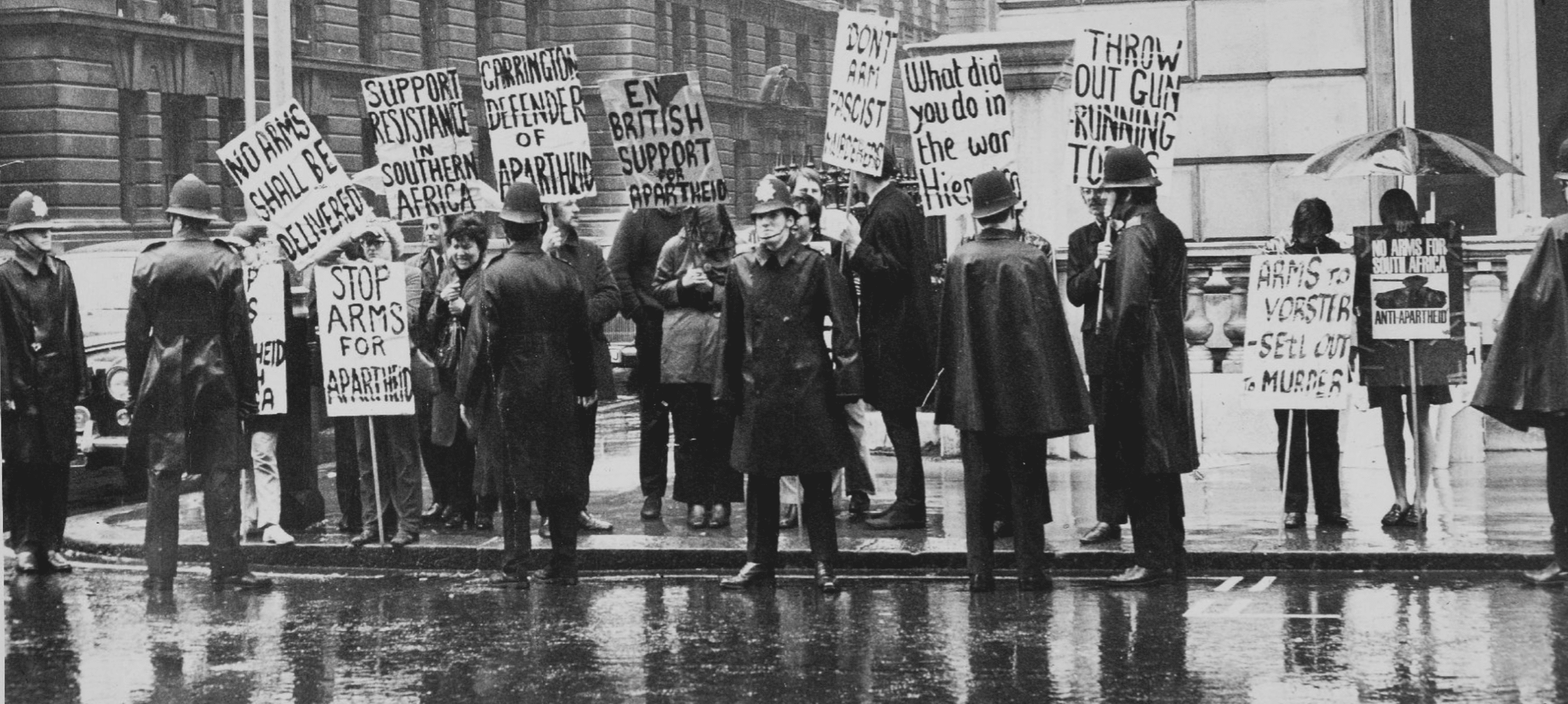
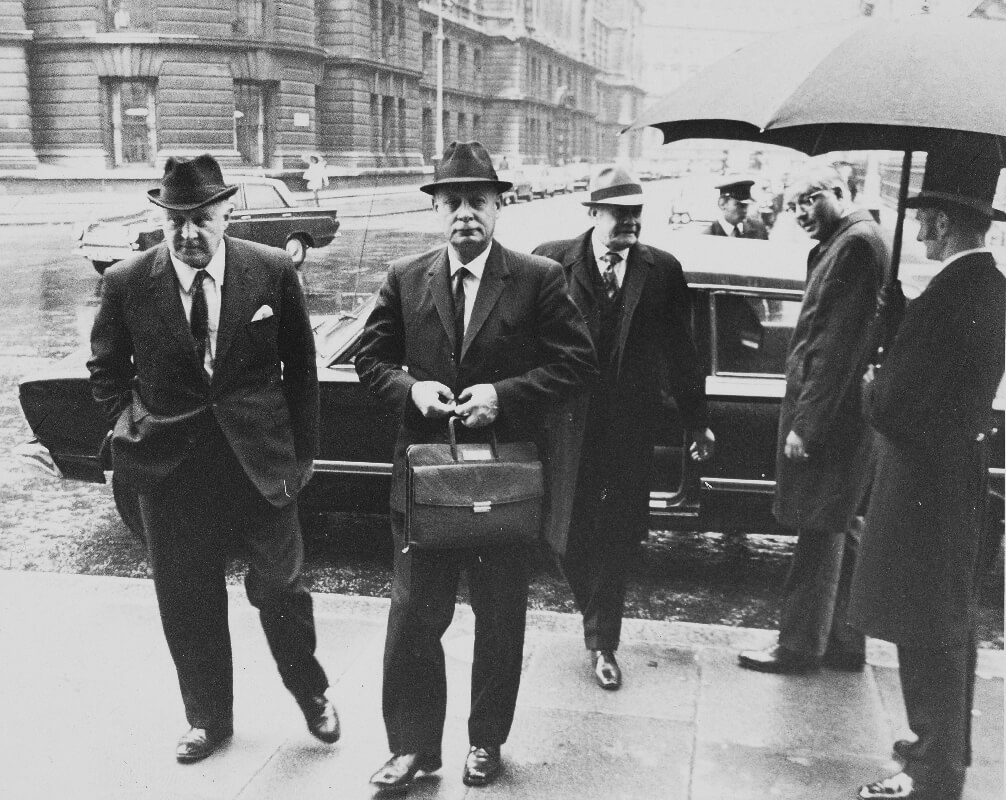
In June 1971, South African Defence Minister P.W. Botha visited London for talks with British Defence Secretary Lord Carrington about arms supplies. Protesters gathered here to oppose the visit. In a dramatic act of resistance, demonstrators threw tomatoes and smoke flares as Botha arrived — confronting both the South African minister and the British government’s willingness to continue military cooperation.

This protest is remembered in the oral history shared by Christabel Gurney, who took part and whose recollections form part of the Anti-Apartheid London Digital Map project. Through her memory, this stop reminds us how anti-apartheid activism was not only organised in meeting rooms and rallies, but enacted physically in spaces like this, at the heart of British government.

By the mid-1970s, global outrage against apartheid intensified. In 1976, thousands of school students in Soweto protested against the imposition of Afrikaans as a language of instruction in schools — a policy that symbolised the wider violence of apartheid education. Police opened fire on the protest, killing hundreds of young people.

One image from that day became internationally iconic: the photograph of Hector Pieterson, a 12-year-old boy, being carried after being shot, with his sister running beside him. Taken by photographer Sam Nzima, the image exposed the brutality of apartheid to the world and became a rallying point for global solidarity. It also appeared in anti-apartheid campaigning materials in Britain, connecting the violence in South Africa directly to boycott and sanctions activism here (see “Look Before you Buy” poster above, linked to Stop 2, Trafalgar Square).

In 1977, after the murder of Steve Biko, the United Nations imposed a mandatory arms embargo on South Africa. Britain voted in support. It was one of the few moments when the British government formally aligned with the demands of the Anti-Apartheid Movement, marking an important turning point in the struggle to isolate apartheid internationally.

Stand facing the Ministry of Defence, if possible,  from the pavement directly outside it, or opposite next to Raffles Hotel.
Demonstrators waiting for the arrival of South African Defence Minister P W Botha at the Ministry of Defence in Whitehall, 10 June 1971. Botha was seeking assurances from his British counterpart Lord Carrington that Britain would supply warships to South Africa. He was accompanied by SADF Commander in Chief General Hiemstra, a former Nazi sympathiser.

Workers Press / Anti-Apartheid Movement Archives

South African Defence Minister P W Botha visited the Ministry of Defence on 10 June 1971 for talks with his British counterpart Lord Carrington. Protesters threw tomatoes and smoke flares as he entered the Ministry. Botha was seeking assurances that Britain would supply warships to South Africa. The 1970–74 Conservative government announced that it would lift the arms embargo against South Africa, but because of public opposition the only weapons it supplied were seven Wasp helicopters.

Anti-Apartheid Movement Archives

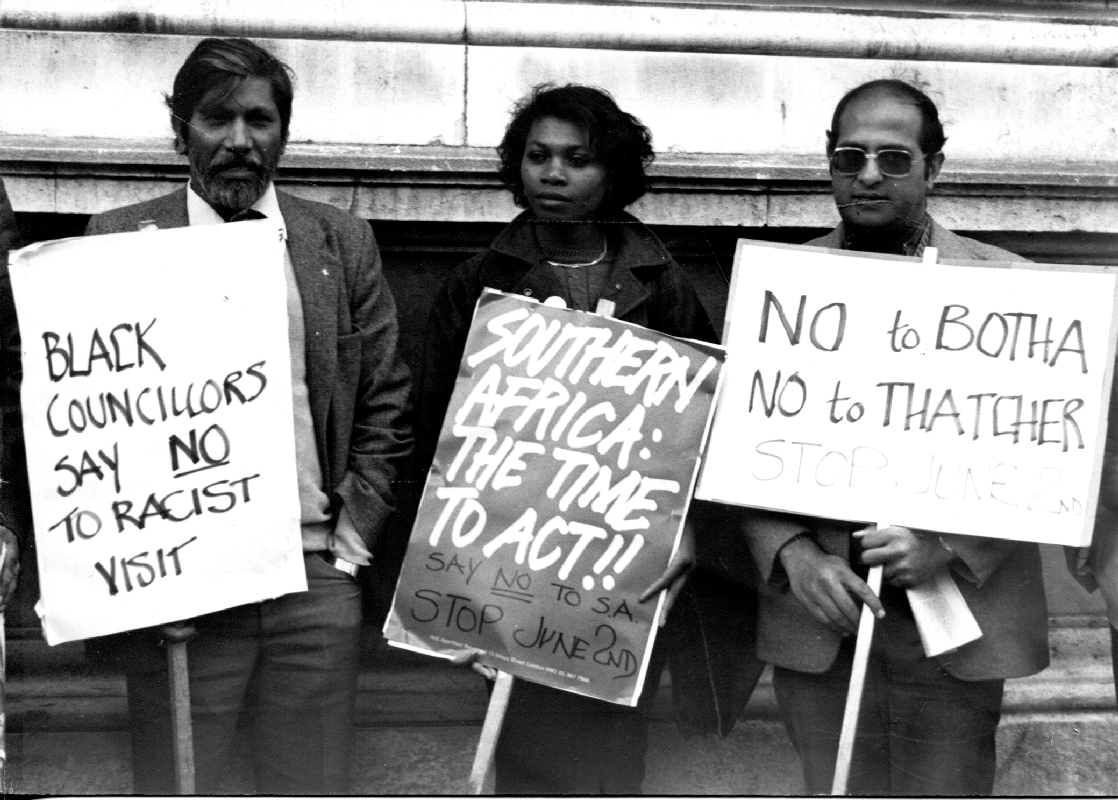
Three local councillors from London’s black community express their opposition to Botha’s visit to Britain in June 1984. Black organisations were prominent in the opposition to the visit. They formed a special mobilising committee and there were many articles in the London black press. The West Indian Standing Conference held on all-night vigil on 1–2 June.

Bernadette Vallely- Anti-Apartheid Movement Archives

Further information for Anti-Apartheid & The Ministry of Defence (Stop 5)

Visit our Layers of London ‘Anti-Apartheid London Digital Map’ information point for Ministry of Defence

Route information: Between The Ministry of Defence (Stop 5) and Downing Street (Stop 6)

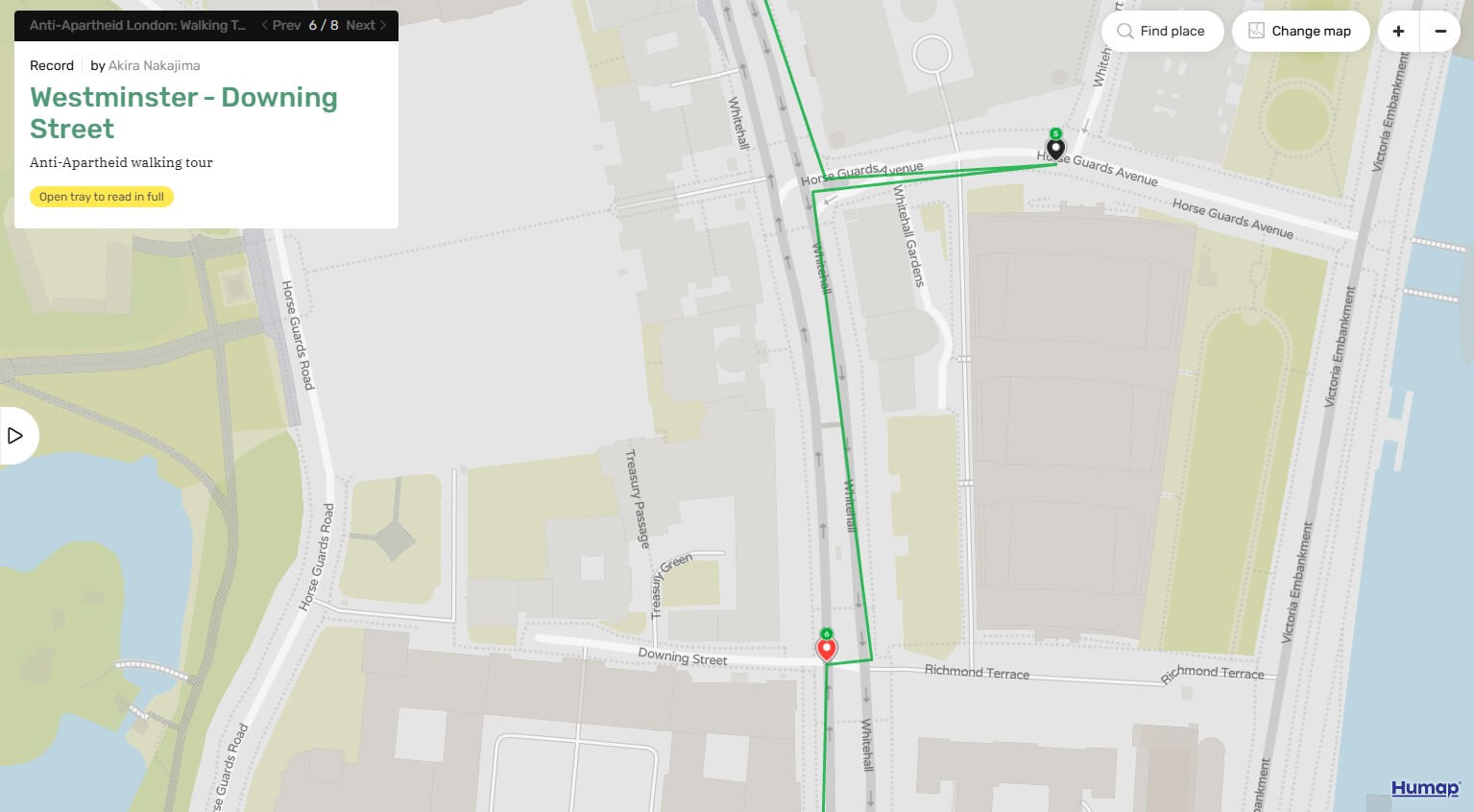
From the Ministry of Defence on Horse Guards Avenue, return to Whitehall and continue south towards Downing Street.

This short stretch takes you through the heart of British government. Along Whitehall, you pass the headquarters of state power — departments responsible for defence, foreign affairs and the civil service — the institutions that shaped Britain’s political and economic relationship with apartheid South Africa.

Ahead, you will reach the highly secured gates connecting Downing Street to Whitehall. The area is heavily guarded by armed police, and while Downing Street is technically a public right of way, access is now strictly limited to those with official government or press clearance. The gates and the iconic façade of Number 10 can be clearly seen from Parliament Street, outside the security perimeter.

If the area is particularly busy or crowded, we recommend staying on the opposite side of Whitehall to view the gates and continue the stop from there. This offers a safer and often clearer vantage point.

As you walk, consider how anti-apartheid campaigners repeatedly moved through these same streets: from direct protest outside government buildings to formal lobbying, petitions and public pressure aimed at changing British policy. The next stop shifts the focus from military cooperation to political leadership itself.

Stop 6: Downing Street (SW1A 2HB)

Theme: Sanctions, political pressure and the limits of government support

Standing outside (or opposite) the gates of Downing Street, this stop focuses on one of the Anti-Apartheid Movement’s most persistent campaigns: pressuring the British government to impose sanctions on South Africa.

Throughout its history, the AAM combined public protest with political lobbying. Campaigners wrote letters, organised petitions, met ministers, gave evidence to parliamentary inquiries and worked with MPs and local councils to push for change. By the 1980s, the question was no longer whether apartheid was wrong, but how Britain should respond.

For the AAM, the answer was clear: sanctions.

Economic sanctions, they argued, would force the apartheid government to negotiate by increasing the financial and political cost of racial rule. Across Britain, support for sanctions grew. In March 1985, representatives of 45 British local authorities gathered here at Downing Street to deliver a petition calling for stronger action against South Africa. Their presence reflected how anti-apartheid solidarity had spread beyond activist groups into local government, trade unions, churches and wider civil society.

Yet the British government, led by Margaret Thatcher, remained firmly opposed. While Thatcher publicly criticised apartheid, she rejected broad sanctions, arguing they would damage British trade and investment. This put her government increasingly at odds with anti-apartheid campaigners, much of the Commonwealth, and growing international opinion.

Downing Street therefore became an important site of confrontation — not only symbolically, but politically. Demonstrations here challenged the government’s refusal to act and highlighted Britain’s continuing economic ties to apartheid.

The black security gates you see today were installed in 1989, originally in response to threats from the Provisional IRA. But even before then, this narrow entrance was a key visual marker of political power — one that anti-apartheid activists repeatedly targeted to demand accountability.

Standing here, the distance between the street and the Prime Minister’s door feels short. For campaigners, that proximity mattered: it represented the possibility — and frustration — of trying to force government to act against injustice.

Standing outside the gates to Downing Street, or if too crowded, stay on the Horse Guards Avenue side of Whitehall to view, before crossing over to continue the route.
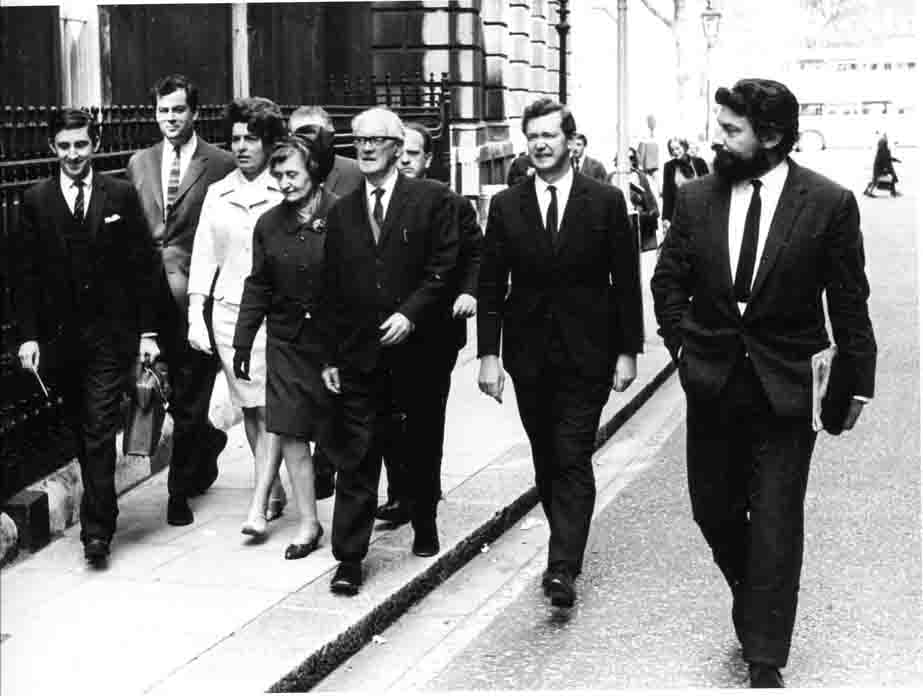
A delegation of MPs on their way to 10 Downing Street to hand in a letter protesting at a visit by three British warships to Cape Town in June 1967. A motion ‘regretting the visit’ was tabled in the House of Commons and a lobby of Parliament took place on 31 May. Left to right: Liberal MP and President of the AAM David Steel, Liberal MP John Pardoe, Labour MPs Joan Lestor, Joyce Butler and Hugh Jenkins, Lord Brockway, and Labour MPs Frank Judd, Michael Barnes and Andrew Faulds.

Anti-Apartheid Movement Archives

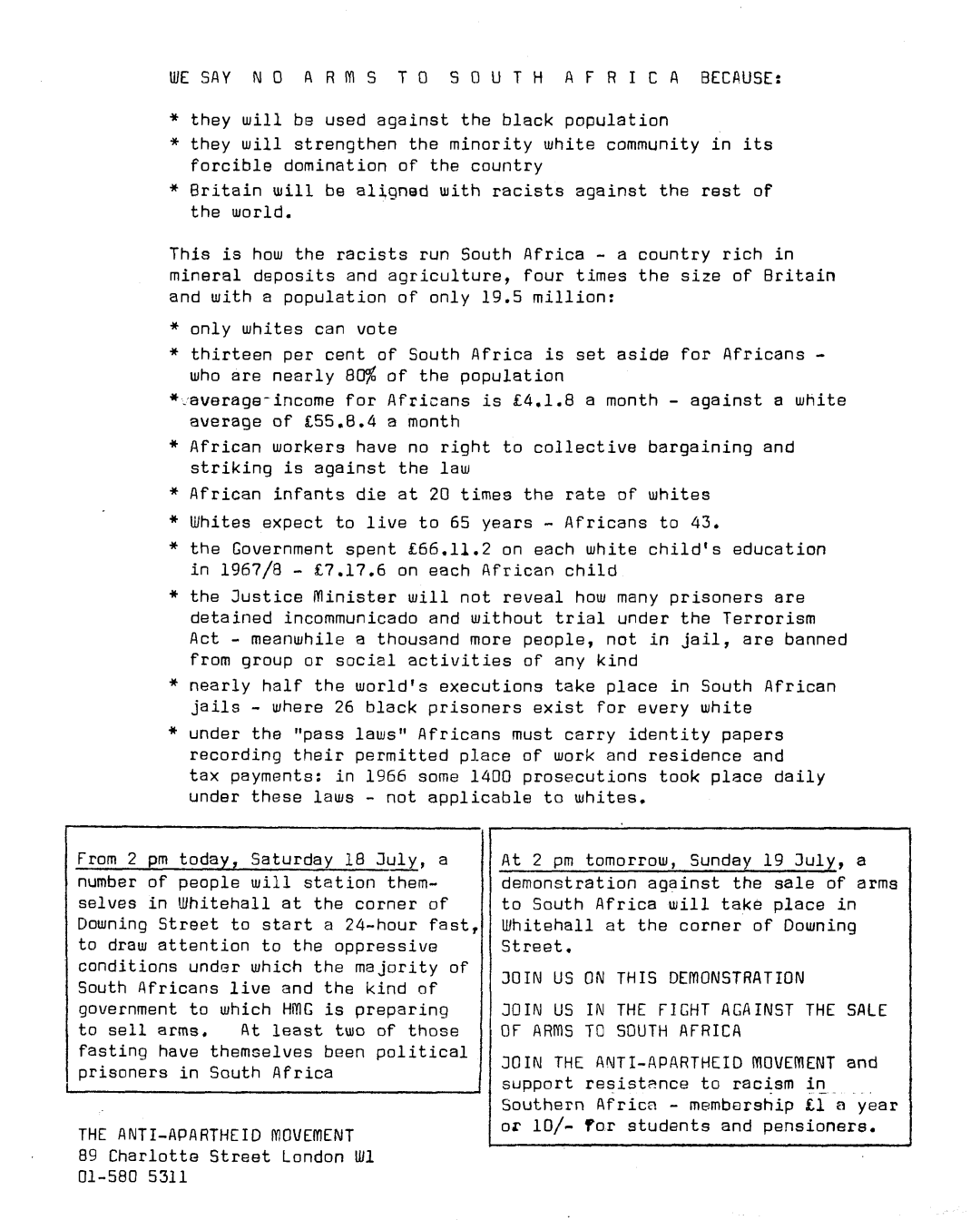
One of the first decisions of the Conservative government elected in June 1970 was to resume arms sales to South Africa. The AAM immediately appealed to people in Britain to oppose the decision. This leaflet publicised a 24-hour protest fast in Downing Street by former South African political prisoners. In 1971 a Gallup poll found that 71 per cent of people surveyed were opposed to arms sales.

Anti-Apartheid Movement Archives

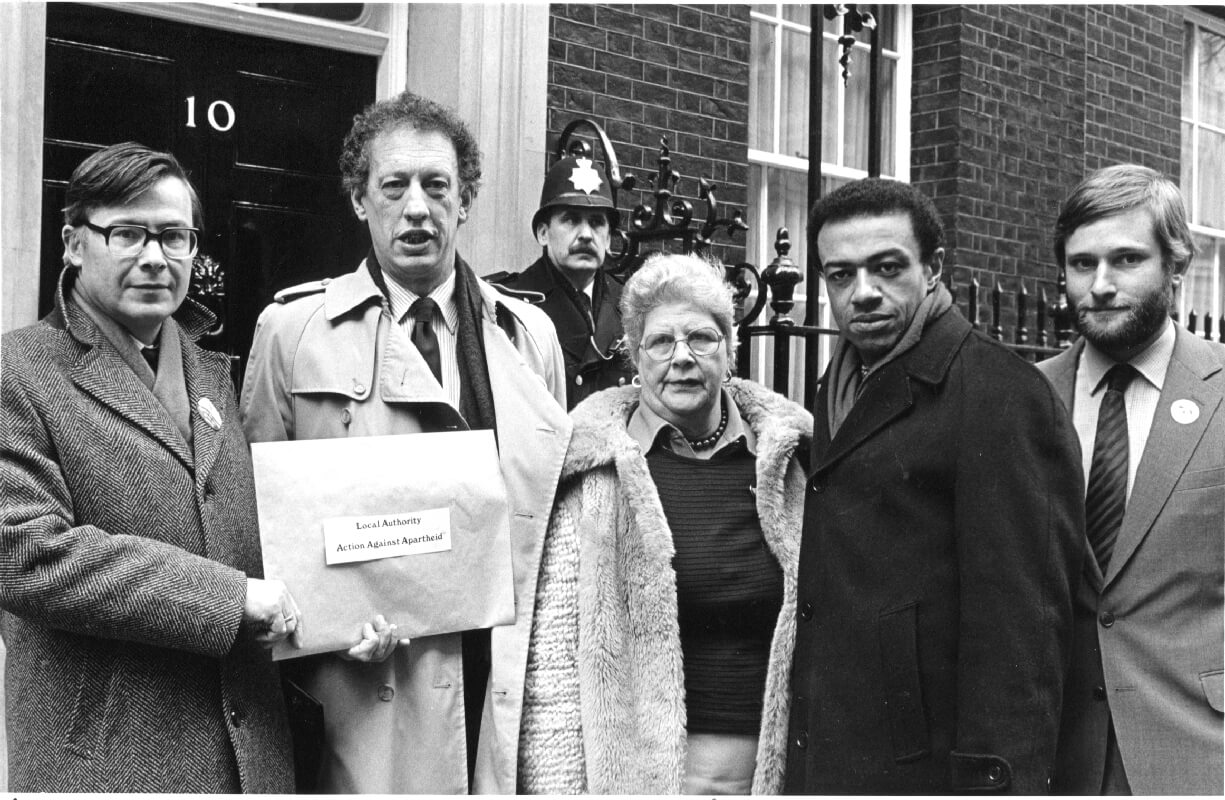
Local councillors handed in a petition for sanctions to the Prime Minister at 10 Downing Street on 18 March 1985. The petition was supported by 42 councils. Local authorities all over Britain organised exhibitions and film shows and supported local AA group activity during a week of action against apartheid, 18–22 March. Left to right: Councillors Mike Pye (Sheffield), Phil Turner, Phyllis Smith (Sheffield), Paul Boateng (GLC) and Hugh Bayley (Camden).

André De Wet – Anti-Apartheid Movement Archives

Further information for Anti-Apartheid & Downing Street (Stop 6)

Visit our Layers of London ‘Anti-Apartheid London Digital Map’ information point for Downing Street

Route information: Between Downing Street (Stop 6) and Church House (Stop 7)

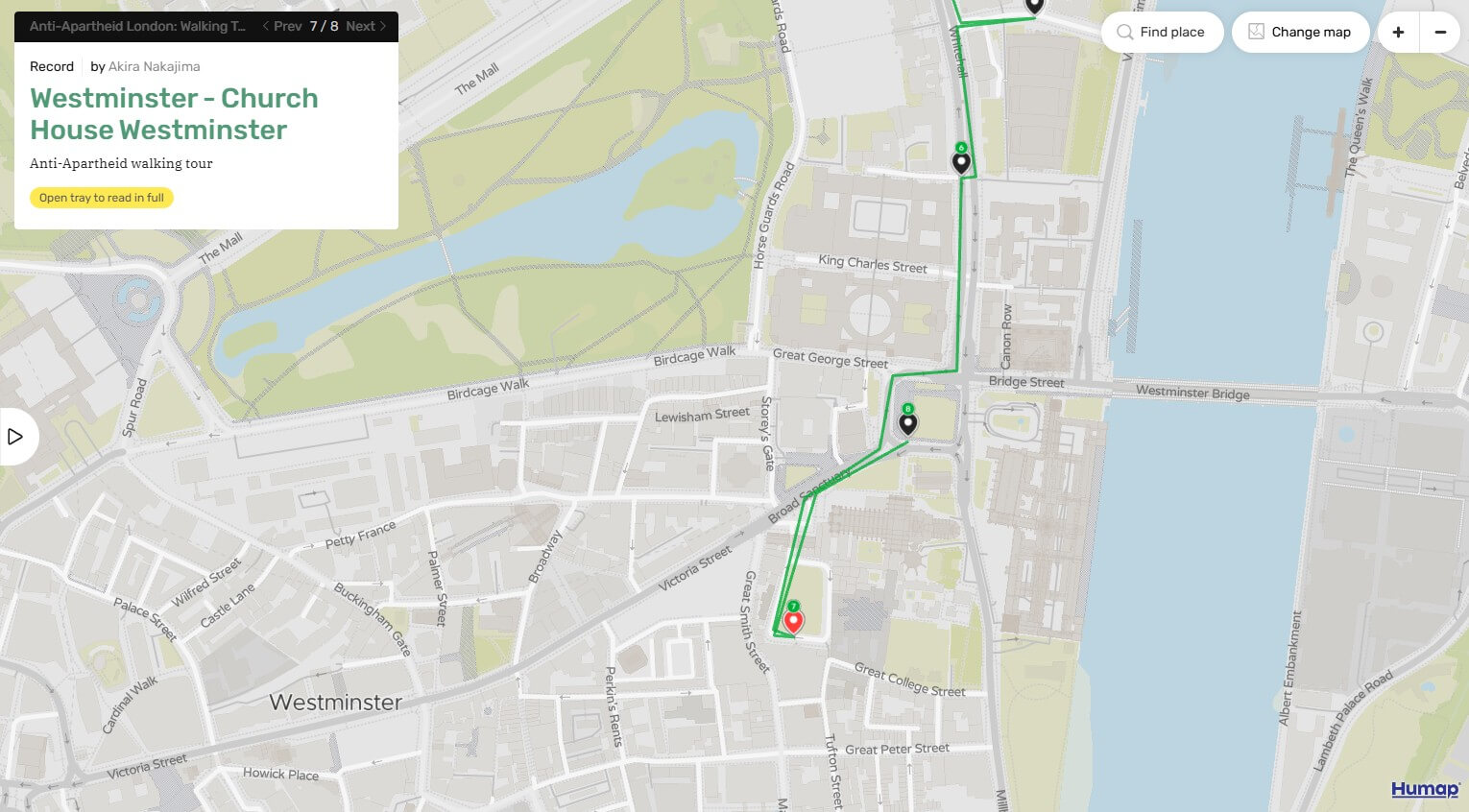
From the gates of Downing Street, continue south along Whitehall and keep left on Great George Street. Cross over the road, using the small traffic island between George Street and Parliament Square, and walk around the side of Parliament Square (likely to be quieter on the green side with the statue of Abraham Lincoln on your right). Cross over towards the Abbey and go right. With the front of Westminster Abbey on your left, walk past it and go through the archway into the grassy open space of Dean’s Yard. Continue across the yard towards Church House, on the far side of the green.

This part of the route moves away from the formal centres of executive power into a quieter space shaped by religious and civic life. The contrast is important: anti-apartheid activism was not only fought in government offices and on the streets, but also through churches, charities and civil society networks that helped widen support for sanctions and international solidarity. Dean’s Yard offers a moment of pause before the next stop, reflecting on how these different spheres of influence worked together in the struggle against apartheid.

Stop 7: Church House (SW1P 3NZ)

Theme: Faith, finance and widening the anti-apartheid coalition

This stop explores how the anti-apartheid struggle in Britain expanded beyond activist circles into churches, charities and broader civil society.

From its earliest years, the Anti-Apartheid Movement sought to build the widest possible support for ending Britain’s links with apartheid South Africa. But for many years, the relationship with Britain’s churches was complicated. Some church leaders were reluctant to support sanctions, viewing the South African liberation movements as too closely aligned with Marxist or left-wing politics. Others were hesitant because of institutional ties — including financial investments in companies operating in South Africa.

Yet there were important exceptions. The Methodists and the Quakers were among the strongest early supporters of anti-apartheid campaigning, helping to sustain moral and practical solidarity when wider church support remained limited.

By the late 1980s, this began to shift. In September 1989, Church House hosted the launch of the Southern Africa Coalition — a broad alliance bringing together churches, trade unions, aid agencies and the Anti-Apartheid Movement itself. This marked an important breakthrough, showing how anti-apartheid solidarity had grown into a much wider movement that crossed political, religious and institutional boundaries.

The Coalition focused on selective sanctions, particularly the issue of bank loans to South Africa. By this point, financial pressure had become one of the most effective tools against the apartheid economy. In 1985, the American bank Chase Manhattan had cut off loans to South Africa — a major blow that exposed the regime’s economic vulnerability. Campaigners here worked to ensure British and international banks would not step in to replace that support.

Standing at Church House, in the shadow of Westminster Abbey and close to Parliament, this stop reminds us that the struggle against apartheid was fought not only through marches and demonstrations, but also through moral persuasion, financial campaigning and the building of unlikely alliances. By the end of the 1980s, that broad coalition helped make apartheid increasingly unsustainable.

Find Church House at the far side of the Dean’s Yard. Pay attention to signage which lets you know if you can or cannot stand on the grass in the centre of the yard.
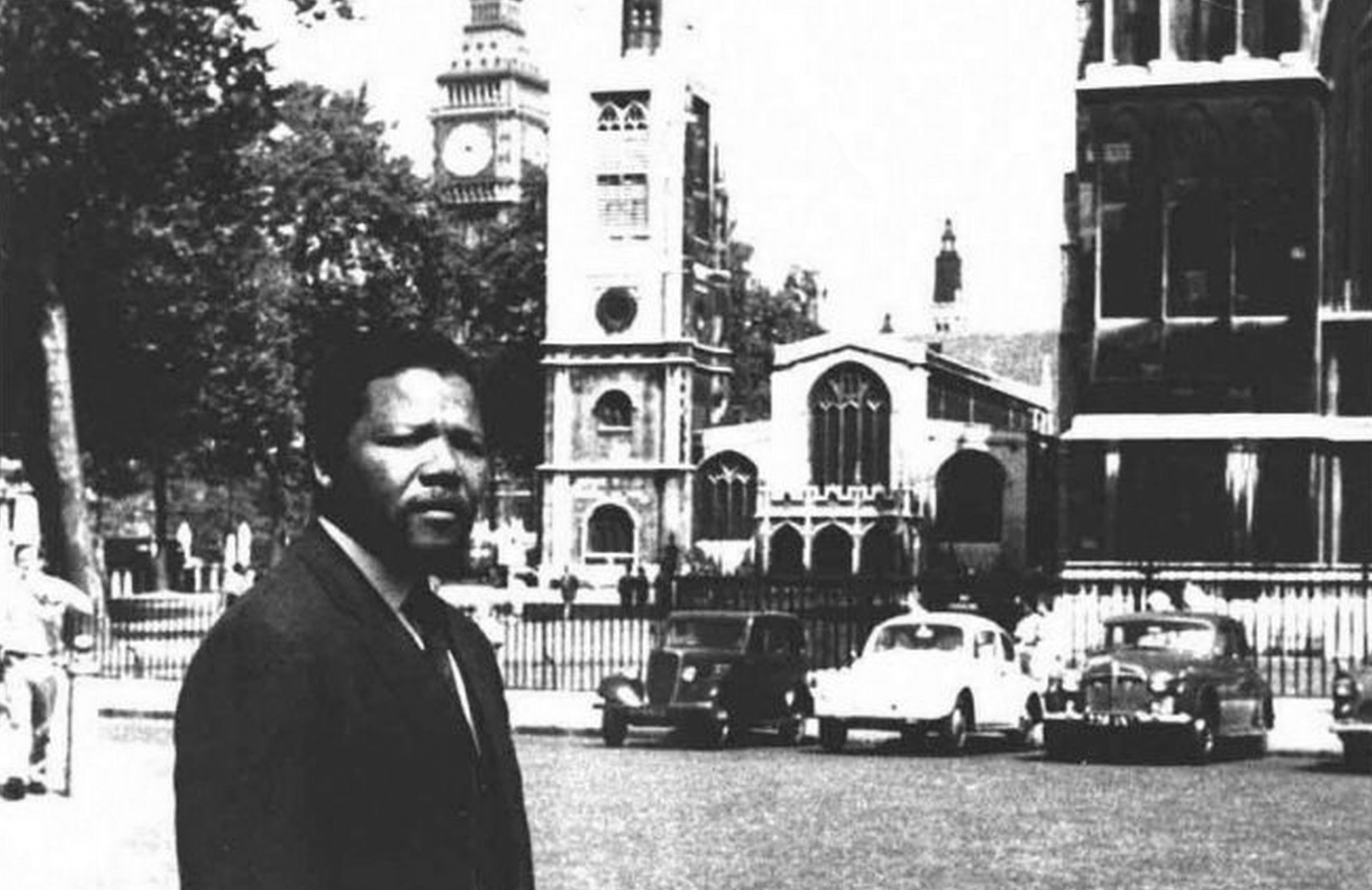
Nelson Mandela outside Westminster Abbey in 1962, during a cIandestine visit to the London build international support for the ANC and uMkhonto weSizwe. He stayed with Oliver Tambo, exiled-ANC leader who was living in Haringey.
International Defence and Aid Fund / Rex Features
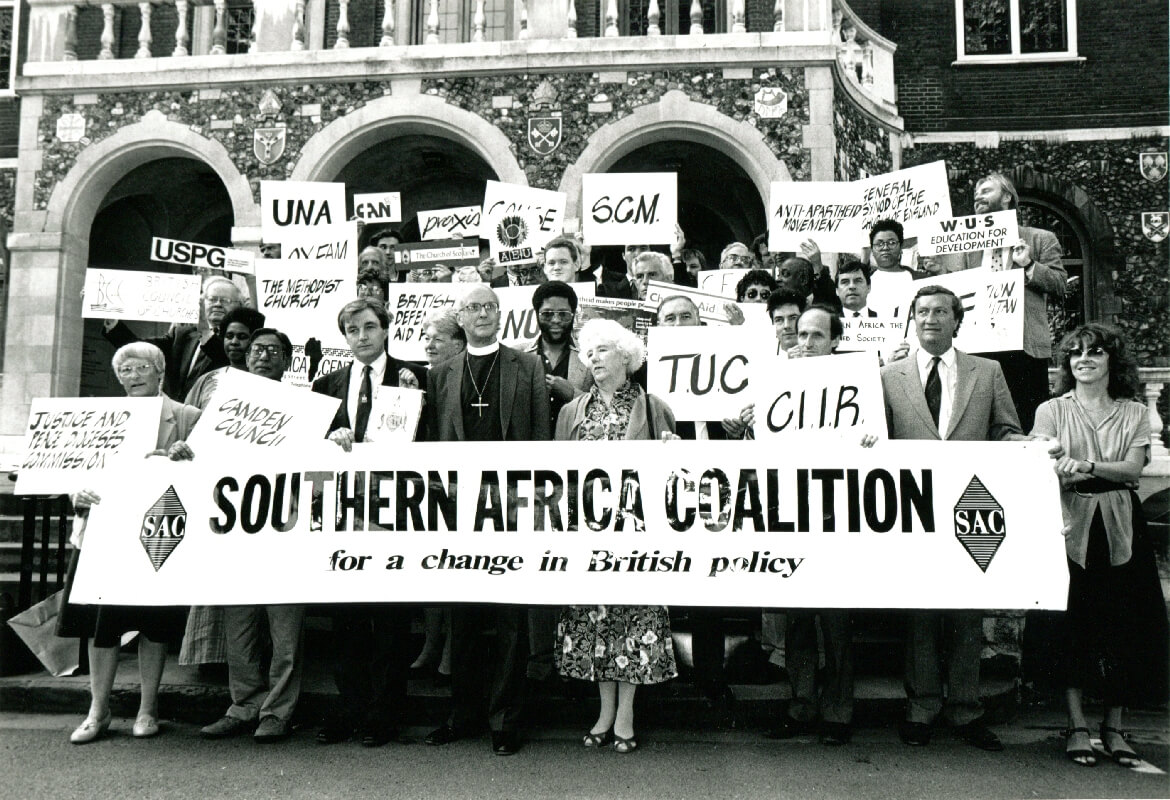
The Southern Africa Coalition was launched on 1 September 1989 to press the British government to impose targeted sanctions against South Africa. These included a ban on imports of coal and agricultural products and on loans to South Africa. The Coalition brought together a wide range of organisations, including trade unions, churches, overseas aid agencies and the Anti-Apartheid Movement
James Hawkins/Oxfam – Anti-Apartheid Movement Archives
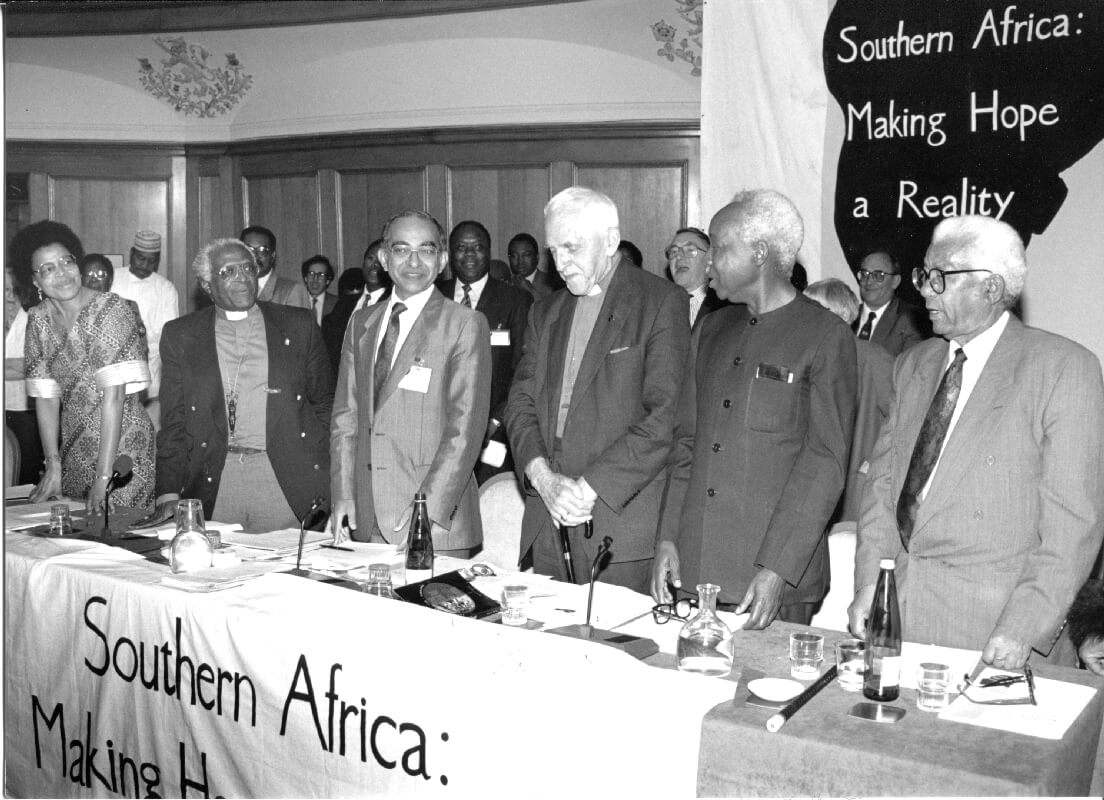
A conference organised by the AAM in London in June 1993 discussed post-apartheid solidarity and mapped out a new agenda of support for the people of Southern Africa. The conference was convened by AAM President Trevor Huddleston and the former President of Tanzania, Julius Nyerere, with the support of the UN Special Committee against Apartheid. The main speakers were Walter Sisulu and Archbishop Desmond Tutu. Left to right: Graca Machel, Desmond Tutu, Abdul Minty, Trevor Huddleston, Julius Nyerere and Walter Sisulu.

Rod Leon – Anti-Apartheid Movement Archives

Further information for Anti-Apartheid & Church House (Stop 7)

Visit our Layers of London ‘Anti-Apartheid London Digital Map’ information point for Church House

Route information: Between Church House (Stop 7) and Parliament Square (Stop 8)

From Church House, walk back across Dean’s Yard and retrace your steps through the archway, with Westminster Abbey on your right as you return towards Parliament Square. Cross carefully at the designated crossings and make your way to the Nelson Mandela statue on the square’s south-west corner.

As you walk, it is worth remembering that Mandela’s relationship with London stretched much further back than his celebrated return in 1990. In 1962, on his first visit to the city, he travelled secretly under the alias David Motsamayi, meeting political allies, building international support for the ANC and its newly formed armed wing, uMkhonto we Sizwe (MK), and reconnecting with Oliver Tambo, who was already leading the ANC’s external mission from exile.

This route back towards Parliament Square retraces part of that wider political geography — from the churches and civic networks that helped build solidarity, back into the heart of British political power, where Mandela’s legacy now stands permanently inscribed in bronze.

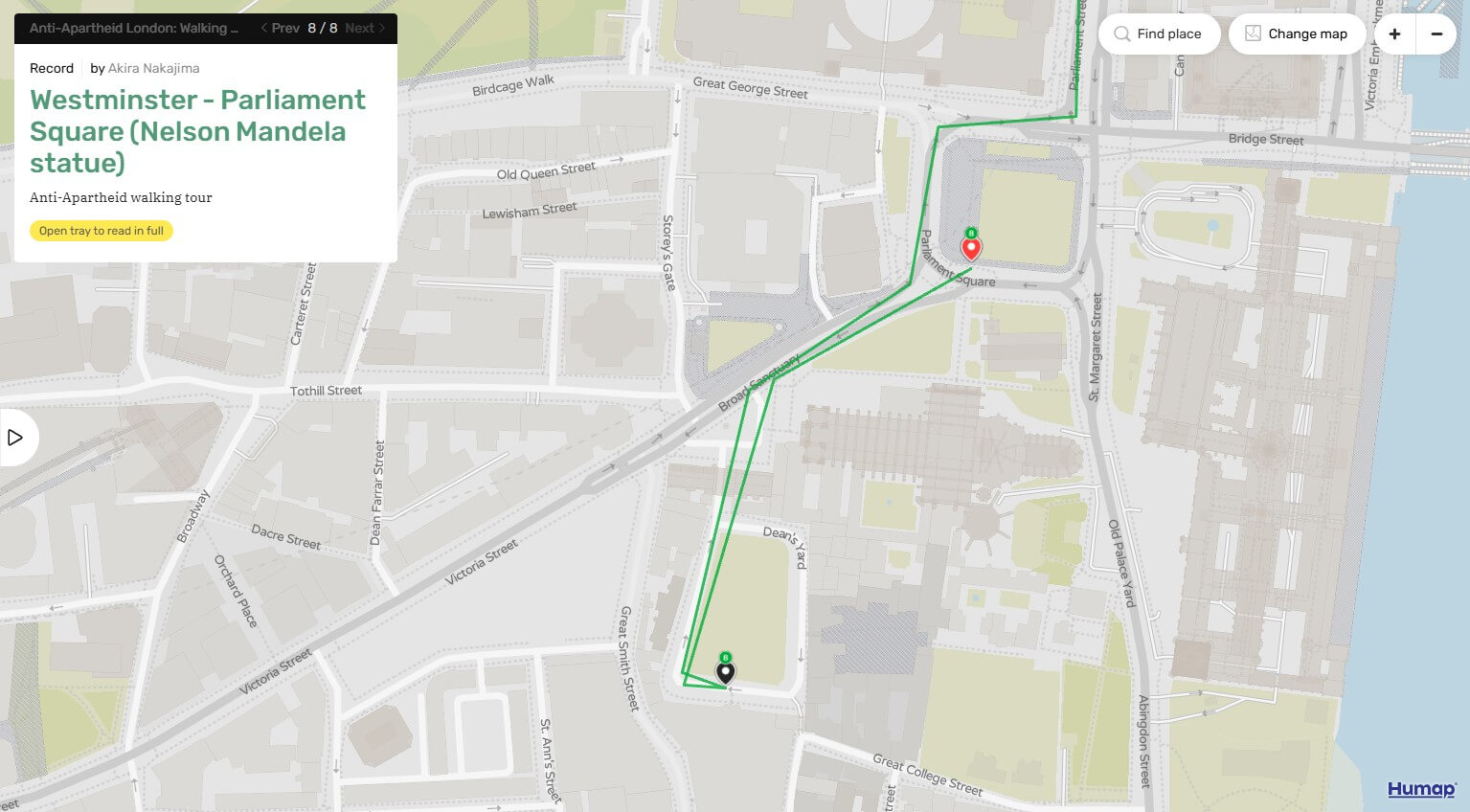
Stop 8: Parliament Square – Mandela Statue (SW1P 3JX)

Theme: Free Nelson Mandela — from campaign symbol to public memory

This final stop brings together one of the Anti-Apartheid Movement’s most powerful and enduring campaigns: the global struggle to free Nelson Mandela.

By 1980, a campaign for Mandela’s release had begun inside South Africa and quickly spread across the world. In Britain, Mandela became the human face of the anti-apartheid struggle. The demand to “Free Nelson Mandela” appeared on posters, banners, badges and petitions, transforming a political prisoner into an international symbol of resistance.

Support for Mandela in Britain grew dramatically during the 1980s. Streets, gardens and public spaces were renamed in his honour, with Glasgow becoming the first British city to grant him the Freedom of the City in 1981. More than 2,000 mayors worldwide signed declarations calling for his release.

The campaign reached its global high point in 1988 with the Nelson Mandela 70th Birthday Tribute Concert at Wembley Stadium. Broadcast to more than sixty countries, it transformed Mandela’s imprisonment into a truly international cause and brought anti-apartheid politics into millions of homes. Days later, thousands gathered in Hyde Park and St James’s Piccadilly for rallies and services, with cards and messages of solidarity delivered to South Africa House.

Mandela was released on 11 February 1990 after 27 years in prison. Just two months later, he returned to London, where he was welcomed at a second Wembley concert and thanked the British Anti-Apartheid Movement, describing its support as “a source of real inspiration.”

his statue stands here because campaigners argued that Parliament Square — the symbolic centre of British political life — was the most fitting place to commemorate Mandela. Its location was debated for years, with earlier proposals including Trafalgar Square and South Africa House, before Westminster Council finally approved this site in 2007.

The campaign to establish the statue was led over many years by Wendy Woods, widow of anti-apartheid journalist and activist Donald Woods, alongside supporters including Lord Richard Attenborough, who argued that Mandela’s place in world history deserved recognition at the heart of British political life. Their efforts turned the statue itself into part of the continuing story of anti-apartheid memory and public recognition.

That location matters. Parliament Square is filled with statues of political power: British prime ministers such as Winston Churchill, David Lloyd George and Benjamin Disraeli, alongside international figures including Abraham Lincoln, Mahatma Gandhi — and Jan Smuts, the South African statesman, imperial military leader and one of the architects of racial segregation whose policies helped lay foundations for apartheid.

To place Mandela here, in conversation with Smuts and these other political figures, is deeply significant. It marks a shift not only in South Africa’s history, but in Britain’s public memory: from celebrating imperial and colonial power to recognising those who fought against racial oppression.

At the statue’s unveiling in 2007, Mandela recalled that during his secret visit to London in 1962, he and Oliver Tambo had joked about the idea of a Black man one day standing in Parliament Square. Nearly half a century later, that improbable conversation had become part of London’s landscape.

The statue makes visible just how much had changed — and how much had been fought for. Mandela, once imprisoned and condemned by the apartheid state, now stands here facing the Houses of Parliament: not as a symbol of empire, but as a reminder of the power of collective resistance to transform history.


Stand as close as the likely crowds of visitors to Parliament Square will allow you to get to the statue of Nelson Mandela.
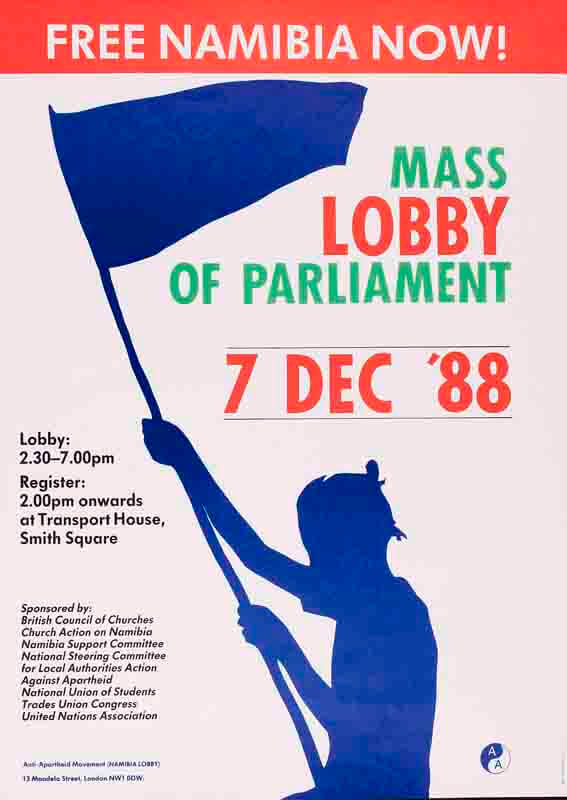
Poster for a mass lobby of Parliament in December 1988, during the final stages of negotiations for Namibian independence. Gathering in Parliament Square before moving into the House of Commons, hundreds of campaigners urged the South African government not to renege on its commitments, while calling for continued international support for an independent Namibia. The meeting inside Parliament was addressed by SWAPO leaders and former Foreign Secretary David Owen.

Anti-Apartheid Movement Archives

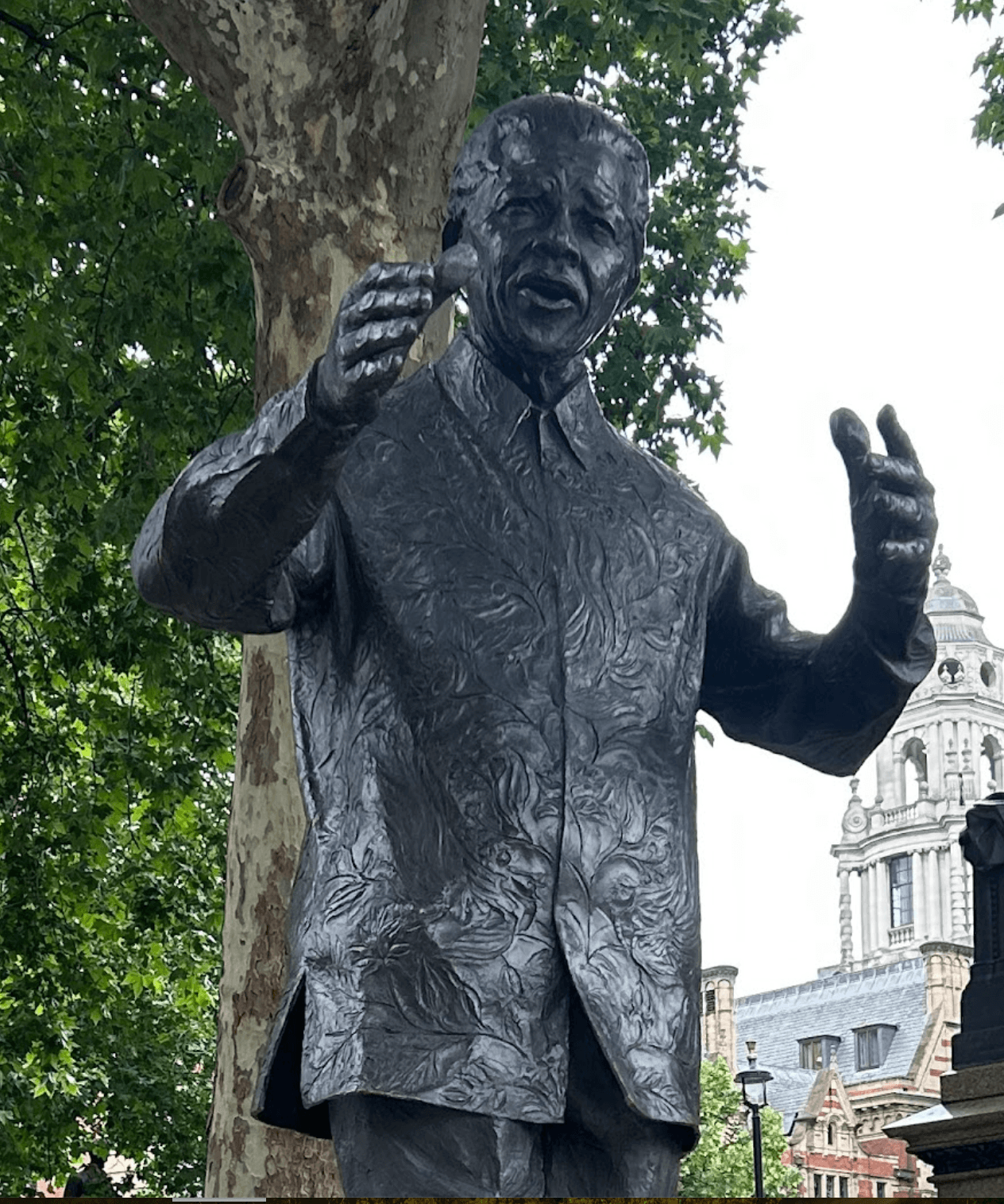
Nelson Mandela’s statue in Parliament Square, sculpted by Ian Walters and unveiled in 2007, a year after the artist’s death. Walters — who also created the bust of Mandela outside the Southbank Centre — chose to depict him in his trademark patterned “Madiba shirt” rather than formal political dress, emphasising the humanity and individuality that made Mandela a global symbol of resistance, dignity and reconciliation.
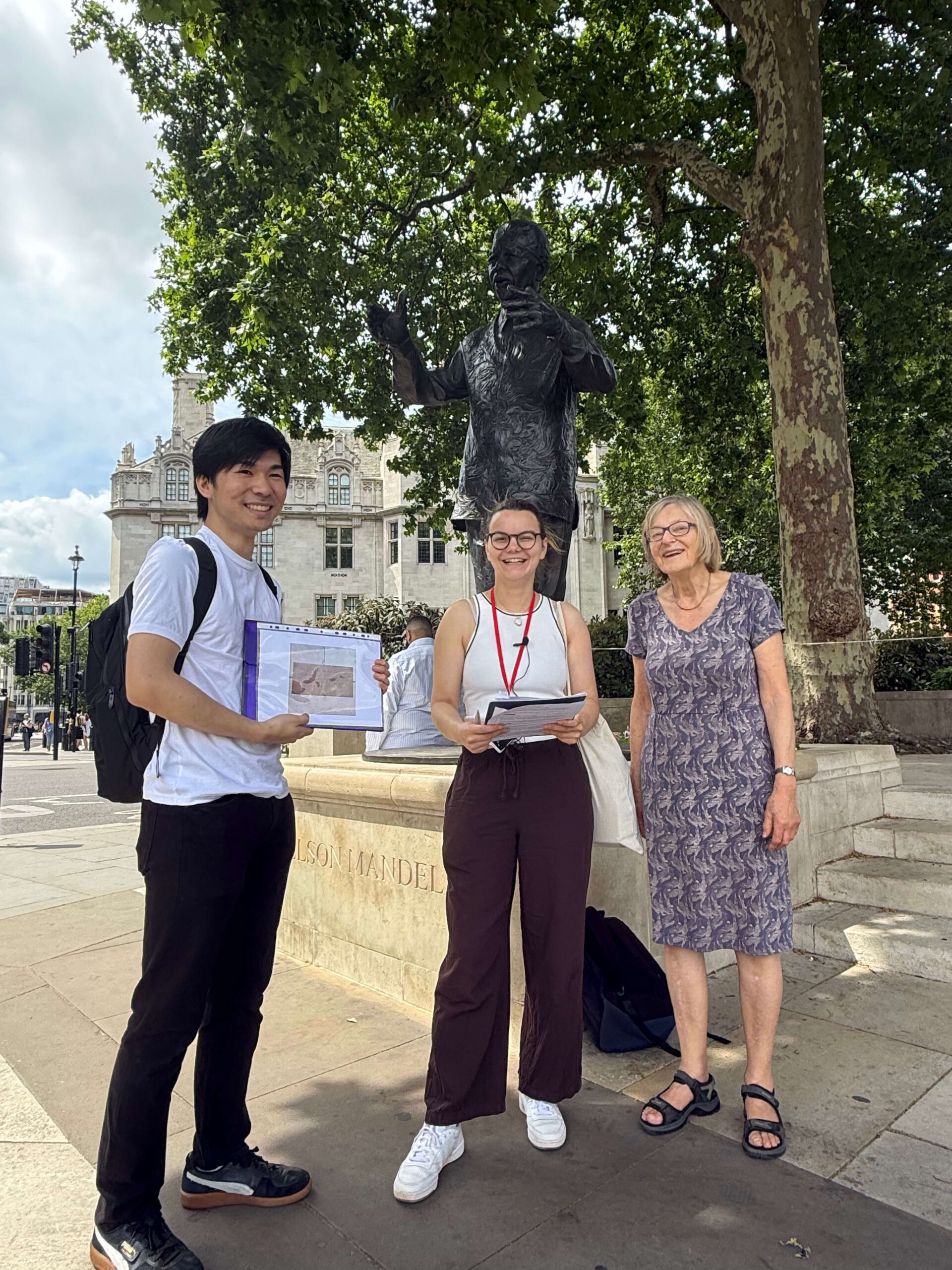
L-R) Akira Nakajima, Dr Julie Partsch, Christabel Gurney in front of the Nelson Mandela statue on Parliament Square, 2026.
The statue was unveiled by Prime Minister Gordon Brown at a ceremony attended by Nelson Mandela and his wife Graça Machel on 29 August 2007. “We thank the British people once again for their relentless efforts in supporting us during the dark years. When Oliver Tambo and I visited Westminster Abbey and Parliament Square in 1962, we half-joked that we hoped that one day a statue of a black person would be erected here,” Mandela said.

Further information for Anti-Apartheid & Parliament Square (Stop 8)

Visit our Layers of London ‘Anti-Apartheid London Digital Map’ information point for Parliament Square – Mandela Statue

Route information: Between Parliament Square (Stop 8) and The Mall (End of Route)

From the Nelson Mandela statue in Parliament Square, continue up the north-west side of Parliament Square, cross back over Great George Street and walk left until you come to the corner of St James’s Park. Walk north east along the edge of St James’s Park, following the path towards The Mall.

This final stretch offers a quieter space to reflect on the stories of resistance, solidarity and political change encountered along the walk. As you move through the park, consider the contrast between these spaces of royal ceremony and the struggles for liberation and justice that unfolded nearby.

Emerging onto The Mall — the ceremonial route linking Buckingham Palace to Trafalgar Square — you arrive at a place closely tied to monarchy, state spectacle and imperial history. It is also the site of one of the most iconic images of the post-apartheid era: Nelson Mandela riding in an open carriage with Queen Elizabeth II during his first State Visit to the UK in 1996. The photograph (not shown here for reasons of copyright permissions but easily found online) captured a profound political transformation — from Mandela as a banned and imprisoned “terrorist” in the eyes of many Western governments, to being welcomed here as the democratically elected President of South Africa.
Ending the route here offers a powerful reminder of how far that struggle travelled — and how public memory can transform alongside political change.

Exhibition Feedback

We’d love to hear your feedback and comments on the exhibition, whether you have been able to visit the exhibition as it tours around the UK, and/or have engaged with it online here.

Completing this short survey will take just a few moments of your time and all feedback is really helpful in order for us to understand more your engagement with the themes of the exhibition and the artwork – thank you.

Click here for the feedback survey.

Scan the QR code to access the feedback survey

Supported by the University of Oxford’s Knowledge Exchange Seed Fund and the Department of Education, the Anti-Apartheid London Digital Map project maps more than fifty sites across London connected to anti-apartheid activism, resistance and international solidarity. Combining archival research, public history and digital storytelling, the project preserves these interconnected histories while making them accessible to wider audiences.

Delivered through a close partnership between the University of Oxford and the Anti-Apartheid Legacy Centre, the project brings together academic research, community knowledge and lived experience. Content for the map has been developed through a working group convened by the Centre, with project production led by Akira Nakajima.

The Anti-Apartheid Legacy Centre’s contribution to the project has also been supported through its National Lottery Heritage Fund programme, including research undertaken with six University of Oxford student interns in the Bodleian’s archives during 2025. The completed map will support school teaching, public learning and community engagement by grounding global solidarity and liberation histories in familiar local spaces.

The Anti-Apartheid London Digital Map is a partnership between the Anti-Apartheid Legacy Centre and the University of Oxford. The Anti-Apartheid Legacy Centre’s contribution to the project is supported by the National Lottery Heritage Fund. Thanks to National Lottery players, we are able to uncover, preserve and share these histories of resistance and solidarity with wider audiences.