

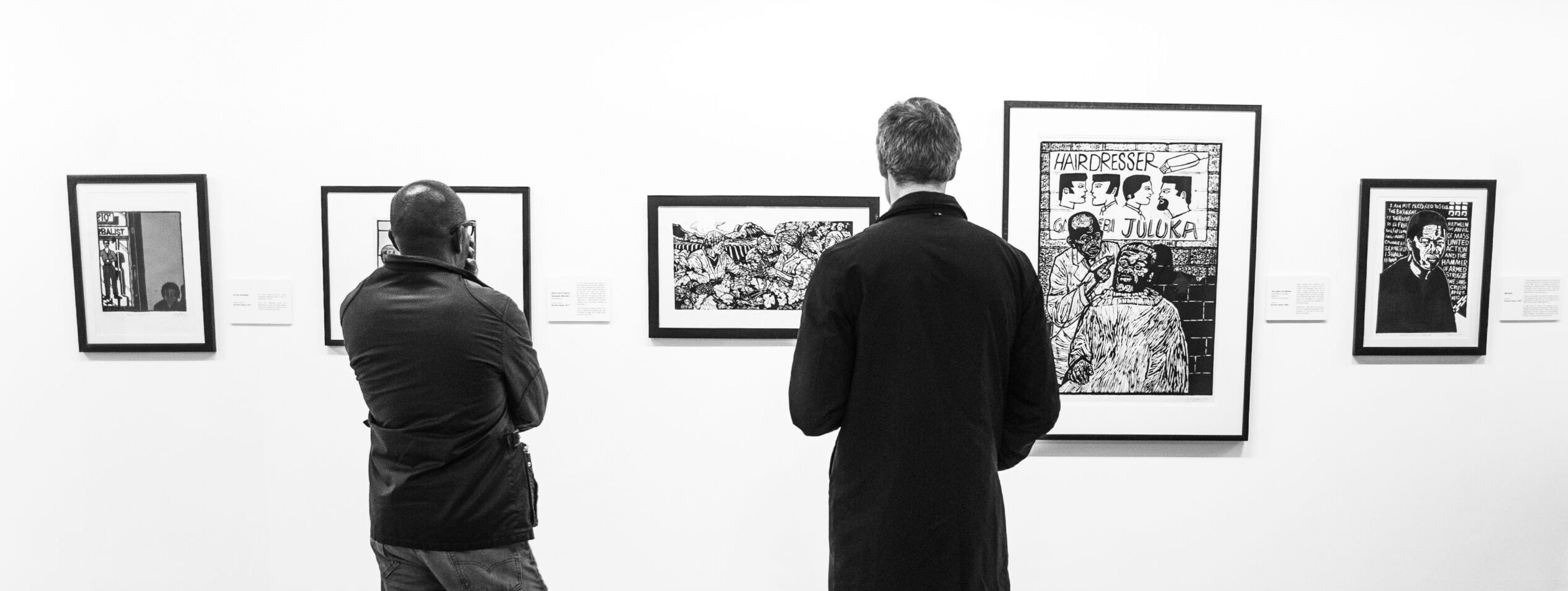
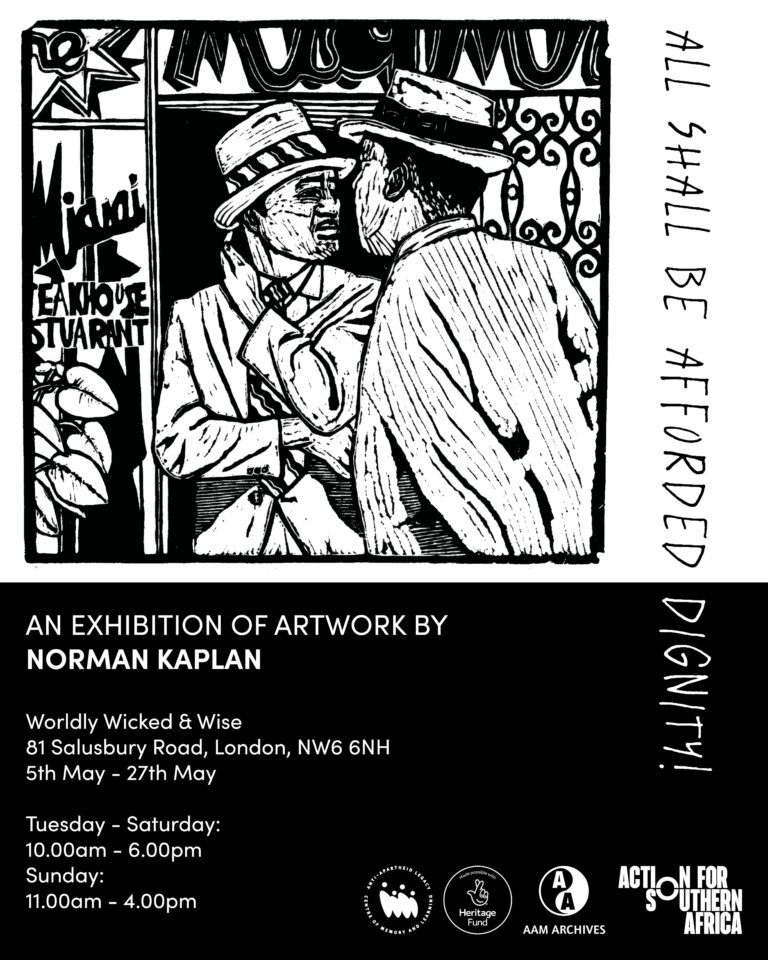
Norman Kaplan: All Shall Be Afforded Dignity! Worldly Wicked & Wise, Queen’s Park, London. 5th to 24th May, 2026.
‘Norman Kaplan: All Shall Be Afforded Dignity!’
This display of artwork commemorates the journey to democracy in South Africa, affirming the fundamental human right to dignity for all.
Norman Kaplan’s linocuts and prints speak to what life was like under the apartheid regime and remind us of the enduring relationship between art and protest.
‘All Shall Be Afforded Dignity!’ is curated around the work (of the same name) that artist Norman Kaplan made in 1996 in response to a call for art to celebrate the Constitution of the new democratic South Africa.
His linocut, Bill of Rights, was awarded the first prize honour and along with All Shall Be Afforded Dignity is engraved into a window in South Africa’s Constitutional Court, on permanent display.
Through sharing the linocuts as well as political and satirical cartoons made by Kaplan, during a career that spans apartheid South Africa, exile in the UK, and the hopes of post-liberation South Africa, this exhibition weaves a narrative that explores the interconnected themes of dignity, democracy, and the enduring human spirit. For an online showcase of the works visit https://antiapartheidlegacy.org.uk/resources/exhibitions/asbad/
‘All Shall Be Afforded Dignity!’ is a travelling exhibition that has been visited by over 15,000 people in nine locations across the UK in the last 18 months. For the first time in this iteration of ‘All Shall Be Afforded Dignity!’, a selection of Norman Kaplan’s recent linocuts is presented publicly. These new works turn to Palestinian land and people, foregrounding the realities of colonial dispossession alongside expressions of determination and resilience.
81 Salusbury Road
London, NW6 6HN
Free admission
Opening Hours
Tuesday to Saturday, 10am – 6pm
Sundays, 11am- 4pm
Access
Worldly Wicked & Wise is wheelchair accessible. There are no toilet facilities.
The gallery is situated a couple of minutes walk from Queen’s Park Station (Bakerloo Line and Lioness Line) and within 10 minutes walk from Brondesbury Park (Mildmay Line). A number of buses stop close by, including the 6, 36, 187, and 316.
Co-Programme and Workshops
Guided tours, thematically linked talks and creative response workshops engaging the exhibition and its themes can be arranged for interested groups.
We welcome enquires from alternative education providers, home educators, schools (KS3, KS4 and KS5/post 16), tertiary institutions and community facing/organised groups. Please email info@antiapartheidlegacy.org.uk to register your interest and to find out more.
For an online viewing of Norman Kaplan’s work visit the showcase on our website.
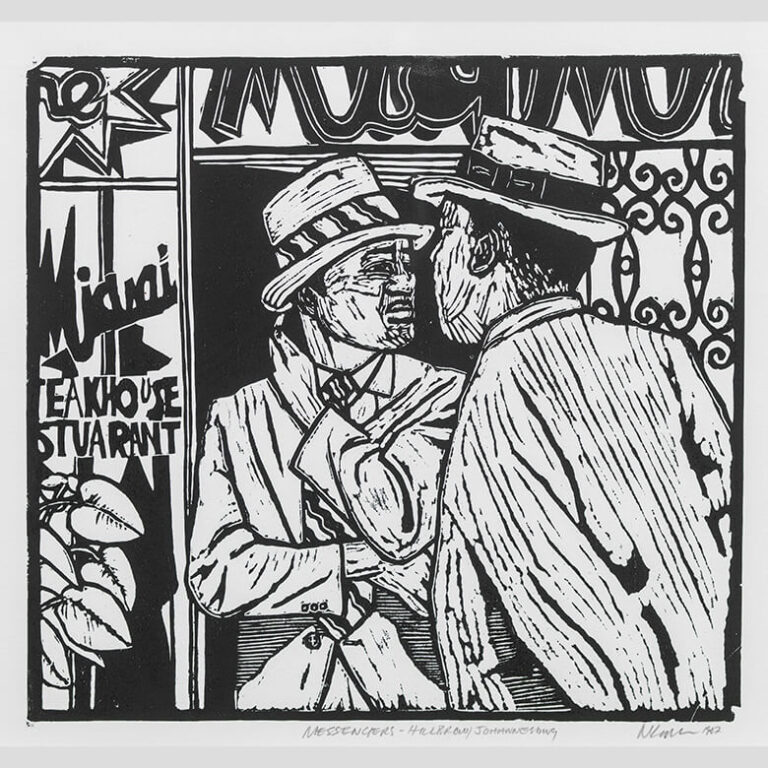
Messengers
Hillbrow, Johannesburg
Linocut on paper
Norman Kaplan, 1977
At that time, extensive use was made of male messengers in towns and cities. The men would be responsible for the delivery of letters, documents, parcels, purchases, etc. Despite their lowly wages, they were expected to be smartly turned out, supporting an extensive underground trade in expensive suits, shoes and hats.
Regardless of age and experience, messengers were always referred to as ‘boys’ – part of the deliberate ‘subordination’ strategy, along with the term ‘native’ for Black people (initiated by British colonialism). Africans had to call all whites, even children, ‘baas’ (boss) or madam.
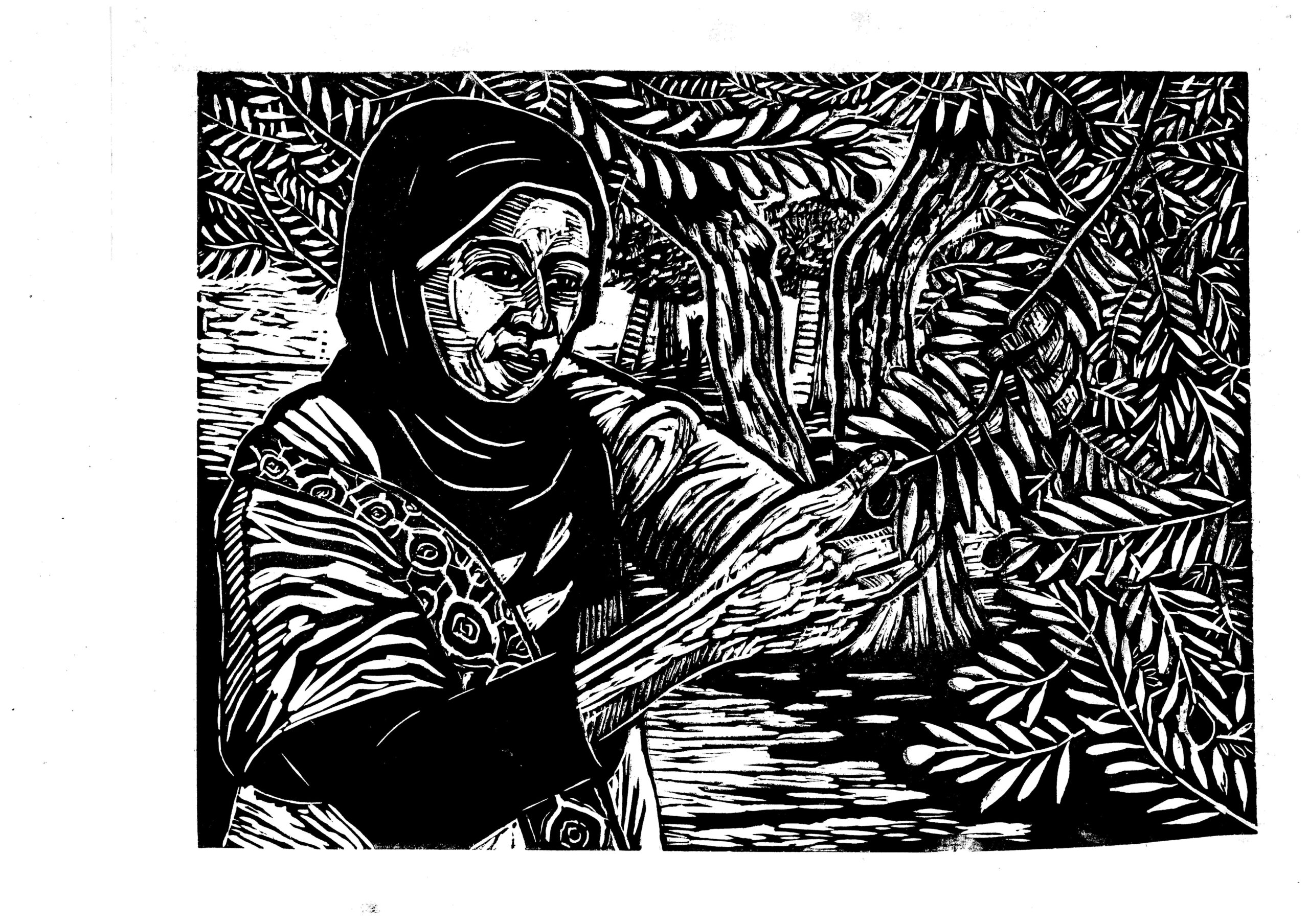
Palestinian Woman Picking Olives
Linocut on paper
Norman Kaplan, 2026
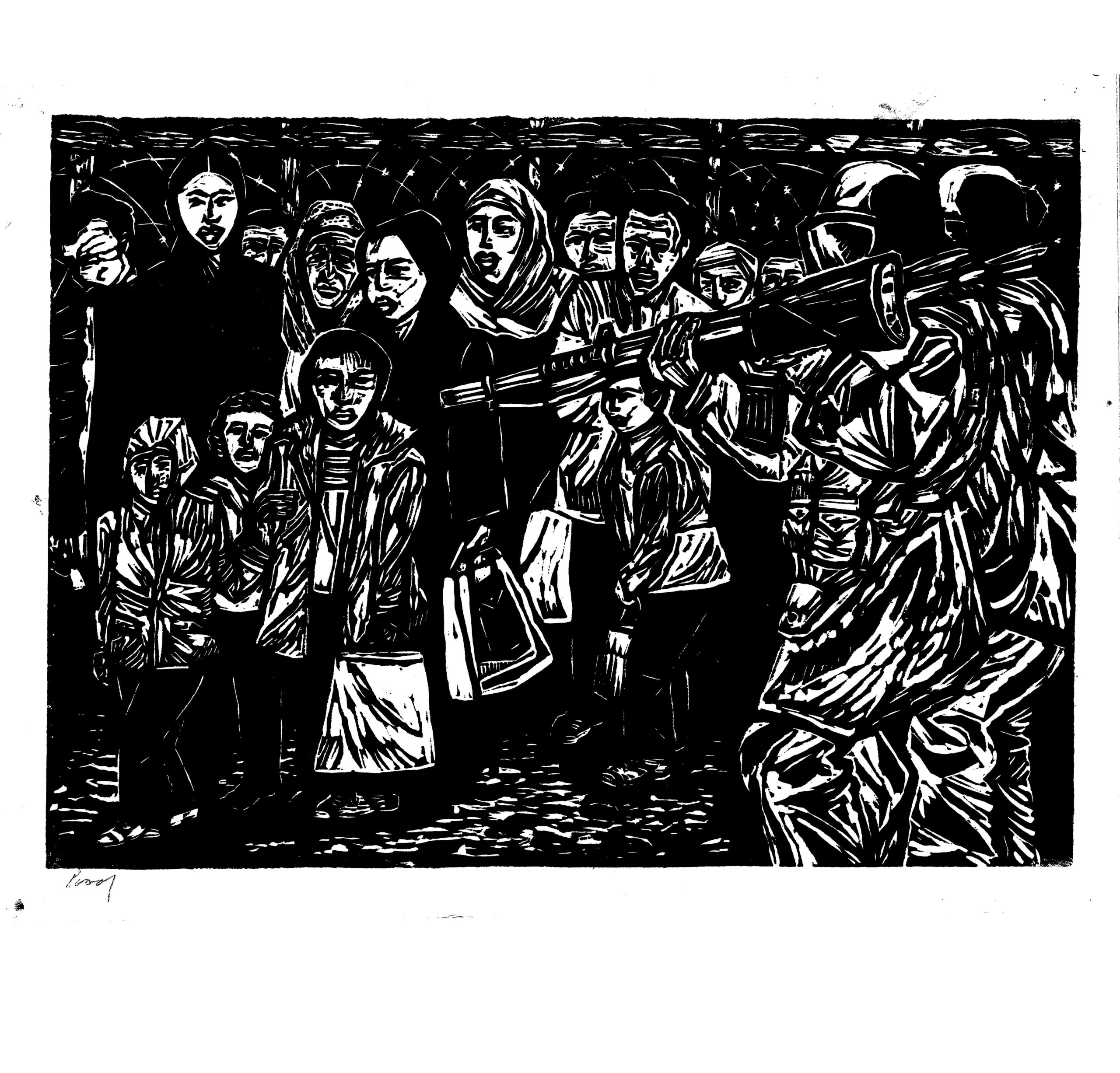
Gaza Checkpoint
Linocut on paper
Norman Kaplan, 2026
Statement from Norman Kaplan read at the opening of the exhibition of his prints and cartoons at John Wesley’s New Room, Bristol, 7th May 2025
Dear friends and comrades,
Statement from Norman Kaplan read at the opening of the exhibition of his prints and cartoons at Thin Ice Press, York, 6th March 2026
When I entered Art College, our graphics teacher set us a project. He asked us to write a short children’s story. We were then required to hand-letter a chapter and illustrate it with linocuts. This engendered in me a lifelong love of lino as a medium, printmaking and type. All of which, I am happy to see, are a mainstay of Thin Ice Press. The story of the history of the name is a gem. It is a great joy to see your beautiful studio and those wonderful presses, so marvellously restored and cared for. I cannot imagine a finer venue in which to present my work. I feel so close to everything you are doing and achieving. This exhibition marks a highlight in my life for which I am extremely grateful, proud and honoured.
It is also a source of great pleasure that it is situated in the city of York, which I know, from my years in exile, for taking a principled and committed stand against the brutal, racist policies of the apartheid government of South Africa and strongly supporting the Anti-Apartheid Movement and the liberation struggle.
As regards the aims and objectives of Thin Ice, I am in total accord with the sentiments expressed by your director Helen Smith:
” What we have here is working equipment. What we really care about is that it is all very well preserving the materials, it’s all very well preserving the presses and the type, but if you don’t have the people who know how to use them and are excited about making something with them, then you’re not preserving the most important thing of all, which is the knowledge, skills and craft that go into making printing and all the heritage crafts what they are.”
That is so important in this age of bland and soulless instant gratification of Artificial Intelligence that is beginning to dominate all facets of creativity. Art is an expression of the human spirit, of joy and grief, love and hate, of wonder, of things beautiful and ugly and above all of love.
That great printmaker and humanist, Frans Masereel, said “Love seems to me the mainspring of a life worth living. Loving another is only a beginning, one must love as much as possible, and in such a way that one can hate strongly what is not worthy of being loved.”
No algorithm can give love or the experience of a life lived.
I say let’s have more GUTENBERG and less ZUCKERBERG!
I’d be remiss if I did not mention the powerful role printmaking has had in the struggle for truth and social justice against racism, oppression, inequality and fascism. Having been expelled from art school 60 years ago for making prints critical of the South African apartheid government, it saddens and angers me that artists are today facing expulsion, vilification, gaol and even death for showing solidarity with the Palestinians facing genocide by the apartheid state of Israel.
Finally I’d like to purloin two quotes, again from Frans Masereel:
“I don’t like to speak of myself. I prefer to leave this to my works, which I believe faithfully reflect my nature, my dreams and my development.”
And on a series of well received exhibitions he held….
“… they are so important to me and do me so much good that I can’t find words to tell you….yet it seems to me that I’ve grown three metres, it also seems to me that I am a better man. But what I am sure of is that this is for me the finest reward and the most wonderful springboard for leaping joyously forward.”
I would like to express my profound thanks to all who made this possible.
The Anti Apartheid Legacy Centre of Memory and Learning, whose Director, Caroline Kamana, has put in so much committed and incredibly hard work at organising the many exhibitions across the UK.
Also Action for Southern Africa.
And, of course, all at Thin Ice Press for hosting the event, and whose achievements in keeping printmaking alive are so admirable. May you go from strength to strength. All power to your presses!
Statement from Norman Kaplan ahead of the exhibition at Worldly, Wicked & Wise
I’ve always loved that saying by Picasso, ‘I am an artist; I am a Communist; whatever I produce is communist art!’ Art is a weapon! Looking at people suffering just seemed to engender something in me that drew me towards that art. In my teens, finding artists who reflected that — Käthe Kollwitz, Frans Masereel – was mind-blowing. America had great social art movements in the 1920s and 30s and 40s that have been completely obliterated. Later I discovered the Mexican tradition of graphic work, particularly lino – 90 percent of the art they produce is on social issues. These are the artistic traditions I feel part of.

Simon and Frances (1975)
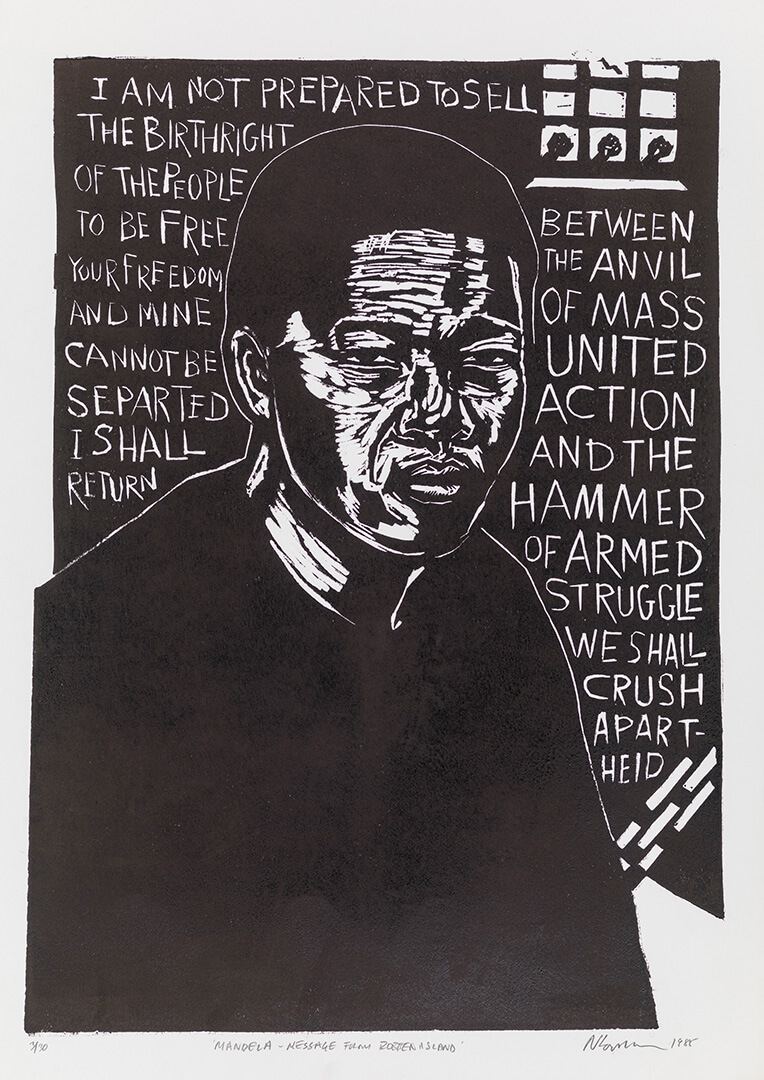
Mandela – Message From Robben Island (1986)
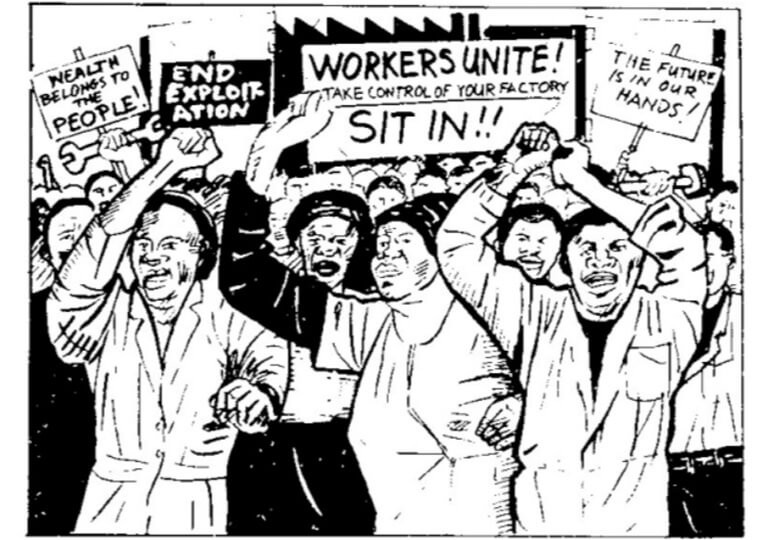
Workers negotiate for their rights – part 3 of 4 (1987)
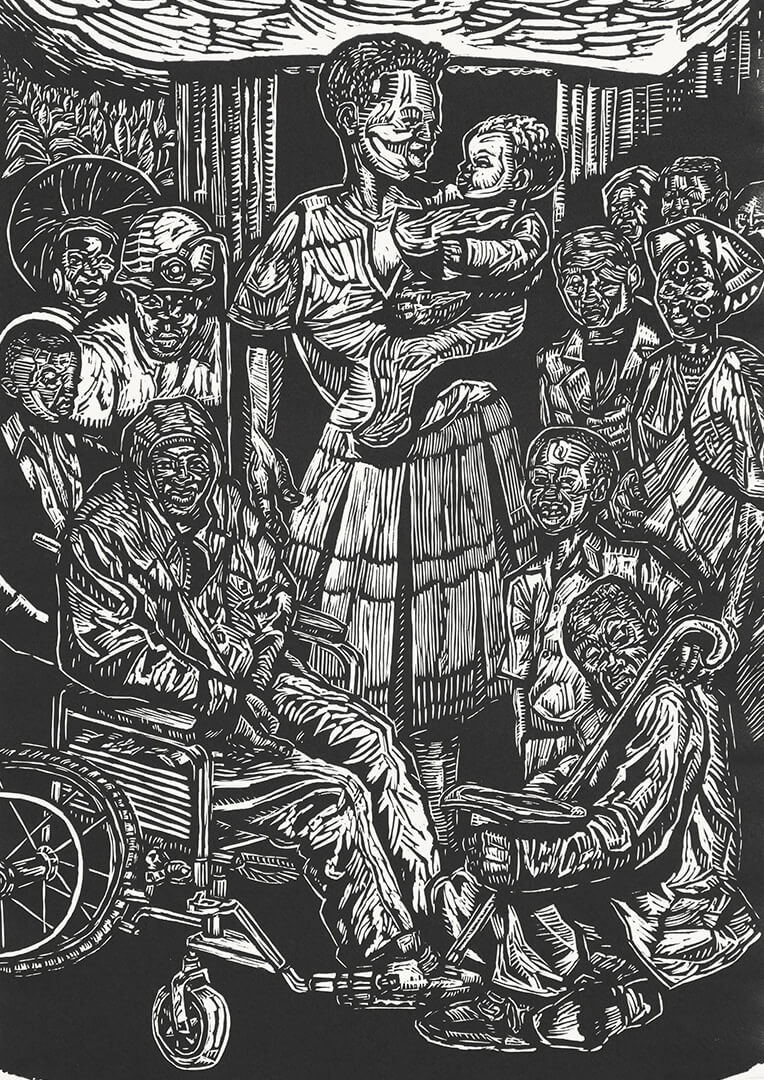
All Shall Be Afforded Dignity (1996). All Shall Be Afforded Dignity photograph by Ben Law-Viljoen. Constitutional Court Art Collection. Courtesy Constitutional Court Trust.
‘Norman Kaplan: All Shall be Afforded Dignity!’ has been organised and presented for display by the Anti-Apartheid Movement Archives, Action for Southern Africa, and the Anti-Apartheid Legacy Centre
‘All Shall Be Afforded Dignity’ is our theme for the exhibition programme. It is both commemorative and a call to action for the future.
Our aim is to draw on the spirit of the 1994 election year, where hope with action were the key ingredients to achieving a new dawn for South Africa and for the world.
A travelling exhibition, ‘All Shall Be Afforded Dignity!’ at Worldly Wicked & Wise is made possible by National Lottery Heritage Fund and National Lottery Players.