
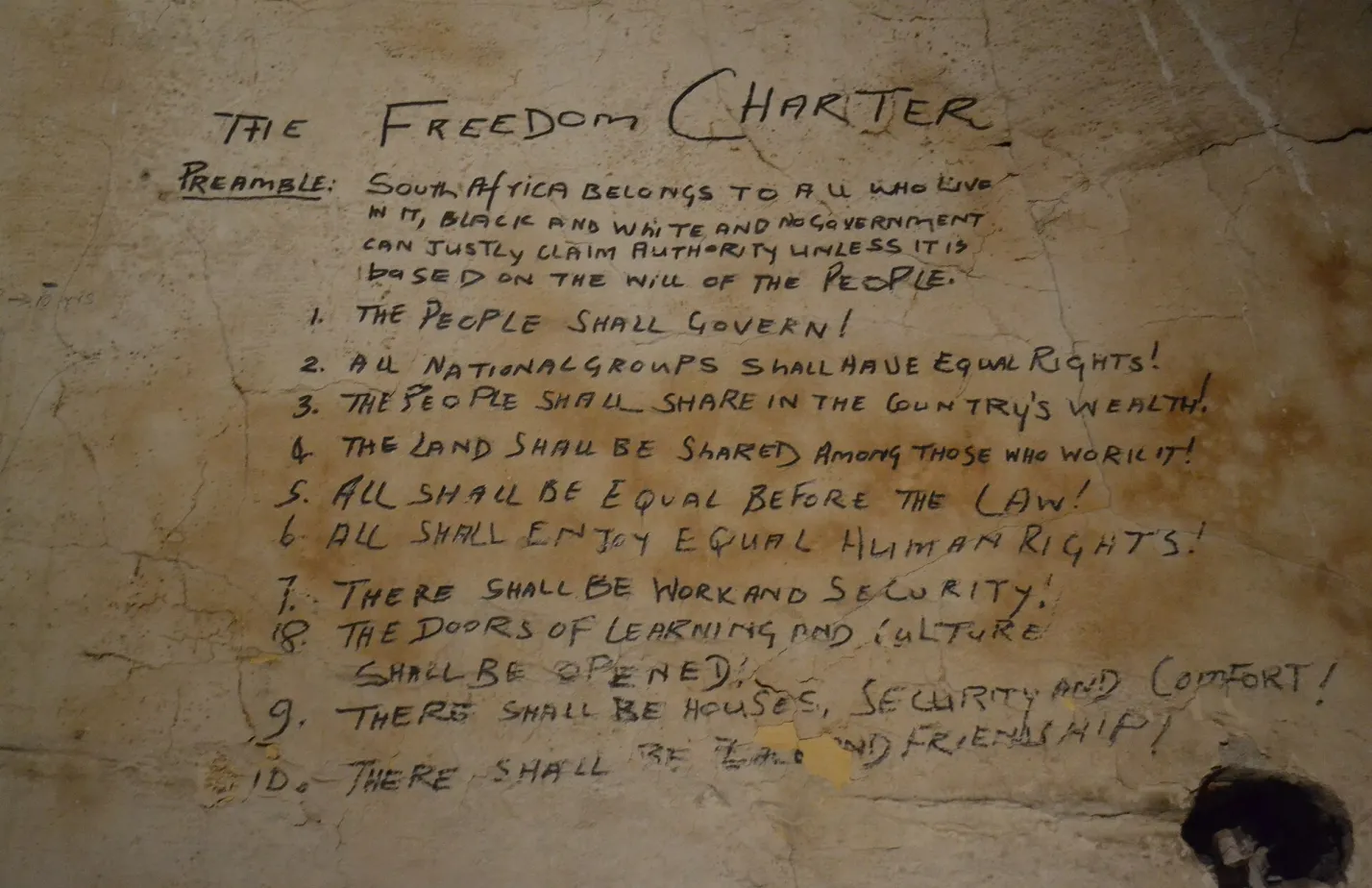
The opening lines of the Freedom Charter inscribed on the wall of a holding cell beneath Pretoria’s Palace of Justice – the site of the Treason Trial (1956–61), where the Charter itself was used by the apartheid state as evidence against anti-apartheid leaders.
The Freedom Charter written on the wall of the Palace of Justice in Church Square, Pretoria (PHParsons) Creative Commons 3.0
About this Resource
Exploring the Freedom Charter
On 25 and 26 June 1955, around 7,000 people from across South Africa gathered in Kliptown, Johannesburg to declare that “South Africa belongs to all who live in it.”
The Freedom Charter was constructed from the demands of ordinary South Africans struggling against the implementation and entrenchment of racist apartheid law. Over the years, the Charter became the rallying vision of the liberation struggle and a cornerstone of the democracy that followed.
This resource, developed in collaboration with Teach for Tomorrow, brings the story of the Charter — and the political questions it raises — into the classroom. Its development was supported by the University of East Anglia and the National Lottery Heritage Fund.
This resource teaches students about the Freedom Charter and the context of apartheid South Africa during its creation, while promoting the legacy and values of the Southern African liberation struggle. Across five lessons, students explore apartheid and the resistance to it, reflecting on how exclusion was experienced, how freedom was defined, and how collaboration across communities shaped resistance. Alongside the history, the resource invites students to consider contemporary questions of social justice, inclusion and human rights, helping them draw connections between the liberation struggle and the issues that continue to shape political life today.
In engaging with this history, students are encouraged not only to deepen their historical understanding, but also to develop skills in discussion, negotiation and working together.
Resources include
- Five fully planned 50-minute lessons, with handouts and PowerPoints
- A unit overview grid
- Exam-style discussion prompts for GCSE and A-Level
The materials can be delivered as either a five-lesson unit or as a single off-timetable Personal Development Day. They have been mapped onto GCSE and A-Level History specifications (including WJEC, OCR and Edexcel apartheid units) and are also well suited to enriching PSHE, Citizenship and SMSC provision.
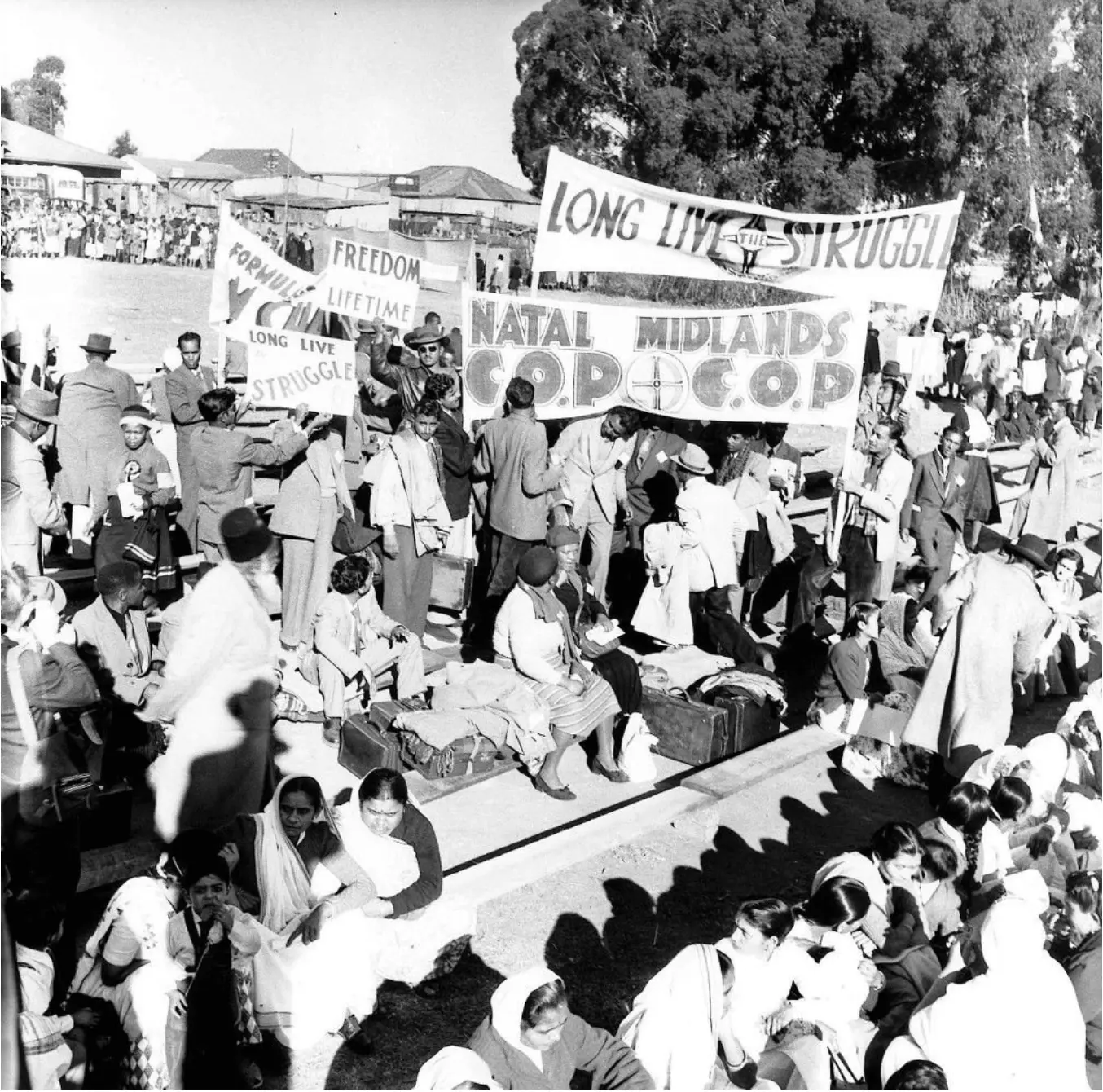
Delegates and supporters arriving at Kliptown, Johannesburg, for the Congress of the People, 25–26 June 1955. Organised by the Congress Alliance after months of gathering demands from ordinary South Africans in homes, workplaces and public spaces across the country, the Congress brought together thousands of people from different racial and political backgrounds.
It was at Kliptown that the Freedom Charter was debated and adopted, setting out a democratic vision of South Africa based on equality, human rights and shared citizenship — a vision that would later shape the post-apartheid Constitution.
Photo: Mayibuye Archive, University of the Western Cape / Robben Island Museum.
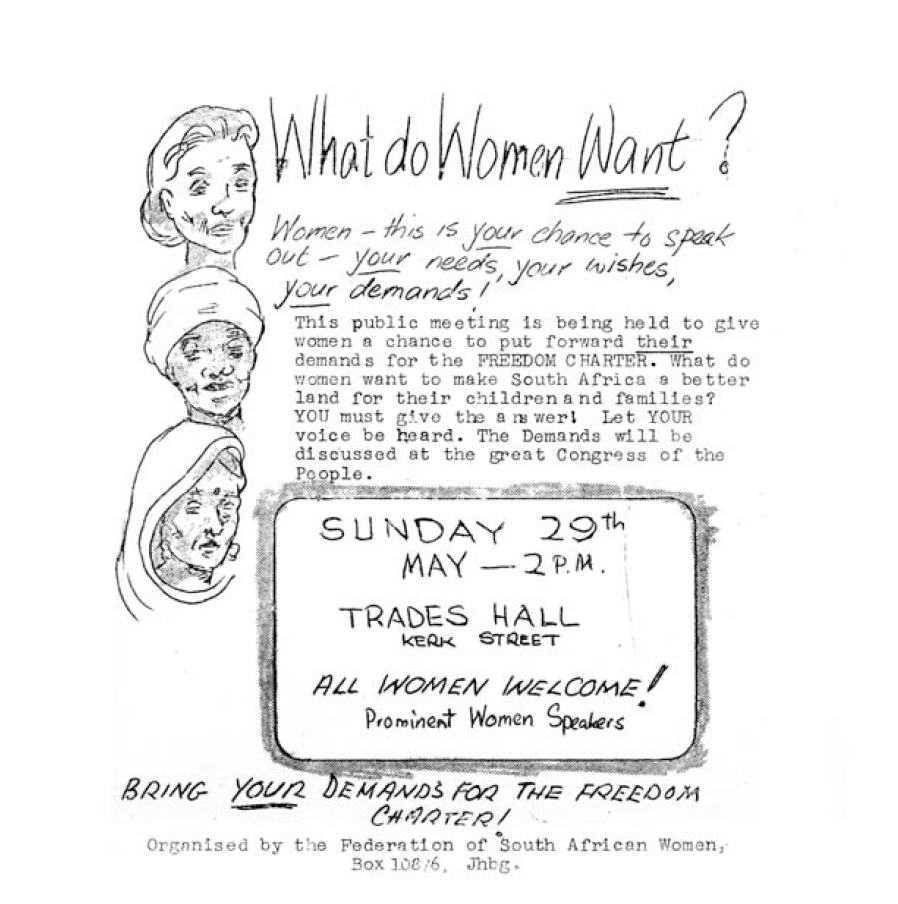
A flyer produced by the Federation of South African Women (FEDSAW) calling on all women in the Johannesburg area to attend a meeting to express their demands for rights and freedoms, in preparation for the Congress of the People.
Source: Wits Historical Papers. University of the Witwatersrand.
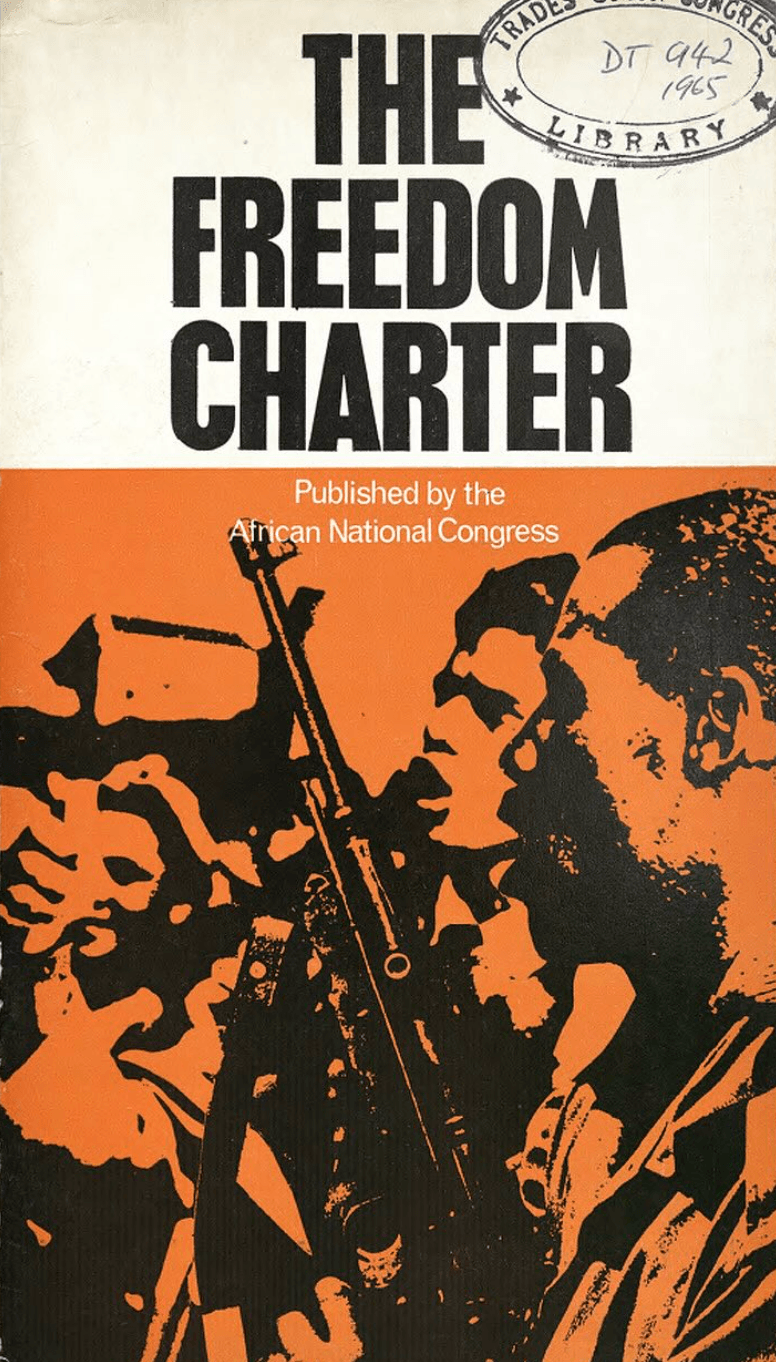
Pamphlet published in London by the African National Congress-in-exile (1965). To view the document visit the Trade Union Congress Library Collections (London Metropolitan University Special Collections).
Use the Resource
This resource can be used and adapted by those teaching apartheid at GCSE and A-level. To this end, we have included a range of exam style questions at the end of each lesson, which are intended as discussion prompts, extension activities and/or homework tasks rather than formal examination questions. They are designed to encourage students to engage with second-order historical concepts and assessment objectives commonly assessed across GCSE and A-level History specifications, including causation, consequence, change and continuity, significance, source analysis and historical interpretations. Teachers can select and adapt the questions that are relevant to their teaching and their students.
Access the lessons and supporting materials below:
Lesson Overview Grid
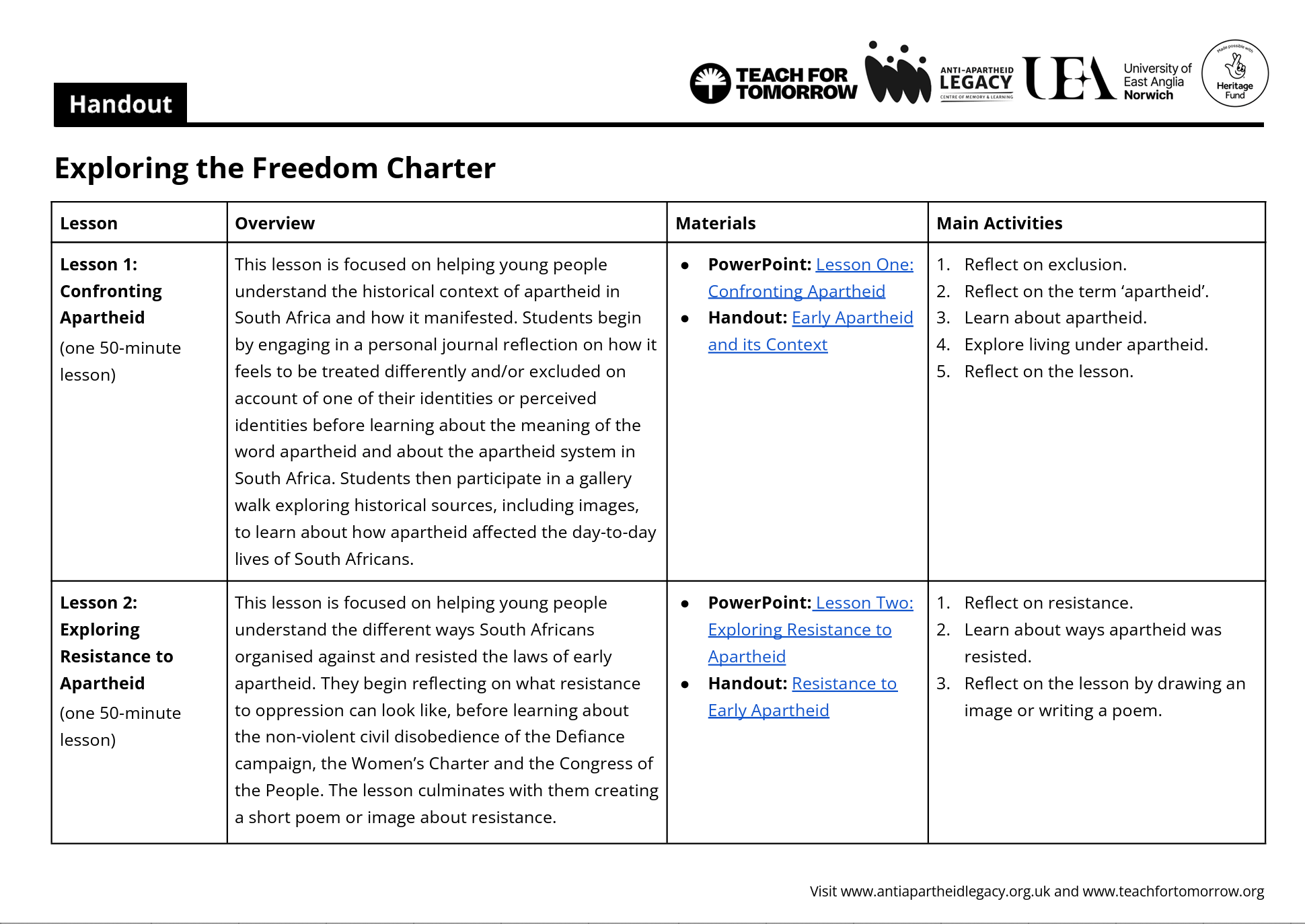
Lesson 1: Confronting Apartheid
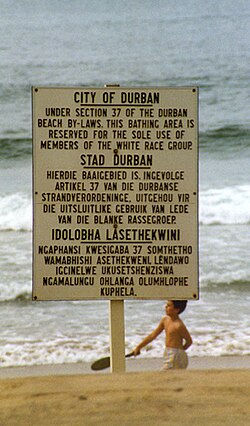
Segregation sign at a beach in Durban, displayed in English, Afrikaans and Zulu, enforcing “Whites Only” access under Section 37 of the Durban beach by-laws. Photograph taken in 1989.
The sign was aimed not just at informing white beachgoers, but at policing Black South Africans in the dominant local African language (Zulu), making apartheid’s racial exclusions unmistakably legible to those being excluded.
This lesson is focused on helping young people understand the historical context of apartheid in South Africa and how it manifested.
Students begin by engaging in a personal journal reflection on how it feels to be treated differently and/or excluded on account of one of their identities or perceived identities before learning about the meaning of the word apartheid and about the apartheid system in South Africa.
Students then participate in a gallery walk exploring historical sources, including images, to learn about how apartheid affected the day-to-day lives of South Africans.
Lesson 1: Main Activities
- Reflect on exclusion.
- Reflect on the term ‘apartheid’.
- Learn about apartheid.
- Explore living under apartheid.
- Reflect on the lesson.
Lesson 2: Exploring Resistance to Apartheid
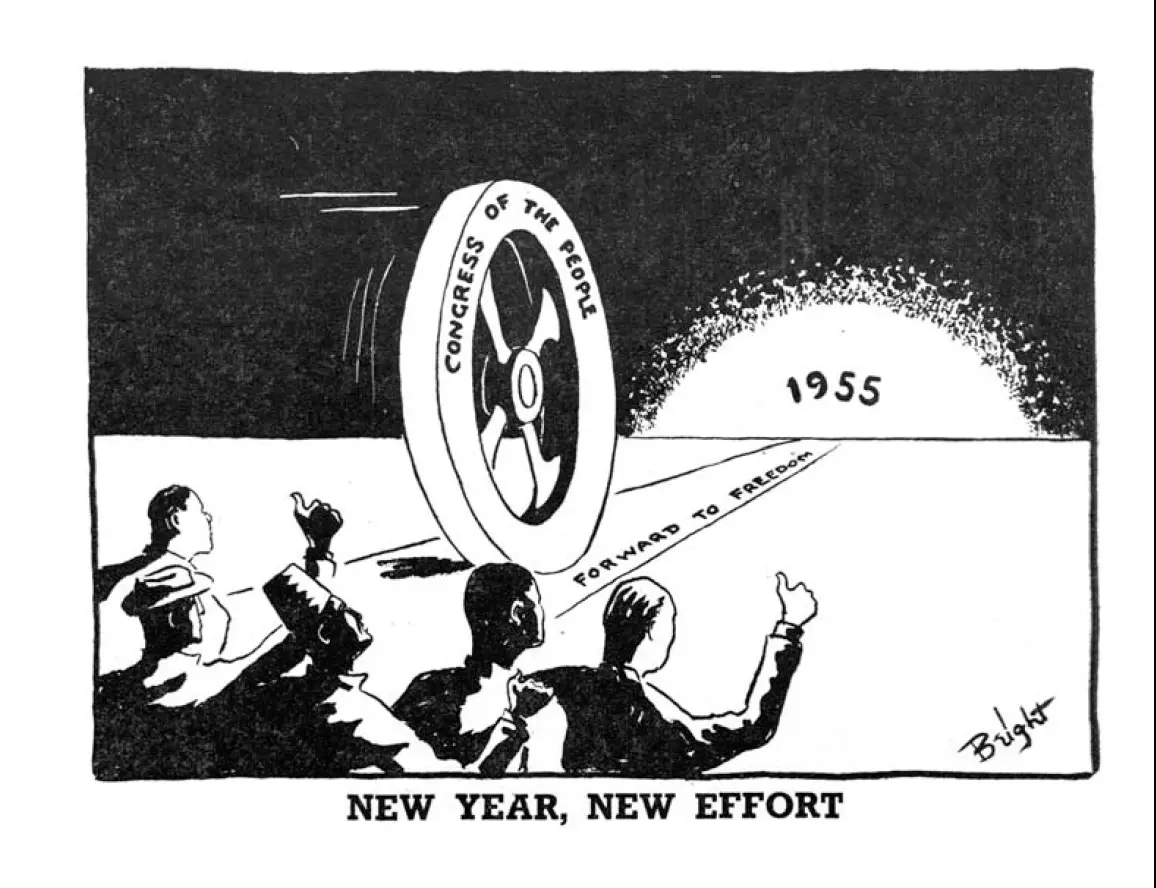
“New Year, New Effort” — political cartoon by Bright, published in New Age magazine in February 1955. The image depicts the “Congress of the People” as a wheel rolling “Forward to Freedom”, symbolising the growing momentum of the Congress Alliance’s campaign to gather the demands of ordinary South Africans. These demands would later form the basis of the Freedom Charter, adopted at Kliptown in June 1955.
Source: Wits Historical Papers. University of the Witswatersrand.
This lesson is focused on helping young people understand the different ways South Africans organised against and resisted the laws of early apartheid.
They begin reflecting on what resistance to oppression can look like, before learning about the non-violent civil disobedience of the Defiance campaign, the Women’s Charter and the Congress of the People.
The lesson culminates with them creating a short poem or image about resistance.
Lesson 2: Main Activities
- Reflect on resistance.
- Learn about ways apartheid was resisted.
- Reflect on the lesson by drawing an image or writing a poem.
Lesson 3: Reflecting on the Freedom Charter
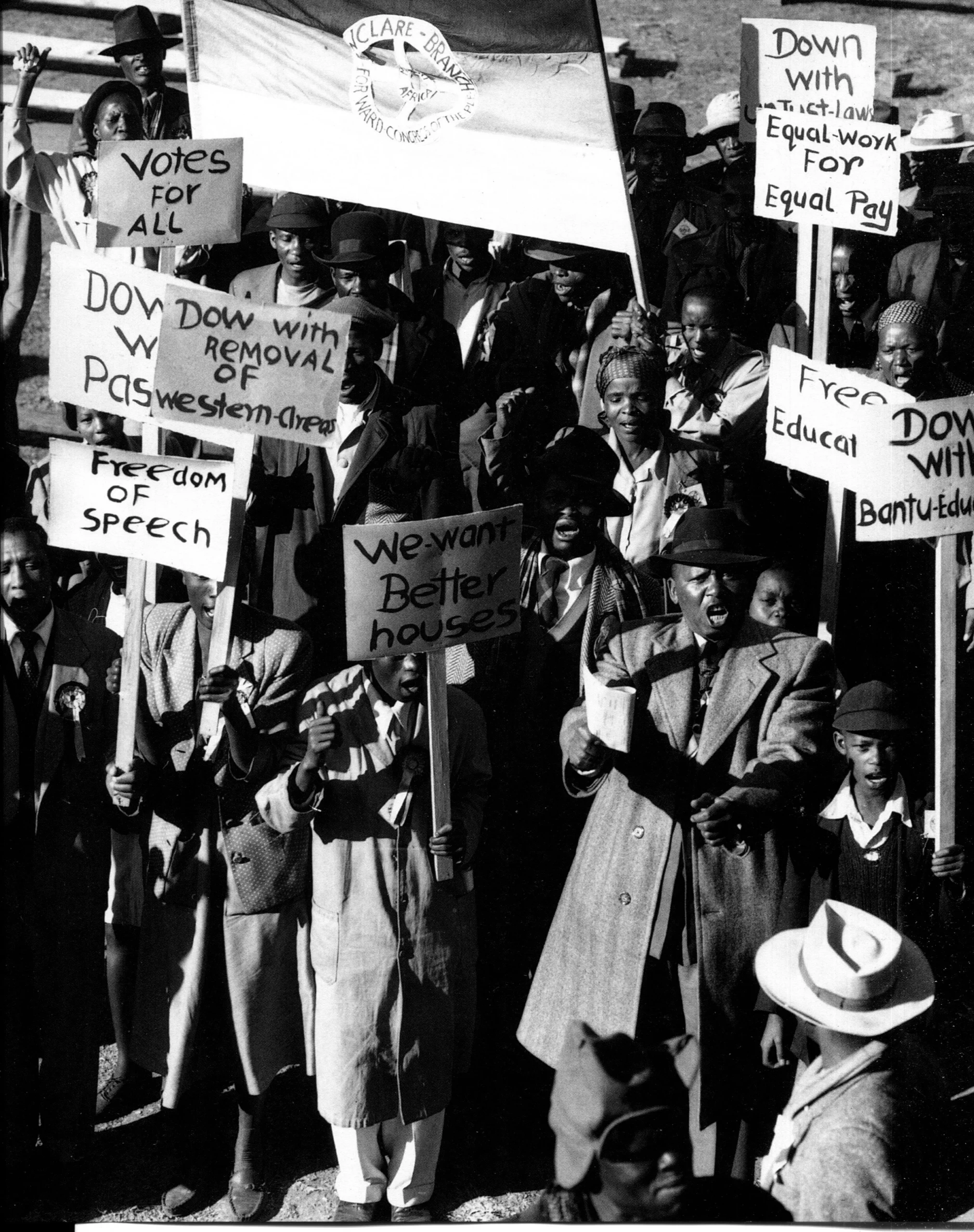
Delegates and supporters at the Congress of the People, Kliptown, Johannesburg, 25–26 June 1955, carrying placards that reflect some of the demands gathered from communities across South Africa — including calls for universal suffrage, freedom of speech, better housing and equal pay. These demands were debated and adopted as the Freedom Charter, which became the guiding vision of the anti-apartheid struggle.
Photograph: Eli Weinberg. Courtesy Canon Collins Trust / International Defence and Aid Fund.
This lesson is focused on helping students reflect on the content of the Freedom Charter.
Students will begin the lesson by reflecting on freedom, what it means to them and what it looks like in practice.
They will then engage in a ‘silent conversation’, exploring different sections of the Freedom Charter, before having a discussion on the charter in groups.
Lesson 3: Main Activities
- Reflect on freedom.
- Engage with the Freedom Charter.
- Reflect on the Freedom Charter.
Lesson 4: Creating a Modern Day Freedom Charter (Part 1)
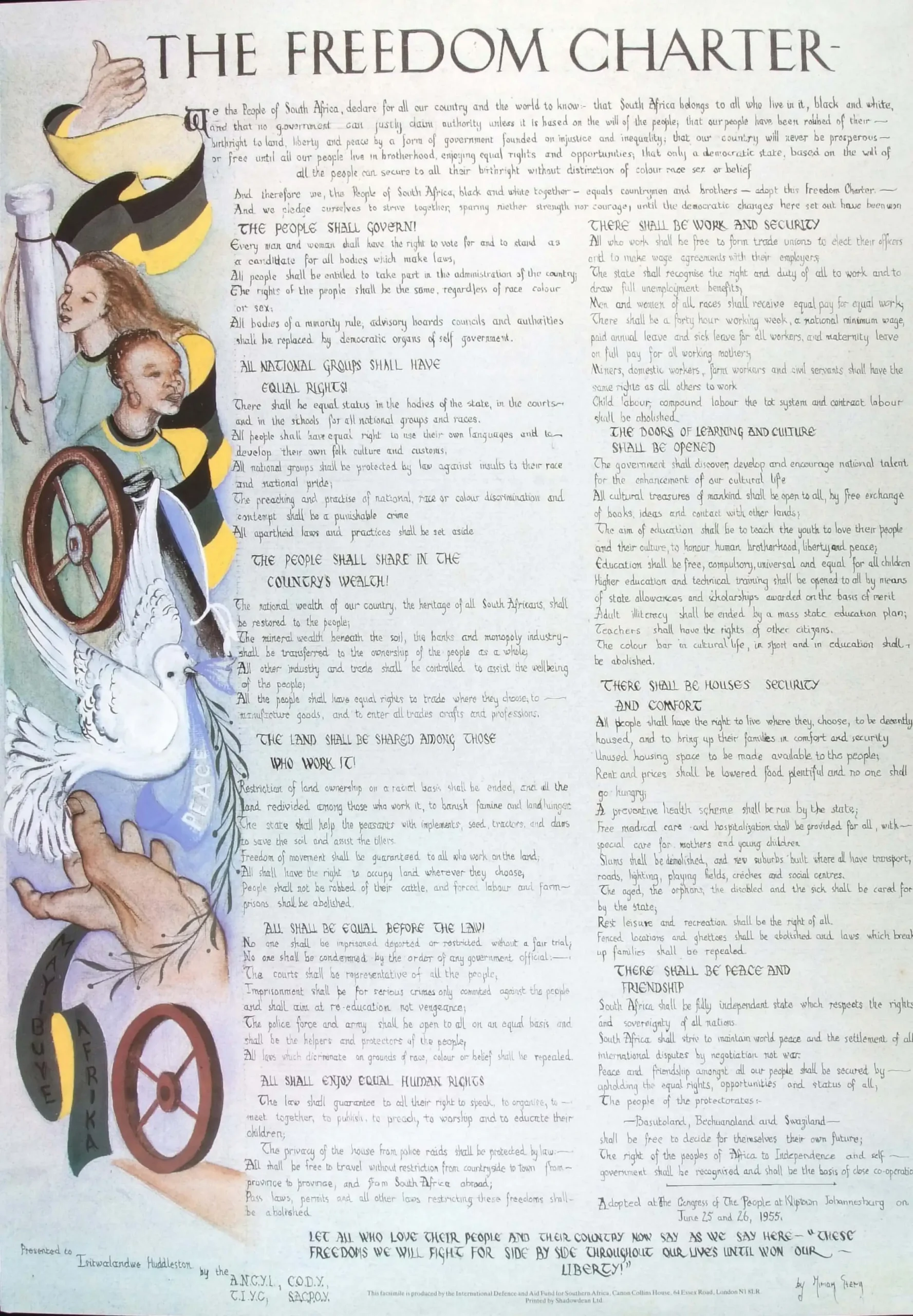
Originally adopted at the Congress of the People in Kliptown in June 1955, the Freedom Charter became the guiding vision of the liberation struggle. This illustrated version, produced by the Anti-Apartheid Movement in the 1980s, shows how its demands for equality, democracy and freedom continued to inspire resistance in the final years of apartheid.
Design: Miriam Stern. Anti-Apartheid Movement Archives / International Defence and Aid Fund.
In the final two lessons, students create their own call to people of the UK and their own freedom charter.
They begin by reflecting on the different issues impacting people’s quality of life in the UK (this content can be adjusted to suit students in another country).
They are then divided into groups to write their call and charter, and decide how they would like to present it to other students.
Lesson 4: Main Activities
- Reflect on societal issues.
- Write a call for a modern day freedom charter.
- Write a modern day freedom charter.
- Reflect on inclusion and collaboration.
Lesson 5: Creating a Modern Day Freedom Charter (Part 2)
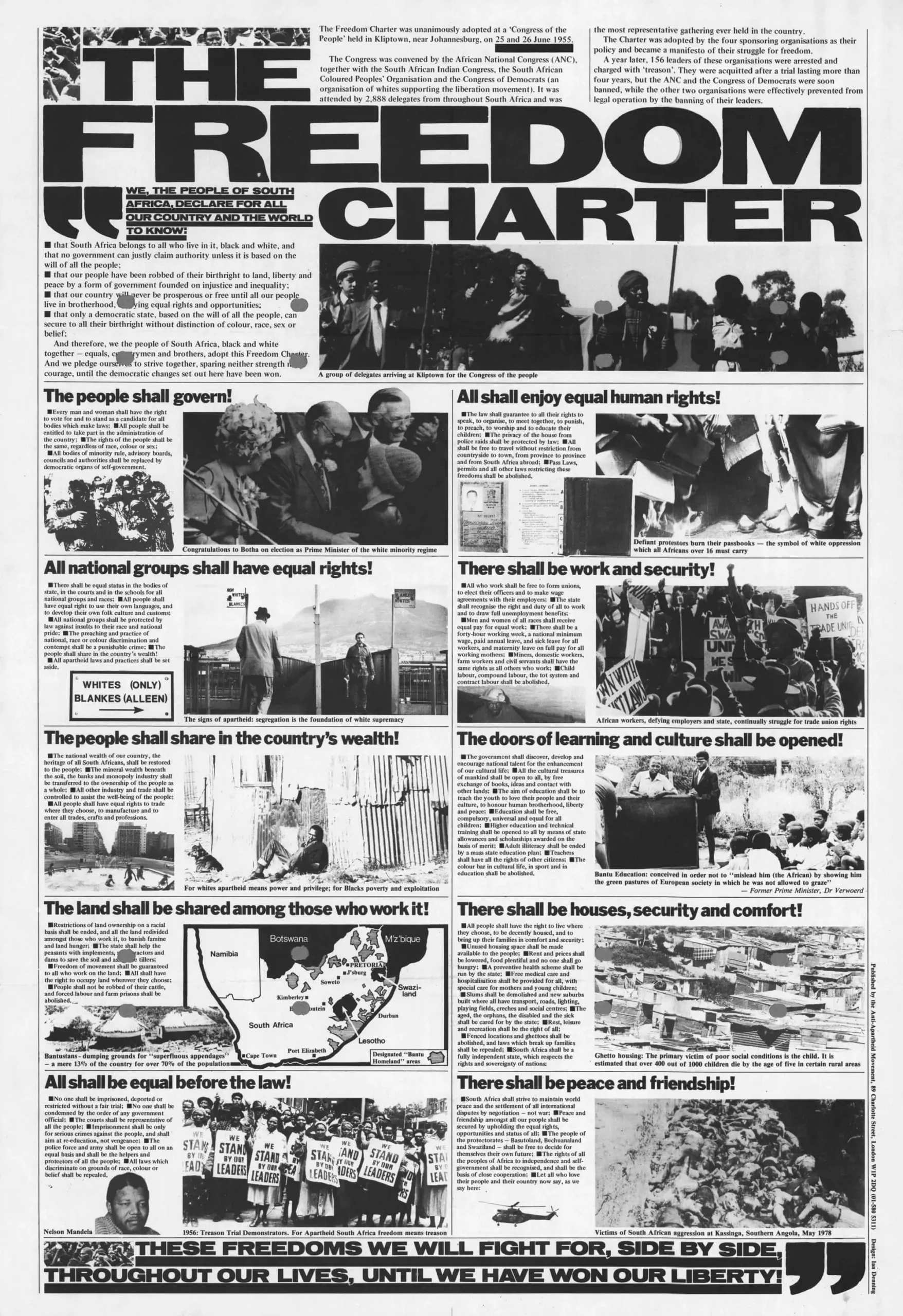
The Freedom Charter was adopted by the Congress of the People held in South Africa in 1955. In the 1980s it once again became a rallying point for anti-apartheid organisations within the country. The African National Congress declared 1980 the ‘Year of the Charter’ and the Anti-Apartheid Movement distributed thousands of copies of the Freedom Charter during the year.
This illustrated version sets out the Charter’s ten key demands and uses contemporary photographs to show how, decades after its adoption, apartheid laws and state violence continued to deny Black South Africans the rights, freedoms and dignity it called for.
Design: Ian Denning. Courtesy Anti-Apartheid Movement Archives Committee.
In the final two lessons, students create their own call to people of the UK and their own freedom charter.
They begin by reflecting on the different issues impacting people’s quality of life in the UK (this content can be adjusted to suit students in another country).
They are then divided into groups to write their call and charter, and decide how they would like to present it to other students.
Lesson 5: Main Activities
- Reflect on the modern day freedom charter.
- Finish the modern day freedom charter.
- Reflect on the learning.
Notes to Teachers
1. Delivery
This resource can be taught over five lessons or as a full day off-timetable (a Personal Development Day). Personal Development Days are a means of supporting the Spiritual, Moral, Cultural, Mental and Physical development (SMSC) of pupils, and of giving them opportunities to engage in enrichment activities beyond the curriculum. As noted above, they are a helpful way of helping schools fulfil a range of statutory and non-statutory obligations. See here for the rest of our partners Teach for Tomorrow’s Personal Development Day provision.
2. Preparation
In order to deliver the resources effectively, students will need access to the following:
- Journals or exercise books;
- Paper;
- Post-it notes;
- Handouts and worksheets.
Students taking part may also require additional resources during Lessons 4 and 5 when they begin work on their own presentations. This may include sugar paper, cameras, computers, laptops or access to a school library.
3. Classroom Contracting
Apartheid can be a challenging topic to discuss in the classroom.
We recommend that you revisit your classroom contract before teaching this lesson. If you do not have a class contract, you can use Teach for Tomorrow’s contracting guidelines for creating a classroom contract or another procedure you have used in the past.
We also recommend that you teach the first two lessons in the Teach for Tomorrow unit Discussing Race and Racism in the Classroom: Preparing to Discuss Race in the Classroom and Introducing the Concept of Race.
4. Curriculum Connections - Statutory and Non-Statutory Obligations
The content covered and the approach used means this resource can help schools invigorate their PSHE / Learning for Life and Work / Health and Well-being / Citizenship curriculums, while providing young people with additional enrichment and personal development opportunities.
This resource supports students to develop:
- Positive, healthy and nurturing relationships with their peers through the use of group work;
- Skills in speaking and listening, negotiation and compromise;
- An understanding of what resistance against injustice can look like;
- An understanding of the impact of exclusion and discrimination;
- The ability to identify and communicate which pressing societal issues need to be addressed.
The content also helps schools fulfil a range of statutory and non-statutory obligations in relation to:
- Keeping Children Safe in Education 2025;
- Relationships and Sex Education 2025:
- Promoting Fundamental British Values as Part of SMSC;
- The Education Inspection Framework for September 2023;
- The OFSTED School Inspection Handbook for September 2025;
- The Spiritual, Moral, Cultural, Mental and Physical development (SMSC) of pupils.
GCSE (WJEC Curriculum)
This resource can be used and adapted by those teaching apartheid at GCSE and A-level. To this end, we have included a range of exam style questions at the end of each lesson, which are intended as discussion prompts, extension activities and/or homework tasks rather than formal examination questions. They are designed to encourage students to engage with second-order historical concepts and assessment objectives commonly assessed across GCSE and A-level History specifications, including causation, consequence, change and continuity, significance, source analysis and historical interpretations. Teachers can select and adapt the questions that are relevant to their teaching and their students.
This resource supports those studying the unit ‘Changes in South Africa, 1948-1994’ (WJEC GCSE in History: Unit 2: 2D). It helps address some of the areas explored under the key questions:
- The apartheid system: Why was the apartheid system established?
South Africa in 1948; the results of the election of 1948; main apartheid laws,1949-1956; Bantustans.
- The effects of the apartheid system: What was the effect of the apartheid system on life and work?
Education and employment; segregation in society.
- Opposition to apartheid in South Africa: What were the main methods of opposition to apartheid?
The work of the ANC; the Defiance Campaign; the Freedom Charter.
In Unit 2 of WJEC GCSE in History, students are examined on their ability to meet the following assessment objectives:
- AO1: Demonstrate knowledge and understanding of the key features and characteristics of the periods studied.
- AO2: Explain and analyse historical events and periods studied using second-order historical concepts.
- AO3: Analyse, evaluate and use sources (contemporary to the period) to make substantiated judgements, in the context of historical events studied.
- AO4: Analyse, evaluate and make substantiated judgements about interpretations (including how and why interpretations may differ) in the context of historical events studied.
A-Level Curricula (Pearson Edexcel - History Route F & Cambridge OCR - History A)
This resource can be used and adapted by those teaching apartheid at GCSE and A-level. To this end, we have included a range of exam style questions at the end of each lesson, which are intended as discussion prompts, extension activities and/or homework tasks rather than formal examination questions. They are designed to encourage students to engage with second-order historical concepts and assessment objectives commonly assessed across GCSE and A-level History specifications, including causation, consequence, change and continuity, significance, source analysis and historical interpretations. Teachers can select and adapt the questions that are relevant to their teaching and their students.
Cambridge OCR Level 3 Advanced GCE in History A
This resource supports those studying the unit ‘Apartheid and Reconciliation: South African Politics 1948–1999’ (Cambridge OCR Level 3 Advanced GCE in History A: H105, H505: Unit group 2: Y224). It helps address some of the areas in the key topics ‘establishing Apartheid’ and ‘the development of Apartheid and growing resistance’, including the 1948 election, the origins, nature and impact of apartheid, apartheid laws, the ANC and mobilisations against apartheid.
Pearson Edexcel Level 3 Advanced GCE in History (Route F)
This resource supports those studying the unit ‘Establishment of apartheid and resistance to apartheid’ (Pearson Edexcel Level 3 Advanced GCE in History: 9HI0: Route F: 2F.2). It helps address some of the areas in key topic 1 ‘the response to apartheid, c1948–59’, including life in South Africa c.1948, reasons for the 1948 National Party victory, the codification and implementation of apartheid and African nationalism, 1948-59 (the revival of the African National Congress (ANC); the Youth League and the Defiance Campaign; and the Freedom Charter).
In the History GCE, students are examined on their ability to meet the following assessment objectives:
- AO1: Demonstrate, organise and communicate knowledge and understanding to analyse and evaluate the key features related to the periods studied, making substantiated judgements and exploring concepts, as relevant, of cause, consequence, change, continuity, similarity, difference and significance.
- AO2: Analyse and evaluate appropriate source material, primary and/or contemporary to the period, within its historical context.
- AO3: Analyse and evaluate, in relation to the historical context, different ways in which aspects of the past have been interpreted.
Next Steps
This resource is designed as a starting point for deeper engagement with the history and legacy of apartheid, resistance and liberation. Teachers may wish to build on these lessons through further enquiry into anti-apartheid activism, international solidarity movements, and the ongoing struggle for equality and human rights.
Students can extend their learning by creating their own Freedom Charters, reflective writing, or creative responses that connect the themes of the resource to contemporary social and political issues. We welcome schools and students sharing their reflections, writing and creative responses with the Anti-Apartheid Legacy Centre.
For further resources on helping students develop as conscientious and civically minded individuals, teachers may also wish to explore Teach for Tomorrow’s wider educational offer, including Standing Up for Democracy, Building a Classroom Community: Creating an Environment for Connection and Learning, and their Building Community Personal Development Day.
To explore more educational resources, films and archival materials from the Anti-Apartheid Legacy Centre, visit our wider Resources section.
We highly recommend visiting the Apartheid Museum’s “Speaking of Freedom” page, detailing a temporary exhibition held at the South Africa museum in 2025, marking the Freedom Charter’s 70th Anniversary. A downloadable PDF of archival pictures and source materials is availalable.
If you have any reflections on using this resource, student responses to share, or questions about delivery, please get in touch with the Anti-Apartheid Legacy Centre at info@antiapartheidlegacy.org.uk

_1902_Church_Square_Pretoria_054.jpg)